Astronomy 110
HOMEWORK #2
Use a calculator whenever necessary.
For full credit, always show your work and explain how you got your answer.
Be careful about units!
Please CIRCLE or put a box around your final answer if it is numerical.
If you wish, you may discuss the questions with friends, but please turn in your own hand-written solutions, with questions answered in your own way.
Note: All of the stuff on the homework sets is important to know; the questions will give you valuable practice. Some of these questions may also appear on the exams. (However, computational questions on exams will not require the use of a calculator.) This homework set is being assigned early in order to give you a chance to brush up on the metric system, scientific (exponential) notation, and ratios – in case you’re rusty.
Common prefixes: kilo = 1000 = 103, mega = 1,000,000 = 106, milli = 1/1000 = 0.001 = 10-3 = 1/103, centi = 1/100 = 0.01 = 10-2 = 1/102. We will frequently use mega and occasionally micro = 10-6 and nano = 10-9.
Numbers such as 210,000 are written as 2.1 x 10⁵ in scientific notation, because you need to move five spaces to the right of the decimal point in 2.1 to get 210,000. The number 0.00015, on the other hand, is written as 1.5 x 10⁻⁴, because you need to move four spaces to the left of the decimal point in 1.5 to get 0.00015. Generally, you want to express quantities as a number between 1 and 10, multiplied by 10 raised to some integer (power).
Rules for manipulating numbers expressed with scientific notation: (1) To add or subtract numbers you first have to make sure the exponents are the same; (2) to multiply numbers you add the exponents; (3) to divide numbers you subtract exponents; and (4) to exponentiate numbers you multiply exponents. Remember that multiplications and divisions are done before additions and subtractions. Some Examples:
4 x 10⁴ + 6 x 102 = (4 x 10⁴) + (6 x 10²) = (4 x 10⁴) + (0.06 x 10⁴) = 4.06 x 10⁴.
51000 x 400 = (5.1 x 104) x (4 x 102) = (5.1 x 4) x (104 x 102) = 20.4 x 10(4 + 2) = 20.4 x 106 = 2.04 x 10⁷.
(1.4 x 10⁸) / 200 = (1.4 x 10⁸) / (2x10²) = (1.4 / 2) x (10(8-2)) = 0.7 x 106 = 7 x 10⁵.
(2 x 10²)5 = 25 x (102)5 = 32 x 10(2 x 5) = 32 x 1010 = 3.2 x 10¹¹.
Finally, it is useful to be familiar with the following symbols: ~ means "roughly" or "around"; » means "approximately equal to" (like ~); ³ means "greater than or equal to"; £ means "less than or equal to"; » means "much greater than"; « means "much less than"; ^ means "perpendicular to"; | | means "parallel to"; and µ means "proportional to."
Questions
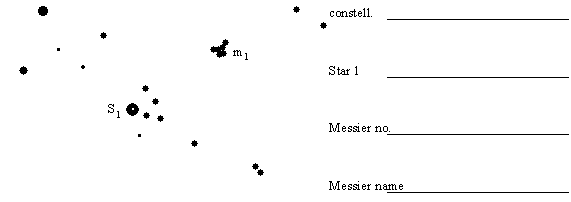
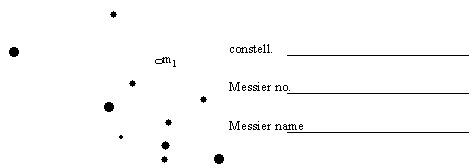
4) Identify the following asterisms and any numbered stars or special objects….
a)
b)
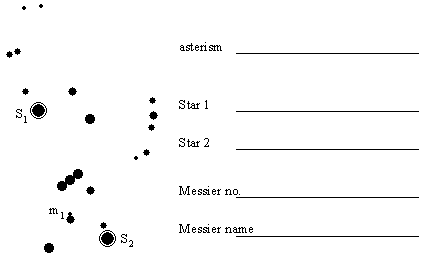
c)
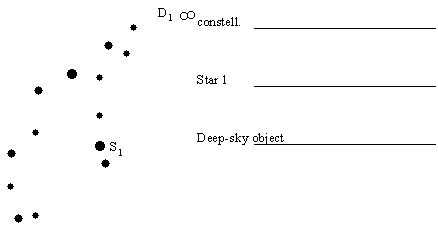
d)
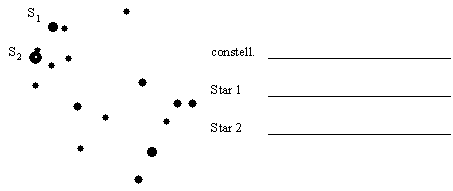
e)
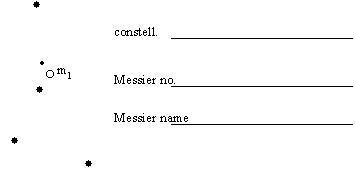
f)