
Original
White Family
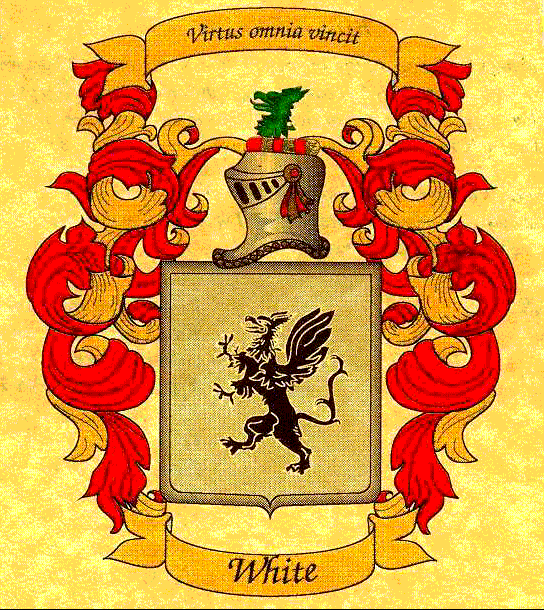
Coat of Arms
 |
 |
 |
|
Research has determined the White Coat of Arms (above) to be the most ancient recorded for the family surname "White"... |
||
The white family ... A SHORT HISTORY...
The name "White" is one of the oldest non-royal recorded family names in history. The name is traced back to our Norsemen (OK ... "Viking") War Leader ancient ancestors some 2,300 years ago ... according to records & manuscripts found in the Library of Congress...
Others claim the lineage officially started with it's ascension to the status of "Knights of the Realm" in the earliest recorded Norman history...
Though shrouded by the mists of time, the chronicles of Scotland reveal the early records of the Norman surname "White" which ranks as one of the oldest. The history of the name is interwoven within the colorful plaid of Scottish history and is an intrinsic part of the heritage of Scotland.
Diligent analysis by professional researchers using such ancient manuscripts as the "Doomsday Book" (compiled in 1086 by William the Conqueror), the Ragman Rolls, the Wace poem, the Honour Roll of the Battel Abbey, the Inquisitio, the Curia Regis, Pipe Rolls, the Falaise Roll, tax records, baptismal records, family genealogies, and local parish & church records shows the first record of the name White was found in Durham where they had been seated from very early times in English history.
Variable spellings of the name were typically linked to a common root, usually one of the Norman nobles at the Battle of Hastings. The name "White" occurred in many references from time-to-time, and variables included were "White", "Whyte", "Wight", and many more festive flavors. Scribes recorded and spelled the name as it sounded. It was not unlikely that a person would be born with one spelling, married with another, and buried with a headstone which showed another still.
Preferences for different spellings were derived from a branch preference as well, to indicate a religious adherence or sometimes to show nationalistic allegiances...
The family name "White" is believed to be descended originally from the Norman race. The Normans were commonly believed to be of French origin but were, more accurately, of Norse (Viking) origin.
The Vikings landed in the Orkneys and Northern Scotland about the year 870 A.D., under their King, Stirgud the Stout. Later, under their Jarl, Thorfinn Rollo, they invaded France about 910 A.D. The French King, Charles the Simple, after Rollo laid siege to Paris, finally conceded defeat and granted Northern France to Rollo.
Rollo became the first "Duke of Normandy"... Duke William, who invaded and defeated England in 1066, was descended from Rollo...
After the "Conquests", Duke William took a census of most of England in 1086, and it became known as the "Doomsday Book". By 1070, Williams' nobles were growing restive, dissatisfied with their grants of land. William took an army north and laid waste most of the northern countries. King Malcolm Canmore of Scotland offered refuge to these nobles, granting them land. Later, King David, about 1160 A.D., also encouraged his Norman friends to come north to join the royal court and obtain lands.
The surname "White" emerged as a notable Scottish family name in the county of Durham where the Viniet Whyte witnessed a charter by King Edgar to the Church of Durham about 1106 A.D. The episode at Durham was part of the transition of the Whites, originally the noble family of Le Blancs in Normandy, northward into Scotland.
John Whyte later completed the Great Hall of Saint Andrew in 1236 A.D. The family settled in Fife and Perth and were seated at Maw and Lumbenny.
Meanwhile to the south in England, Walter White accompanied the Earl of Pembroke in his invasion of Ireland in 1172 A.D. He was made Governor of the Castle of Leixlip in County Kildare.
Other branches of the family were prominent in Northumberland, Yorkshire, Lancashire, Nottingham, and Northampton.
John White, Bishop of Winchester, conducted the funeral ceremony of Mary I but was unfrocked by Queen Elizabeth in 1560 A.D.
They held Bishop's Castle in Shropshire and were elevated to the peerage as the Earls of Bantry, Barons Anally, and Viscount Grandison. Of note amongst the family at this time was the Earl of Bantry...
The surname "White" contributed much to local politics and in the affairs of England or Scotland. Later, in the 16th, 17th, and 18th centuries the country was ravaged by religious and political conflicts.
The Monarchy, the Church, and Parliament fought for supremacy. The unrest caused many to think of distant lands ...
Settlers in Ireland became known as the "Adventurers for land in Ireland". Essentially, they "undertook" to keep the Protestant faith, and became known as "the Undertakers". In Ireland they settled in Counties Down, Dublin, Wexford, and Longford.
The news about the attractions of the "New World" spread like wildfire. Many sailed aboard the fleet of sailing ships know as the "White Sails"... namely because the White family financed the most notable settlements in the New World at the time ...
In North America, migrants which could be considered kinsmen of the surname "White", or variable spellings of that same family name, included John White of Sir Richard Grenville's crew arrived at Roanoke, North Carolina, in 1587.
His daughter was the first English child born in America...
Peter White settled in Witless Bay, Newfoundland, in 1676. Arthur White settled in Ferryland in 1706. Whites also settled in Harbour Grace, Bacon Cove, Bonavista, Petty Harbour, Greenspond, Ship Island, Salmon Cove, and Heart's Content ... all in Newfoundland...
William White, his wife Susannah, and sons Peregrine and Resolve, settled in Plymouth in 1620. William White settled in Virginia in 1635. Amos White settled in Boston (Mass.) in 1679. Mary White settled in Nova Scotia in 1774. Margaret White settled in Quebec in 1829...
From the port of arrival, many settlers joined the wagon trains westward. During the American War of Independence, some declared their loyalty to the Crown and moved northward into Canada and became known as the United Empire Loyalists...
Meanwhile, the family name was noted in the social stream.
There were many notables of this name, "White", and the following are but a few from antiquity to current times ...
Baron & Baroness White
Professor Alan White
Sir Bruce White
General Cecile White
Sir Dick White
Erica White (Sculptor)
Sir George White
Admiral Sir Henry White
Air Marshall Hugh White
Captain Richard White
Wilfred Hyde-White (Actor)
Reverend Ian White (Dean of Canterbury)
E. B. White (Humorist and Essayist)
Patrick White (Australian Novelist)
During the American Civil War, the family divided once again -- this time between those loyal to the Union and those loyal to state's rights and the Confederacy. During the bloodiest war ever fought on American soil, White fought and killed White ... the wounds left from that war are still open to this day, as neither Northern nor Southern White will speak to one another ...
From the founding of the Republic until today, Whites have served in every branch of our government -- in Congress, in the Supreme Court as Chief Justices, and in many state governments ... as well as in the Officers' Corps of the Armed Forces of the United States.
The White family has notables among the "Captains of Industry and Commerce", past and present. The name "White" can be found on many corporate logos, titles, and signs nationwide...
My "White" family "cousins" can be found today across America, Canada, England, Ireland, Scotland, Wales, Northern France, and Scandinavia...
I trace my roots to those earliest Viking War Leaders of 2,300 years ago. My efforts (below) are starting backwards -- from myself to antiquity -- in order to properly document my family's genealogy, linking us to those earliest ancestors...