A Quick Solution For Very Small Snakes
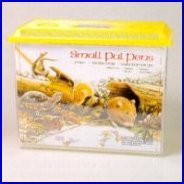
Basic & Simple Vivariums
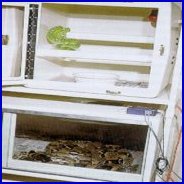
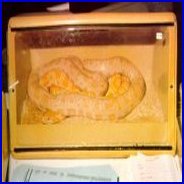
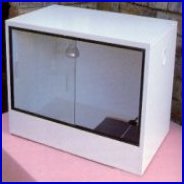
Exhibition Vivariums
Commercial Vivariums
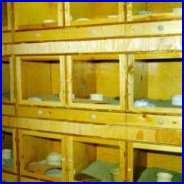
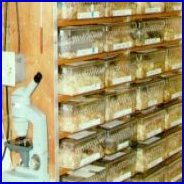
Only Glass Vivariums
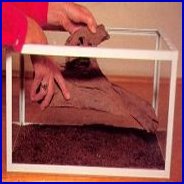
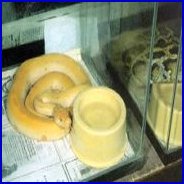
Balik Lagi
Perawatan Ular Sebagai Binatang Peliharaan
Ular sebagai Binatang Peliharaan : Perdagangan ular
hidup tumbuh semakin pesat dalam 10 taun terakhir ini, baik itu berupa ular hasil
tangkapan alam maupun ular yang merupakan hasil peternakan. Memang diakui masih
banyak penjualan ular secara liar... tetapi dengan penjualan ular sebagai koleksi dan
binatang peliharaan tidak mengganggu jumlah ular karena beberapa jenis ular yang
dilindungi dilarang untuk jual beli serta kemampuan dari ular sendiri untuk mereproduksi
speciesnya sangat cepat. Satu jenis ular bisa menghasilkan telor sejumlah 30 butir pada
musim kawin.
Tank Size : Well the size of your tank you will need
depends on the size of your snake type . Most of the snakes are not very active , and they
do not need large places to live . They spend most of the time curled up in a corner or
inside their hide box . For small snakes like garters or green snakes a standard 10 gallon
aquarium is enough . Medium sized snakes , such as corns , king snakes or young boids
(Pythons And Boas) 20 gallon aquarium will be enough . For too active snakes like racers
or bull snakes you will probably need more large aquarium like 40 or 50 gallon aquarium .
For larger boas and pythons (Boids) you will need at least 55 gallon aquarium or a custom
built cage . As a general rule of thumb , a snake's cage should be about two-thirds as
long as the snake , and about half as wide as the snake's length .
Tank Shape : The shape of your tank is too important .
For snakes that spend most of their time on the ground and do not climb very much , the
tank does not need to be too tall but should have as much surface area at the bottom as
possible .
Escape Proof : Snakes are escape artists , so you will
need to cover your aquarium with a secure locking system . You also try reptile cages for
snakes that sold in petstores . Several herpetological supply companies sell specially
made custom snake cages , consisting of a single piece of molded plastic or fiberglass and
fitted with secure locking sliding-glass doors . Especially when you have a venomous snake
in your home , you have to got an escape proof cage for your safety . If you are handy
with a hammer and a screwdriver then why don't you built your own cage .
A Snake Room : A suitable snake room must be chosen
carefully . Remove all breakable objects from the room , and also close any potential
escape routes such as heating ducts or windows , the door of the room must keep locked all
the time .
Substrate : There are many materials that can be used
as the substrate for a snake cage . Every material has advantages and disadvantages .
Newspapers are good substrates for snakes , but it looks ugly and unnatural ; Shredded
treebark , aspen wood chips and coco bean shells are commercially sold cage substrates and
will work well but never forget it is not easy to remove the dirty bark from the cage as a
newspaper . Always avoid to use pine or cedar shavings such as those used to keep mice or
hamsters . These can be toxic and snake can swallow when it took their prey .
Hide Box : Many reptiles like snakes need a time safely
hidden in a burrow or tree hollow . Snakes are physically afraid too quickly and then
become stressed . If you provide them a hidebox then you will have a more healthy and
feels more secure snake . A box measuring just 8 by 10 by 3 inches is big enough for a
typical 5-6foot snake . The entrance hole should be just wide enough for the snake to
squeeze through .
Heat : Snakes are coldblooded animals , you have to
provide them heat to keep them alive . There are many ways to heat you cage , heating with
lights , heat rocks or directly a room heating . I do not prefer heatrocks because the
snake can forget itself on the rock and burn itself . To avoid such problems use the way
of heating with the lights . There are special lights sold in stores for snakes . Never
drop the heat in their cage under 70F (20-21C) , in the day let the temperature be between
77-85F (25-32C) and cool at the night times to 70F (20-21C) , Many people close the light
at the night time to drop the level of heat .
Mixing Species : Most of serious snake breeders will
try to pair up the same species and breed them . You can mix good temper snakes like green
tree python , carpet python , or burmese python . There are also some snake species that
should never mixed with other snakes because of their temper . These are black headed
python , and the water python . Also do not try to mix snakes whom has very different in
sizes . I know some friends of mine mixing poisonous snakes with the normal snakes , this
is quite not good , and make stress on the normal snake . I lived some problems about
mixing species , i have a redtailed boa with burmese python at the same cage , when the
feeding time arrives they fight over the meal . Later on i remove the boa when i feed
burmese , also i remove the burmese when i feed boa .
Feeding : Snakes can eat anything that moves and can be
overpower . As we think snakes as pets then the feeding you can use mouse or pigs or etc
etc , this is directly depending your snake size . Some snake keepers uses frozen food
items , usually many snake will refuse frozen food , but if you get it to used to take
frozen foods then will be too good for it . Frozen food is better than a live food because
livefood can bite your snake or damage your snake skin or eyes or etc etc , deadmeal can
not ruin your snake . Do not over feed your snake , it is very bad and dangerous , also
will effect the snake's future life .
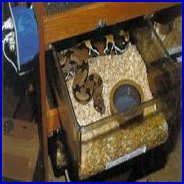
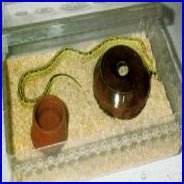
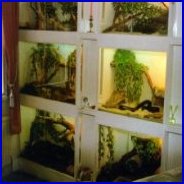
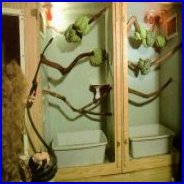
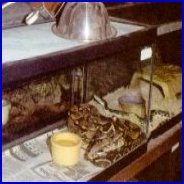
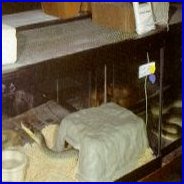
Cage Examples : Depending on the species , your pocket
, your homespace , there are several types of vivariums you can provide to assure
successful snake and breeding .
A Quick Solution For Very Small Snakes
Basic & Simple Vivariums
Exhibition Vivariums
Commercial Vivariums
Only Glass Vivariums
Balik Lagi