
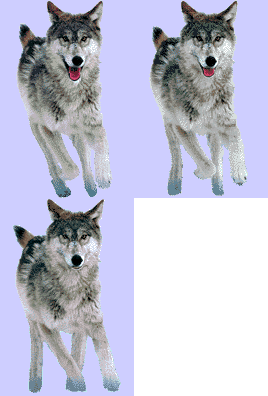
 There has been no other animal so misunderstood, feared, hated, and persecuted thought-out time as the wolf. The gray wolf, also called the timber wolf, is the largest of about 41 wild species within the dog family, Canidae, of the order Camivora. With the exception of the red wolf of southeastern Texas and southern Louisiana, all living wolves are considered a single species, Canis lupus. The red wolf, Canis rufus, is similar to but smaller than the gray wolf and is intermediate in many characteristics between wolves and coyotes; it has been suggested that the red wolf is a fertile cross between gray wolves and coyotes.
 Characteristics of the wolf
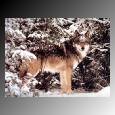
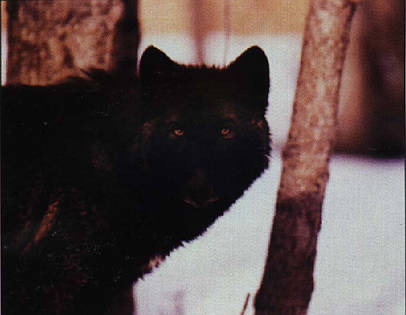
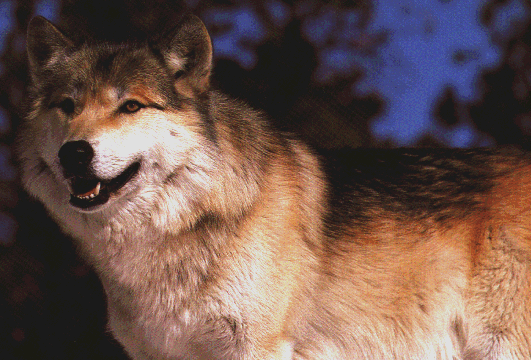
Wolves vary in size depending on their geographic location. The gray wolf size is about 5 to 6.5 feet from nose to tip of tail and they can weigh 40 to 175 pounds. Their coat colors can vary from pure white, which is most common in the far north, to mottled gray to brown or black. The red wolf is often a reddish tan color.
Characteristics of the wolf
Wolves vary in size depending on their geographic location. The gray wolf size is about 5 to 6.5 feet from nose to tip of tail and they can weigh 40 to 175 pounds. Their coat colors can vary from pure white, which is most common in the far north, to mottled gray to brown or black. The red wolf is often a reddish tan color.
 Habitats and Range
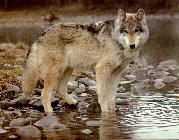
Wolves can live in a variety of habitats, ranging from arctic tundra to forest and prairie. They are absent from deserts and the highest mountains. At one time the wolf ranged throughout most of the northern hemisphere, north Africa, and south Asia. In the Old World wolves still roam throughout many regions of Asia, eastern Europe and, in very small numbers, western Europe and Scandinavia. Most New World wolf populations are in Canada and Alaska, where they are relatively stable; a small population exists in Mexico. Of the 48 contiguous states only Minnesota has a wolf population large enough to maintain itself. Wolves have been reported at scattered locations around the United States, including Isle Royale, in Lake Superior, and in Michigan, Montana, Wisconsin, and Wyoming. Government plans to reintroduce wolves into what was once their native habitat have met with opposition from ranchers and hunters.
Habitats and Range
Wolves can live in a variety of habitats, ranging from arctic tundra to forest and prairie. They are absent from deserts and the highest mountains. At one time the wolf ranged throughout most of the northern hemisphere, north Africa, and south Asia. In the Old World wolves still roam throughout many regions of Asia, eastern Europe and, in very small numbers, western Europe and Scandinavia. Most New World wolf populations are in Canada and Alaska, where they are relatively stable; a small population exists in Mexico. Of the 48 contiguous states only Minnesota has a wolf population large enough to maintain itself. Wolves have been reported at scattered locations around the United States, including Isle Royale, in Lake Superior, and in Michigan, Montana, Wisconsin, and Wyoming. Government plans to reintroduce wolves into what was once their native habitat have met with opposition from ranchers and hunters.
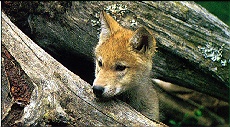
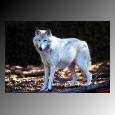 The den, or lair, of the wolf may be a cave, a hollow tree trunk, a thicket, or a hole in the ground dug by the wolf.
 Social Behavior
The basic social unit of wolf populations is the pack, which usually consists of a mature male and female plus offspring one or more years of age. Pack size can reach 36, but usually two to eight individuals are present. Each pack ranges over its own area of land, or territory--which may vary from 50 to 5,000 sc mil and will defend all or much of this area against intruders. Members form strong social bonds that promote internal cohesion. Order is maintained by a dominance hierarchy. The pack leader, usually a male, is referred to by behaviorists as the alpha male. The top-ranking (alpha) female usually is subordinate to the alpha male but dominant over all other pack members.
Social Behavior
The basic social unit of wolf populations is the pack, which usually consists of a mature male and female plus offspring one or more years of age. Pack size can reach 36, but usually two to eight individuals are present. Each pack ranges over its own area of land, or territory--which may vary from 50 to 5,000 sc mil and will defend all or much of this area against intruders. Members form strong social bonds that promote internal cohesion. Order is maintained by a dominance hierarchy. The pack leader, usually a male, is referred to by behaviorists as the alpha male. The top-ranking (alpha) female usually is subordinate to the alpha male but dominant over all other pack members.
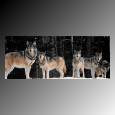 When two wolves meet, each shows its relationship to the other by indicating dominance or submission through facial expression and posture. Additional modes of wolf communication are howling and other vocalizations and scent marking. One function of howling is to communicate position or assemble the pack; advertisement of territory to neighbors is probably another. Scent marking involves deposition of urine or feces on conspicuous objects along travel routes, usually by dominant wolves. This behavior appears to function in territory maintenance and in intrapack communication.
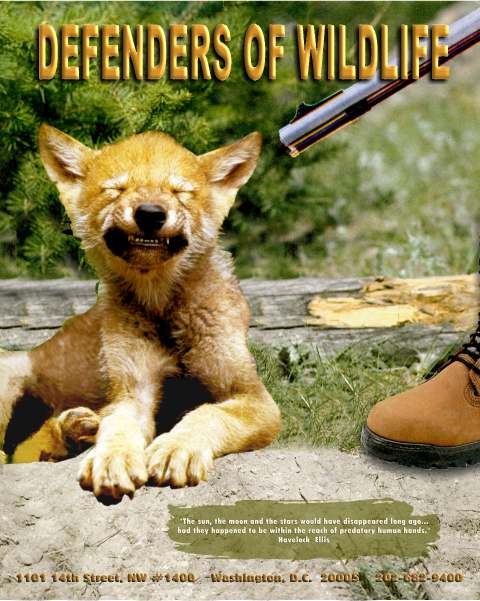 During the course of each year wolf packs alternate between a stationary phase from spring through summer and a nomadic phase in autumn and winter. Activities during the stationary phase involve caring for pups at a den or homesite. During summer most movements are toward or away from the pups, and adults often travel and hunt alone.
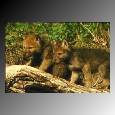 By autumn pups are capable of traveling extensively with the adults, so until the next whelping season the pack usually hunts as a unit throughout its territory. In tundra areas wolf packs follow herds of caribou in their annual migrations.
 The Life Cycle
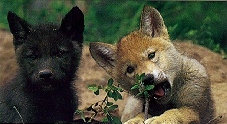
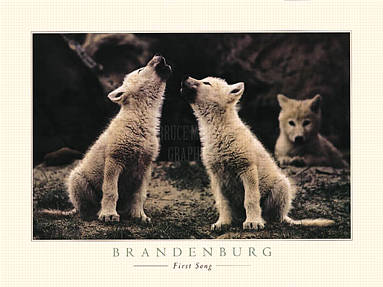
Usually only the highest ranking male and female in a pack will breed. The breeding season can vary from January in low latitudes to April in high latitudes. Pups are born about 63 days after breeding; an average litter is six pups. The mother wolf stays close to her young for the first two months while other pack members bring food. Pups are weaned at about the fifth week. The pups approach adult size by autumn or early winter. Sexual maturity usually is attained at two years.
The Life Cycle
Usually only the highest ranking male and female in a pack will breed. The breeding season can vary from January in low latitudes to April in high latitudes. Pups are born about 63 days after breeding; an average litter is six pups. The mother wolf stays close to her young for the first two months while other pack members bring food. Pups are weaned at about the fifth week. The pups approach adult size by autumn or early winter. Sexual maturity usually is attained at two years.
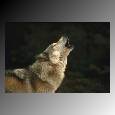 The major prey for the wolves are large hoofed mammals, including deer, moose, elk, caribou, bison, musk-oxen, and mountain sheep. Beaver is eaten when available. In summer a variety of smaller foods, such as small rodents and berries, supplement the diet. Animals killed are usually young, old, or otherwise weaker members of their populations because they are easiest to capture. Healthy wolves rarely, if ever, attack humans. Mortality factors affecting wolves include persecution by humans, killing by other wolves, diseases, parasites, starvation, and injuries by prey. Probably few wolves live more than ten years in the wild.
 Myth and Reality
Although the wolf is still cast as a blood-thirsty villain in folklore and children's stories, the public's image of wolves is improving; interest in their preservation is growing. Several scientific studies have disclosed the wolfs role in natural ecosystems and have done away with some of the misconceptions that have surrounded this colorful and complex animal for centuries.
Myth and Reality
Although the wolf is still cast as a blood-thirsty villain in folklore and children's stories, the public's image of wolves is improving; interest in their preservation is growing. Several scientific studies have disclosed the wolfs role in natural ecosystems and have done away with some of the misconceptions that have surrounded this colorful and complex animal for centuries.
 Ranchers, hunters voice opposition to wolves
Officials at a public roundtable in Enterprise get an earful of opinions
on a controversial subject
Friday, February 4, 2000
--------------------------------------------------------------------------------
By Richard Cockle, Correspondent, The Oregonian
ENTERPRISE -- Ranchers and hunters told federal officials they would
oppose any policy that allowed straying Idaho wolves to stay in Oregon,
arguing that the arrival of wolves would deal a fatal blow to the
livestock and hunting industries.
"We've got to make it clear, we don't want 'em here," Wallowa County
rancher Mack Birkmaier told 75 people at a wolf roundtable at the Wallowa
County Fairgrounds Thursday. "We've got to draw our line in the sand."
Roy Heberger, with the U.S. Fish and Wildlife Service's wolf recovery
program in Idaho, responded, "I think you are whipping yourself into a
frenzy. . . . It is not an emergency to have a wolf pack up in the
mountains."
Ranchers, hunters voice opposition to wolves
Officials at a public roundtable in Enterprise get an earful of opinions
on a controversial subject
Friday, February 4, 2000
--------------------------------------------------------------------------------
By Richard Cockle, Correspondent, The Oregonian
ENTERPRISE -- Ranchers and hunters told federal officials they would
oppose any policy that allowed straying Idaho wolves to stay in Oregon,
arguing that the arrival of wolves would deal a fatal blow to the
livestock and hunting industries.
"We've got to make it clear, we don't want 'em here," Wallowa County
rancher Mack Birkmaier told 75 people at a wolf roundtable at the Wallowa
County Fairgrounds Thursday. "We've got to draw our line in the sand."
Roy Heberger, with the U.S. Fish and Wildlife Service's wolf recovery
program in Idaho, responded, "I think you are whipping yourself into a
frenzy. . . . It is not an emergency to have a wolf pack up in the
mountains." 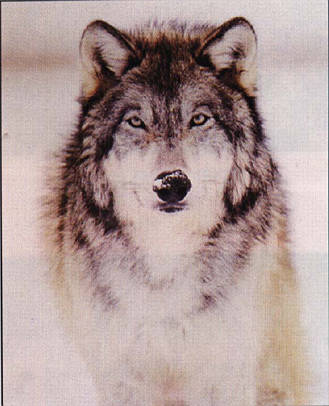 Some participants in the 3 �-hour forum argued that wolves are an integral
part of a healthy ecosystem, strengthening big game herds by killing the
aged and unfit. Others cast wolves in the role of frothing recreational
killers of livestock, horses and wildlife.
Federal wildlife officials say they have no intention of establishing a
wolf-recovery program in Oregon but say they won't return any straying
wolves that are not causing problems.
Last year a female gray wolf known to federal wildlife officials as B45
strayed from Idaho into Oregon. Eventually, the collared wolf was trapped
and returned to the central Idaho, but not before she became a symbol for
conservation groups who hope to bring the wolf back.
And that may already have happened. A rancher told the wolf roundtable
that several experienced hunters recently spotted two adult wolves on the
Oregon side of Hells Canyon of the Snake River.
Some participants in the 3 �-hour forum argued that wolves are an integral
part of a healthy ecosystem, strengthening big game herds by killing the
aged and unfit. Others cast wolves in the role of frothing recreational
killers of livestock, horses and wildlife.
Federal wildlife officials say they have no intention of establishing a
wolf-recovery program in Oregon but say they won't return any straying
wolves that are not causing problems.
Last year a female gray wolf known to federal wildlife officials as B45
strayed from Idaho into Oregon. Eventually, the collared wolf was trapped
and returned to the central Idaho, but not before she became a symbol for
conservation groups who hope to bring the wolf back.
And that may already have happened. A rancher told the wolf roundtable
that several experienced hunters recently spotted two adult wolves on the
Oregon side of Hells Canyon of the Snake River.
 Idaho's wolf-recovery program got under way in 1995. About 160 wolves now
roam that state, and recent reports indicate sightings near Boise.
Hunters at the roundtable said they didn't want another major predator in
Wallowa County, where Rocky Mountain elk populations have plummeted from
19,800 in 1980 to 11,600 this year, according to Oregon Department of Fish
and Wildlife figures.
Biologists say the decline could be caused by cougars and bears, whose
numbers appear to be growing, or by changes in habitat. The decline in elk
promises to be a blow to businesses in Wallowa County, which depend on
income from hunters.
Much of the concern was voiced by ranchers worried about the already
faltering livestock industry if wolves move into Oregon. Arleigh Isley,
whose pioneer great-grandfather settled in Wallowa County, said he worried
that some county residents could run afoul of the law defending themselves
or livestock by killing a wolf, which is classified as an endangered
species. Conviction for illegally killing a wolf can bring a year in jail
and a $100,000 fine.
Idaho's wolf-recovery program got under way in 1995. About 160 wolves now
roam that state, and recent reports indicate sightings near Boise.
Hunters at the roundtable said they didn't want another major predator in
Wallowa County, where Rocky Mountain elk populations have plummeted from
19,800 in 1980 to 11,600 this year, according to Oregon Department of Fish
and Wildlife figures.
Biologists say the decline could be caused by cougars and bears, whose
numbers appear to be growing, or by changes in habitat. The decline in elk
promises to be a blow to businesses in Wallowa County, which depend on
income from hunters.
Much of the concern was voiced by ranchers worried about the already
faltering livestock industry if wolves move into Oregon. Arleigh Isley,
whose pioneer great-grandfather settled in Wallowa County, said he worried
that some county residents could run afoul of the law defending themselves
or livestock by killing a wolf, which is classified as an endangered
species. Conviction for illegally killing a wolf can bring a year in jail
and a $100,000 fine.
 Federal officials do have authority to kill or move wolves that are
killing livestock.
Birkmaier warned that wolves could stampede cattle off their mountain
ranges into fragile riparian areas, putting ranchers in violation of
salmon-recovery laws. He said children would no longer be able to swim in
the county's swimming holes because of the risk of meeting up with one or
more wolves.
Suzanne Laverty of the Defenders of Wildlife, which has taken an advocacy
role on wolves, said there were no recorded incidents of a healthy wild
wolf attacking and killing a human.
"If you are letting kids go to swimming holes where there are bears and
mountain lions, you are taking more of a risk than with wolves," she said.
Mark Henjum, wildlife program supervisor with the Oregon Department of
Fish and Wildlife in La Grande, noted that the wolf-recovery program in
Idaho is still an experiment.
"I think it would be prudent to see how the experiment in Idaho plays out
before we do something here," he said.
--------------------------------------------------------------------------------
Federal officials do have authority to kill or move wolves that are
killing livestock.
Birkmaier warned that wolves could stampede cattle off their mountain
ranges into fragile riparian areas, putting ranchers in violation of
salmon-recovery laws. He said children would no longer be able to swim in
the county's swimming holes because of the risk of meeting up with one or
more wolves.
Suzanne Laverty of the Defenders of Wildlife, which has taken an advocacy
role on wolves, said there were no recorded incidents of a healthy wild
wolf attacking and killing a human.
"If you are letting kids go to swimming holes where there are bears and
mountain lions, you are taking more of a risk than with wolves," she said.
Mark Henjum, wildlife program supervisor with the Oregon Department of
Fish and Wildlife in La Grande, noted that the wolf-recovery program in
Idaho is still an experiment.
"I think it would be prudent to see how the experiment in Idaho plays out
before we do something here," he said.
--------------------------------------------------------------------------------
 Wolves killed with banned rat poison
By the Associated Press
COEUR D'ALENE, Idaho (AP) -- A banned form of rat poison was used to kill
two wolves near Salmon, the U.S. Fish and Wildlife Service reported.
The agency confirmed Compound 1080 was used.
Wolves are protected under the federal Endangered Species Act. The Fish
and Wildlife Service and the Defenders of Wildlife conservation group are
offering $2,500 for information leading to the conviction of those
responsible for deaths of the wolves.
The federal agency is eager for people to know that tasteless, odorless
Compound 1080 is a threat to humans, including someone who touches
poisoned meat retrieved by dogs
Two other animals, a fox and a rancher's dog, were found poisoned, said
Rich McDonald, Fish and Wildlife's senior resident agent in Boise.
Compound 1080 is sus pected in those deaths.
Compound 1080 could poison a human by entering the body through damaged
skin, or by being inhaled along with dust particles. Most often, the
poison kills when it is ingested, McDonald said.
Canines -- dogs, wolves, coyotes -- are most suscepti ble, he said.
The killing of an endangered species is punishable by up to a year in jail
and a $100,000 fine. Use of Compound 1080 by an individual can bring up to
30 days in jail and a $1,000 fine.
`` I can think of no more cowardly act than to indis criminately spread
poison baits so that animals will ingest them and die,'' Defenders of
Wildlife President Rodger Schlickeisen said.
`` The recent anti-wolf propaganda and the wolf smear campaigns ...
certainly may have served as a catalyst for illegal actions such as
this,'' said Schlickeisen.
`` You can't go around spreading false information about wolves and then
claim no responsibility when things like this happen,'' he said after
naming some farm groups that oppose wolve reintroduction programs in
central Idaho and Yellowstone National Park.
`` We have made it very clear in many conversations with folks that belong
to the Farm Bureau that we absolutely, fervently believe that the law
should be upheld,'' Farm Bureau spokesman Jon Doggett said. `` If it's
against the law to poison wolves, we're against it.
Wolves killed with banned rat poison
By the Associated Press
COEUR D'ALENE, Idaho (AP) -- A banned form of rat poison was used to kill
two wolves near Salmon, the U.S. Fish and Wildlife Service reported.
The agency confirmed Compound 1080 was used.
Wolves are protected under the federal Endangered Species Act. The Fish
and Wildlife Service and the Defenders of Wildlife conservation group are
offering $2,500 for information leading to the conviction of those
responsible for deaths of the wolves.
The federal agency is eager for people to know that tasteless, odorless
Compound 1080 is a threat to humans, including someone who touches
poisoned meat retrieved by dogs
Two other animals, a fox and a rancher's dog, were found poisoned, said
Rich McDonald, Fish and Wildlife's senior resident agent in Boise.
Compound 1080 is sus pected in those deaths.
Compound 1080 could poison a human by entering the body through damaged
skin, or by being inhaled along with dust particles. Most often, the
poison kills when it is ingested, McDonald said.
Canines -- dogs, wolves, coyotes -- are most suscepti ble, he said.
The killing of an endangered species is punishable by up to a year in jail
and a $100,000 fine. Use of Compound 1080 by an individual can bring up to
30 days in jail and a $1,000 fine.
`` I can think of no more cowardly act than to indis criminately spread
poison baits so that animals will ingest them and die,'' Defenders of
Wildlife President Rodger Schlickeisen said.
`` The recent anti-wolf propaganda and the wolf smear campaigns ...
certainly may have served as a catalyst for illegal actions such as
this,'' said Schlickeisen.
`` You can't go around spreading false information about wolves and then
claim no responsibility when things like this happen,'' he said after
naming some farm groups that oppose wolve reintroduction programs in
central Idaho and Yellowstone National Park.
`` We have made it very clear in many conversations with folks that belong
to the Farm Bureau that we absolutely, fervently believe that the law
should be upheld,'' Farm Bureau spokesman Jon Doggett said. `` If it's
against the law to poison wolves, we're against it.
 BACK TO HOME PAGE!


BACK TO HOME PAGE!