I have an electrical engineering/computer background. So, some of what follows may have to be translated for those without any electrical knowledge. Having said that, I hope this information benefits some who have asked questions about RO, misting and fogging systems, what to do about hard water, and making it easier to water and care for your orchids. I got advice from many people including Ray Barkalow with First Rays Orchids and Rick Sumner. Both were very helpful and I used or modified and used many of their suggestions and appreciate their help. I have included edited versions of the essence of their inputs at the end for reference.
We wanted to automate our greenhouse so that we could reduce the amount of time we spend on caring for our orchids and so the greenhouse could take care of itself when we go on 1-2 week trips. We have a Janco 10.5 ft by 16 ft lean-to greenhouse mounted on a 30" high brick knee wall, which is attached to the side of our garage. We have used standard techniques to automate control of the temperature using various thermostats, fans, vents and an Empire gas heater, which continues to operate, except for the fan, in the event of a power outage. To control moisture we tried a Herrmidifier 500 fogging system ($243.50) from Charlie's Greenhouse Supply which puts out plenty of moisture and is very quiet. But, because we have hard water we ended up with white deposits on all of our orchid leaves and everything else in the greenhouse, which was not acceptable. We tried storing and using rainwater but two long droughts ended those attempts. Since other watering strategies proved to be problematic, the heart of our water system is now a 4 stage Reverse Osmosis (RO) system.
Reverse Osmosis water systems can produce water that is almost completely devoid of dissolved solids. This is accomplished by passing impure water under pressure through a filter element. The outputs from this filter element are near pure water and impure water that has passed by the element. Different RO systems waste different amounts of water. Thus, it may take anywhere from 4 to 11 gallons of water to produce one gallon of pure water, depending on several factors including temperature and pressure. Each RO system should have a flow restrictor in the waste output to limit the waste flow. The waste generated is a little higher in total dissolved solids than the input water and is generally suitable for watering trees, lawns and gardens or filling a swimming pool. So if the impure water is used properly it really is not really wasted!
We settled on and are happy with the integrated RO unit, which Ray Barkalow recommended. See Ray's comments below. The unit is a Model 4SV with a 50 gal per day membrane, an auto shut off valve, a 3 gallon pressurized storage tank and an air gap faucet for $220 plus shipping & handling from Premier Manufactured Systems, Inc., 17431 N. 25th Ave., Phoenix, AZ 85023, 800-752-5582. Our water comes from a municipal system and its temperature is between 55F and 60F, the pressure is 50- 55psi and the pH is 8.0 with Total Hardness of 158 ppm and Total Dissolved Solids of 162 ppm. This unit generates about 35+ gpd under these conditions, which is quite satisfactory for our use. Premier suggested this unit after I told them the input water conditions and that I needed about 20gpd. This unit feeds a 35 gallon poly agricultural tank through a 1&1/2" stand pipe, which is as tall as the tank and is the fill and level control tube for the tank. I mounted a Grainger model 2A553 float valve in the tube which shuts off a 24vac Toro lawn sprinkler "fill" solenoid ($12), when the tank is full. There is no pressure in the holding tank.
To pump water from the holding tank to pressurize the RO water distribution system, I bought a Water Ace "Jet Tank System" Model R-520C-T7 with an integrated � HP pump, a 7 gal diaphragm pressure tank, a pressure regulator, a pressure switch and a pressure gage from Lowes for $247. You must install a check valve on the inlet side of the pump to prevent bleed back and maintain pressure in the 7 gal pressure tank. The unit comes with a standard 20-40 psi pressure switch, which can be adjusted. Don't try it unless you know what you are doing. To achieve a 45 psi "pump off" setting there is an adjustment nut inside the pressure switch housing. The low pressure "pump on" setting is a fixed 20 psi differential below the "pump off" setting. The base air pressure in the 7 gal diaphram tank must be set to 2 psi less than the lower "pump on" pressure setting- 23 psi in my case. This system provides more than enough pressure to run my sprays and misters.
Since automating the greenhouse is a work in progress, we wanted a way to easily reconfigure the watering, misting and fertilizer system. All inputs and outputs to major components and valves are either threaded (MPT/FPT) or are made by using MPT to hose adapters fittings on such things as pumps, tanks, mixers and spray lines and running washing machine hoses between these major components. We have already made several changes in system configuration, which made this approach well worth the extra expense.
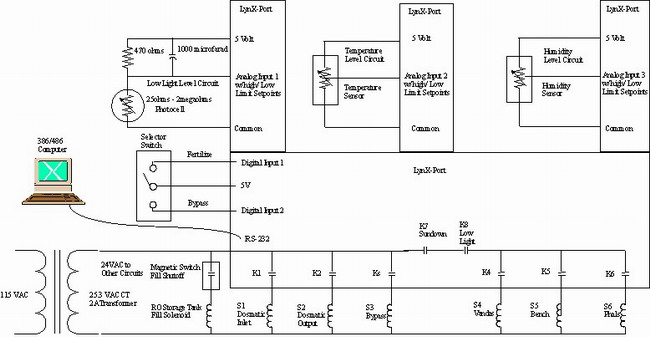
To control the watering, misting and fertilizer system, I use an old 486 laptop computer (a 386 would do) connected via an RS-232 serial port to a LynX-Port microcontroller, which controls up to eight devices through eight fully programmable DPDT relays. Each relay has its own 16-bit timer so you can individually program them to close from .05 seconds all the way up to 9 hours. Relays are rated: 1 Amp at 120 vac, 2 Amps at 30 vac. You can program a device to switch on at a specific time, stay on for up to 9 hours, then automatically switch off. You can also set a relay to trip the next relay in sequence after the first one times out. The LynX-Port also features 4 A/D high/ low limit 0-5V analog inputs and 8 digital inputs. With the analog inputs, you can plug in optional external sensors (temperature, light, moisture, etc.) for even greater automated control. The digital inputs let you use magnetic contacts, user inputs, and any N/O or N/C sensors. The LynX-Port is manufactured by Marrick Limited and is available from Home Automation Systems, Inc. for $249.95. You also need the 7590B Regulated 12VDC Power Supply ($16.95) to power the unit. I bought a RS-232 serial cable, jumper blocks to configure the LynX-Port circuit card and a 25 VAC 2 amp transformer from Radio Shack to power the 24 VAC Toro lawn sprinkler solenoids. The LynX-Port looks as if it was designed for this application. If you want to find out more about this controller the web site is: www.smarthome.com/1154.html. You can download the controller's software program, "LynX-SOFT lite", which includes the programming manual, from Marricks. The computer and controller are connected to a Tripelite 500VA uninterruptible power supply, ($90) from Sam's Club, to prevent loss of control during short power outages.
 |
| Click on the image for a slightly larger version. |
To measure light levels I took a photocell, which measures 2 megaohms under no light and drops to 25 ohms under full sunlight, out of an old dusk to dawn lamp module. I used it as the bottom leg of a simple voltage divider network with the top leg being a 470 ohm resistor in parallel with a 1000 microfarad filter capacitor. The top of the divider is connected to the controller's 5V supply and the bottom is connected to the controller's common. The center terminal of the divider provides a 0-5v signal that is proportional to the amount of sunlight and is connected to one of the A/D converter inputs on the controller. The A/D's high/ low limit function allows you to turn any relay on or off when the limits are reached. For this circuit higher light levels generate lower voltages. I used a light meter to determine the voltage for the light level at which we wanted to water (.4V) and for the level at which we wanted no watering to occur (.8V). This level of sunlight is too low to evaporate the water by dark, which can result in crown rot on Phals or mildew, fungus and root problems on other Orchids. We also have 5 circulating fans creating vigorous air movement under and over the benches to decrease the chance of mildew, fungus and root rot. The output from the light level high/ low limit circuit is programmed to trigger the "low light" relay, which interrupts the common to the watering relay circuit when light levels are not acceptable. In addition, the controller is programmed not to allow watering between three hours before sunset and sunrise, which adjusts automatically as the days grow longer or shorter. This "sunset" relay also interrupts the common to the watering relay circuit. These functions are programmable using the basic software supplied with the controller. The controller has available many timers and you can create different schedules of events, which we have used to create watering schedules. So, depending on the available light and time of day relative to sunrise, we water from three individually controlled banks of sprays and misters. For example, in the Spring and Fall Phals are misted twice a day for 2 minutes each time and Vandas are misted every hour for 2 minutes each time. If humidity drops below 70% or the temperature goes above 90 F then the Hermidifier 500 fogger comes on. I need to find a good humidity sensor (0-5vdc) to go with the controller instead of the contact type. If anyone knows of one, let me know. If temperature goes above 95 F then the misters come on. You can store Spring, Summer, Fall and Winter watering schedules. In the summer time our control system is simple. The plants go outside in the shade of an oak tree. Two battery powered Nelson 5800 garden timers, which can be programmed to water at up to 4 times per day with a duration as short as 1 minute, control misting and spraying.
We have installed a Dosmatic precision fertilizer injector "The Advantage" � MPT Model A10-1% ($295) from Charlie's Greenhouse to mix fertilizer for periodic hand application. The mixer is activated using a selector switch connected to the controller's digital inputs to select "Fertilize" or "Bypass". Ray suggested that the output of the injector be fed to the bottom of a 4" PVC mixing column to get a good consistent mixture. The output from the top of this mixing chamber could also be fed into the watering system and activated by a computerized fertilizing schedule by the controller (like every 3rd watering or once a week). I have not yet incorporated this feature. We mostly fertilize by hand as needed with a wand attached to the mixing system at this point. The Vandas are fertilized about every other day as an example. We also give the greenhouse a good hand soaking about once a week. Selecting the location for different types of plants in the greenhouse is crucial because of the different microclimates that exist. Potting mixture adjustment is also critical so that each plant will maintain about the right moisture level with a more routine automated watering schedule. Coarser mixtures in clay pots or open structures like baskets dry out quicker and finer mixtures in plastic pots dry slowly. Some plants like Phrag seedlings are kept in saucers that fill with water to maintain even higher moisture levels.
As an alternative to what we have done, Rick Sumner sent me some of what he had done with his greenhouse:
"I turned to RO a number of years ago to stop the tips of my orchid leaves from turning brown because of the sometimes high sodium content of my street water. The results were resoundingly successful. By discussing the system components needed with local knowledgeable people I discovered that there are two types of elements. One type (TFC) is better than the other (TFH) but must not be exposed to chlorine in the water. The second type of element is cheaper (TFH) but does not last as long and may be exposed to some chlorine. In any case, chlorine in street water should be minimized for either element. One way to do this is to have one or more charcoal filters in the line upstream of the RO element. The charcoal filters should be preceded with a sediment filter. I found that making my own system by purchasing a couple of filter canisters from the local hardware store was cheaper than buying them from a water filtration company. I plumbed them together with PVC. I purchased an element and a water saver valve from Back to Nature Filtration in California. The element was a 23gallon per day unit, which to my pleasant surprise, delivered 23 gallons per day at a waste water rate of about 4 gallons per RO gallon produced. The only caveat was a recommendation to turn a knob on the flow valve once each week for a few minutes to further rinse the element to help prolong its life. (RO elements do have a finite lifetime but I've had two 23 gpd elements running for 2 years without suffering any deterioration in water purity). My system uses the waste to water fruit trees near my greenhouse, which now produce better fruit than ever because they were only watered sporadically before. The water system stores pure water in two 55gallon poly drums from which it is pumped into a pressure tank for the sprayers in the greenhouse. There is a solenoid valve that controls water input to the RO filters which is turned on or off by a float in one of the barrels. RO system results have been as hoped for- no brown leaf tips, beautiful flowers and no clogged sprayers. If you have a water mineral problem and can put the waste to use, I strongly urge using an RO system for orchids.
"Building a greenhouse I've tried to engineer all the systems with the most cost-effective, off the shelf elements possible. For example, all the valves and timers for my sprayer lines are right off the homecenter shelf intended for watering lawns and shrubs. I think that one of the brands is RAINGO. If I recall correctly, these timers cost about $18 and run on an AC adapter with battery backup. The only circuits that I have put together that offer any complexity are the ones for spraying the Vandas and humidity control. For the Vandas, I use a 24 hour heavy duty (3 prong) timer which drives a Cyclestat timer from Charley's Greenhouse Supply. The Cyclestat in turn drives a 24Volt plug in supply, which actuates the Raingo valve for the Vandas. I use a schedule of about 45 seconds of water sprayed on the roots every 3 hours from 8AM until 4PM. The time varies with the daylight. I lengthen the cycle in the summer and shorten it during the winter. I control humidity with a fogger using a humidistat from Graingers, part no. 2V785 as well as a thermostat 4E636 and a timer. The idea is that early in the morning I fog the entire greenhouse for about 30 minutes. Thereafter, the humidistat keeps the humidity at about 70% unless the temperature gets above 85F. At that point the thermostat turns on the fogger to lower the temperature. It works in conjunction with a swamp cooler, which inputs air at about 65F. The plumbing is all 3/4PVC except for the over bench lines which are 1/2 in. The sprayers are all from the Reed Kofford Co at 3313 Vincent Rd Pleasant Hill, CA (925-935-0603). They have the cheapest and best over the bench sprayers. The sprays for the Vandas come from Charley's Greenhouse Supply. As far as pumps go, I use a positive displacement gear pump from Grainger to keep water pressure in the range of 60 - 85psi along with a 20 gallon pressure tank from Sears. The fertilizer is mixed into the lines using a Dosatron injector system, which works flawlessly. I have three tiered benches in the greenhouse with one watering line per bench, so as not to exceed the capacity of any part of the system. The greenhouse is entirely on its own for plant care all week. I come in during the weekend and check on everything and generally find that everything is doing fine!"
Rick Sumner - rksumner at worldnet att net
This is what Ray Barkalow sent me about his experience with his RO unit:
"My RO system is a Model 4SV with a 50 gal per day membrane, an auto shut off valve, a 3 gallon pressurized storage tank and an air gap faucet for $220 plus shipping & handling from Premier Manufactured Systems, Inc. It dumps into a polyethylene tank that contains a float valve. When it's full, the float shuts off water from the pressure tank. When the tank is full, the pressure switch shuts off the whole thing. I feed a mix tank by gravity from the big holding tank; it contains a submersible pump for watering and misting. The output is somewhat less than 50 gpd, as it's affected by water temperature and pressure (higher of both is better). Mine does not run continuously, and I have gotten 4 years of life - so far - from the membrane with no water quality degradation. I change the other filters annually for under $20. Do I like it? Yes! The unit requires little maintenance and is low cost (around $220 initially, plus $20/year; the membrane is $66). About 2-3 gallons of flush water is relieved per gallon scoured. That's a pretty efficient RO/flush ratio. I get gorgeous, shiny leaves and lots of roots. I use Dynagro and ProteKt, at about � the recommended strength, and the pH is pretty constant at 6.4, sometimes going up a shade if I add magnesium sulfate."
Ray Barkalow - First Rays Orchids
I received another useful input for a simple RO system, but I do not know whom it is from:
"I have had GREAT success with RO water. We live in Indianapolis and have VERY hard water with a lot of limestone and iron. I have a 14' X 18' greenhouse. All of my orchids were dying, but before throwing in the towel, I decided to install an RO system. I got my system from Ron Harlan at "Back-to-Nature" in Glendale, CA (818) 248-7133. Tell him I gave you his name if you call him. The RO dribbles into a 35 gal plastic tank from Farm & Fleet. I then got a boat bilge pump from W.W. Grainger, which pumps to my hose. When I want to water I throw a switch, which turns on the pump. The RO takes about a day to make the 35 gallons and it is about a 3:1 ratio. It has saved my collection. It's amazing the difference. I have since put a system in for our orchid friends in Pittsburgh."
I hope this information is of some use to people and hopefully others of you will share your knowledge and experience with automating your greenhouses and making it easier to care for your orchids. Thanks!