
The Birth of Buddhaism
The main theme of Buddhist belief is that of karma, the evaluation of all life's events and, after ones
death, the rebirth of that karma in a new existence. In this way everyone has it in his own hands to
determine his next life, for better or worse. The Thai proverb "do good and receive good, do evil and
receive evil" sums up this concept well.
The young Prince was seated in the shade of a rose-apple tree. Instead of enjoying the ceremony,
he started meditation: he concentrated on his breathing, now a breath in, now a breath out. When his
attendants returned to him, they found him sitting cross-legged and in a deep trance. "What an unusual
child," they said and went to inform the King.
Siddhartha was very kind to animals. Often he preferred to play alone rather than join his friends
in cruel games. One day, he was out in the woods with his cousin, Devadatta, who shot a bird flying
over head. The bird fell down. Siddhartha ran to it first and gently pulled the arrow out. He then picked
some medicinal herbs and squeezed the juice on to the wound to stop the bleeding and calmed the
frightened bird.
Devadatta said that the bird belonged to him. "It is mine. I shot it," he said.
"Had you killed it, it would have been yours. It is only wounded and I saved its life, so it mine,"
said Siddhartha. They finally decided to go to court of wise men to settle the matter. The court decided
that a life belongs to the one who saves it and not to the one who tries to destroy it. So Siddhartha had
the right to take the bird. Devadatta was very angry.
Siddhartha's compassion and contemplative nature greatly disturbed the King, who often pondered
over the prophecy of the wise men. He decided to make absolutely certain that his son did not see the
four Special Signs that would one day make him give up his royal pleasures.
King Suddhodana, therefore ordered that the Prince should be surrounded only by the happy and
beautiful aspects of life. Old and sick people were kept out of his sight. Death was not mentioned.
It is said that even fading flowers and leaves were removed from the royal gardens and pleasure
parks so that the Prince would not see anything that suggested decay. The King Provided every luxury.
Three palaces were built for the three seasons of the year, the hot season, the rainy season and the
cool months of the winter. These palaces had beautiful gardens laid our with fountains and ponds full of
fish, swans and water-lilies Young attendants served him. Dancing girls and musicians entertained him. In these surrounding,
the Prince grew up to be a young man of great strength and beauty. He was now of an age to marry.
His father, the King, sent messages to neighboring kingdoms for proposals of marriage for Siddhartha.
The messengers returned with the reply that although he was handsome and rich, the Prince was not a
warrior and the neighboring kings did not want to marry their daughters to a coward. When the King
heard this, he was very upset. But Siddhartha said that he would prove his skills in any competition,
including archery
Everywhere, there was great rejoicing on that day. Horses with gleaming armor and with their
riders in bright uniforms, each attended by their own standard-bearers, carrying their colo(u)rful flags,
gathered in the palace square.
"Siddhartha has won the horse-riding and is leading in the archery contests, too," cried the crowds,
excitedly. He easily won every contest that was held. Now that he had proved his skills in the arts of
war, his father held a banquet to choose a bride for him, to which the neighbouring kings gladly sent
their daughters. To everyone's surprise. Siddhartha chose his own beautiful cousin, Yasodhara. Her
father willingly gave her in marriage to gallant Prince They lived in great splendor in a new palace
surrounded by everything delightful and pleasant.
As time went by, the palace with all its luxuries and amusements made Siddhartha bored and
restless. Also, all the efforts of King Suddhodana to make his son worldly-minded only increased the
Prince's curiosity to see the world outside. Channa, to take him for a drive on the outskirts of the
palace.
Channa chose a beautiful chariot drawn by white horses. The people rejoiced to see their
handsome Prince driving through the streets.
They had not gone very far when they saw a hunched-up old man by the roadside. This was a
very unusual sight for the Price. He stopped the horses.
"Who is that, he looks like a man but his hair is white. He has no teeth, his cheeks are sunken and
his skin is wrinkled. He is weak and bent and he is leaning on a stick. What sort of man is that?"
"That is an old man," replied Channa. "He has lived for a very long time."
"Does everyone get old, Channa? Will my beautiful Yasodhara get old, and you, yourself? Will I
get old, too?"
Siddhartha was greatly disturbed by what he had seen.
On another day, when he was out with Channa, they saw a sick man. He was so weak that he
could not stand up but rolled on the ground crying with pain. His body was covered with sores and his
mouth was foaming, Channa explained that anyone could fall ill at any time.
On the third visit outside the palace, they saw a funeral procession pass by. The mourners were
wailing with grief, carrying the corpse.
"Why are they carrying that man?" Siddhartha was amazed.
"That, my Lord, is a dead man."
In answer to more questions from the Prince, Channa explained that death is the end of life and
that it is common to all who are born.
Siddhartha had now seen the four Special Sigh's which would change his life as predicted by the
Sages and wise men at his birth.
The King was deeply grieved that all the precautions he had taken had failed to protect his son,
However, when a son was born to Princess Yasodhara, he was overjoyed and held a grand feast to
celebrate the birth of the grandchild. He hoped that Siddhartha would not leave his wife and baby now.
The Prince attended the feast but was preoccupied with his own thoughts.
"I must become like that, that peaceful, calm person we saw in the street, dressed in yellow,
seeking the way to end suffering. I shall renounce the world this very day. I have lived a very empty
and super ficial life all these years."
He tiptoed out of the room and asked Channa to saddle his favorite horse, Kanthaka. Then he
went to Yasodhara's apartments and looked into the bedroom very quietly. She was fast asleep
embracing the baby in her arms. Siddhartha was only twenty-nine years old. With a heavy heart but
with a strong determination, he tore himself away from them and rode out of the palace gates with
Channa.
When they reach the river, Neranjara, he dismounted, cut of his hair and took of all his princely
clothes and jewelry. He handed them all to Channa and ordered him to return to the palace, taking the
horse with him stay with him. but Siddhartha was firm in his refusal. Above all, he wanted Channa to
return to the royal family and tell them not to grieve over his departure, because he would one day
return to them when his quest was complete.
Channa prepared to leave but this time, Kanthaka refused to move. Siddhartha spoke to him
gently and persuaded him to go with Channa. But Kanthaka knew that he would never see the Prince
again and he was so sad that he kept looking back longingly at his master and died of a broken heart on
the way.
Siddhartha exchanged his princely clothes for those of a beggar and walked alone. He was no
longer a prince, but the homeless ascetic, Gotama, in search of the Truth.
He went to Alara Kalama and Uddaka, well-known teachers of the time. Siddhartha studied very
hard, until, one day, Alara said, "I have nothing more to teach you. You are equal to me mow. Will you
stay and help me with my pupils?" "Can you not teach me how to escape from death, illness and
old-age?" asked Gotama. "No," said Alara, "No-one in the world knows that."
So he continued his search with other teachers and not being satisfied, wandered alone once
again. At this stage he joined five other ascetics. Their names were Kondanna, Bhaddiya, Vappa,
Mahanama and assaji. Together, they practiced self-control and self-mortification, that is, going without
the normal needs of food and rest, sleeping on hard ground and generally leading a very uncomfortable
and hard life. They believed that to become spiritually pure, one had to torture the body.
The ascetic Gotama become so weak that one day he collapsed with hunger and pain. He was
found by a shepherd who fed him on milk and looked after him till he became strong.
He realized that a life of mortification was useless. He knew from experience that the life of
luxury which he had enjoyed as a prince was also futile. He therefore decided to follow a course
between these two extremes--- "The Middle Path"s He started to re-live a normal life. The five
ascetics were disappointed in him and left him.
At this time, there lived in a neighbouring village, a women called Sujatha. She had a baby son and
to fulfil a vow which she had made, she prepared a very special dish of milk-rice as an offering and
came to the same grove where the ascetic Gotama was meditating.
About two thousand six hundred years ago in North India, at the foothills of the Himalayan Mountains, there were a number of little kingdoms, each ruled over by its own Raja or King. One of these kingdoms was the land of the Sakyas. They were a warrior clan and the name of the King whoruled over them at the time was Suddhodana. The King lived in the capital city, called Kapilavastu, on the Nepal frontier.
One night, Queen Maha Maya had a very strange dream. She saw a huge white elephant come into the room, carrying a lotus flower. The elephant trumpeted as it walked round her bed three times.
In the morning, the King summoned the wise men of the land to the palace, to find out the meaning of this dream.
"Oh, King! A great and noble son will be born to your Queen," they said. The King and Queen
were very happy.
When the baby was due, according to the custom at the time, the Queen asked her husband if she could visit her parents in the neighboring kingdom. The King readily granted her wish and ordered that everything possible should be done to make the journey pleasant.
 She was carried in a royal palanquin and was accompanied by many attendants all beautifully dressed and sparkling with jewels.On the way, they had to pass a forest and some lovely gardens called Lumbini. When the Queen arrived at this delightful place, within sight of the snow-capped Himalayas, she thought that she would
like to rest for a while in the cool shade. So it happened that, seated under a Sal tree in the peaceful Lumbini. Grove, she had a baby boy. It was the full moon day in the month of Vest (May). All the trees were in flower and a gentle breeze sang to the music of the birds and animals of this lovely forest garden. The bees hummed cheerfully as they flew from blossom to blossom, gathering honey. It was as if all nature was happy over the birth of this Prince. The whole party returned to Kapilavastu, where the new Prince was greeted with great rejoicing. The baby was very beautiful. His skin was the colo(u)r of gold and his eyes were a lovely deep,
voile blue. His hair was black and his whole body and limbs were perfectly formed.
She was carried in a royal palanquin and was accompanied by many attendants all beautifully dressed and sparkling with jewels.On the way, they had to pass a forest and some lovely gardens called Lumbini. When the Queen arrived at this delightful place, within sight of the snow-capped Himalayas, she thought that she would
like to rest for a while in the cool shade. So it happened that, seated under a Sal tree in the peaceful Lumbini. Grove, she had a baby boy. It was the full moon day in the month of Vest (May). All the trees were in flower and a gentle breeze sang to the music of the birds and animals of this lovely forest garden. The bees hummed cheerfully as they flew from blossom to blossom, gathering honey. It was as if all nature was happy over the birth of this Prince. The whole party returned to Kapilavastu, where the new Prince was greeted with great rejoicing. The baby was very beautiful. His skin was the colo(u)r of gold and his eyes were a lovely deep,
voile blue. His hair was black and his whole body and limbs were perfectly formed.
 One of the first visitors to the palace after his birth, was a wise Sage called Asita. On seeing the baby,
he first smiled and then tears began to trickle down his face. The King and Queen were worried.
"Will any harm come to our son?"
"Oh, no, Your Majesties," the Sage replied. "Your son will be extremely fortunate. I am smiling
because I am very lucky to see him. who is no ordinary human being. He will be most unusual. In fact,
he will become a Buddha one day, a Fully Enlightened One, who will teach the whole world how to
find true happiness and relief from sorrow. I am old now and shall not live to see that day. That is why
I am sad."
The King was not altogether happy at what he heard. He invited more learned and wise men to
the palace, eight of them for the naming ceremony of his child. They studied special markings on the
body of the baby. Seven of them said that he would one day become a great Emperor, or, indeed, a
Buddha. But the eight sage, whose name was Kondanna, was very definite that the Prince would one
day see four Special Signs and give up his palace and family. He would lead the simple life of and
ascetic in meditation and become a Buddha.
The King and Queen were very upset when they heard this. The baby was named Siddhartha,
which means, 'the One whose wishes will be fulfilled' and the family name was Gotama.
Seven days after the birth of the Prince, Queen Maha Maya died. The Queen's sister, Prajapathi
Gotami, nursed and cared for him as if he were her own. He grew up to be handsome. tall and strong
and very good at his studies. He learned many subjects. At the some time, he was gentle and kind,
well-mannered and loved by his people.
One day, his father took him to the ploughing festival which took place every year. The King
drove the first pair of bullocks which were decorated with golden trappings and pulled a golden plough.
The other nobles followed the King, driving silver ploughs and their bullocks had silver harnessing.
One of the first visitors to the palace after his birth, was a wise Sage called Asita. On seeing the baby,
he first smiled and then tears began to trickle down his face. The King and Queen were worried.
"Will any harm come to our son?"
"Oh, no, Your Majesties," the Sage replied. "Your son will be extremely fortunate. I am smiling
because I am very lucky to see him. who is no ordinary human being. He will be most unusual. In fact,
he will become a Buddha one day, a Fully Enlightened One, who will teach the whole world how to
find true happiness and relief from sorrow. I am old now and shall not live to see that day. That is why
I am sad."
The King was not altogether happy at what he heard. He invited more learned and wise men to
the palace, eight of them for the naming ceremony of his child. They studied special markings on the
body of the baby. Seven of them said that he would one day become a great Emperor, or, indeed, a
Buddha. But the eight sage, whose name was Kondanna, was very definite that the Prince would one
day see four Special Signs and give up his palace and family. He would lead the simple life of and
ascetic in meditation and become a Buddha.
The King and Queen were very upset when they heard this. The baby was named Siddhartha,
which means, 'the One whose wishes will be fulfilled' and the family name was Gotama.
Seven days after the birth of the Prince, Queen Maha Maya died. The Queen's sister, Prajapathi
Gotami, nursed and cared for him as if he were her own. He grew up to be handsome. tall and strong
and very good at his studies. He learned many subjects. At the some time, he was gentle and kind,
well-mannered and loved by his people.
One day, his father took him to the ploughing festival which took place every year. The King
drove the first pair of bullocks which were decorated with golden trappings and pulled a golden plough.
The other nobles followed the King, driving silver ploughs and their bullocks had silver harnessing.
 "Yes, even you and your Princess, Yasodhara, must surely die one day, my Lord. There is nothing
you can do about it," emphasized Channa, clearly, heedless of the King's orders. Siddhartha felt almost
ill at this realization. "Let us return to the palace at once," he said, "I don't want to go any further."
On their way back, they were met by another unaccustomed sight. It was a man wearing a yellow
robe and whose head was shaved. His calm and peaceful appearance impressed the Prince. Channa
explained that this was a Sage -- one who had given up home and family to find a way to end
suffering.
At the palace, his step-mother asked him why he seemed to be so sad.
"I have learned that all living beings grow old and ugly, get ill and die. I am sad when I think about
all this," was Siddhartha's quiet reply.
As the evening wore on, he dozed off as he had no interest in the amusements provided. The
dancers and musicians seeing that the Prince was asleep, stopped their dancing and singing and lay
down to rest, but soon fell asleep.
When he woke up, he was surprised to see everyone around him fast asleep. What a changed
scene it was! Dancers and singers who had seemed so elegant before, were now sprawled about,
some snoring, some grinding their teeth. It was a very unpleasant sight. His disillusionment with life in
the world was complete.
"Yes, even you and your Princess, Yasodhara, must surely die one day, my Lord. There is nothing
you can do about it," emphasized Channa, clearly, heedless of the King's orders. Siddhartha felt almost
ill at this realization. "Let us return to the palace at once," he said, "I don't want to go any further."
On their way back, they were met by another unaccustomed sight. It was a man wearing a yellow
robe and whose head was shaved. His calm and peaceful appearance impressed the Prince. Channa
explained that this was a Sage -- one who had given up home and family to find a way to end
suffering.
At the palace, his step-mother asked him why he seemed to be so sad.
"I have learned that all living beings grow old and ugly, get ill and die. I am sad when I think about
all this," was Siddhartha's quiet reply.
As the evening wore on, he dozed off as he had no interest in the amusements provided. The
dancers and musicians seeing that the Prince was asleep, stopped their dancing and singing and lay
down to rest, but soon fell asleep.
When he woke up, he was surprised to see everyone around him fast asleep. What a changed
scene it was! Dancers and singers who had seemed so elegant before, were now sprawled about,
some snoring, some grinding their teeth. It was a very unpleasant sight. His disillusionment with life in
the world was complete.
 When Sujatha saw the beautiful and serene figure sitting under a banyan tree, she was overcome
with awe. She made her offering and said, "Venerable Sir, whoever you may be, god or human, please
accept this milk-rice and may you attain that goal which you seek," He took the offering. Then, he
bathed in the river and sat on its bank and ate the milk-rice. After this, he returned to the river and
placed the empty bowl on the water and said, "May this bowl float upstream if I am to attain
Enlightenment."
The bowl did float upstream.
When Sujatha saw the beautiful and serene figure sitting under a banyan tree, she was overcome
with awe. She made her offering and said, "Venerable Sir, whoever you may be, god or human, please
accept this milk-rice and may you attain that goal which you seek," He took the offering. Then, he
bathed in the river and sat on its bank and ate the milk-rice. After this, he returned to the river and
placed the empty bowl on the water and said, "May this bowl float upstream if I am to attain
Enlightenment."
The bowl did float upstream.
 He returned to the shade of a tree at Gaya and with complete faith in himself, started to meditate.
He resolved, "I shall not move from here until I have attained Full Enlightenment, "and he spent the
whole evening in this meditation posture. Many thoughts came to distract him from his goal. There
were thoughts of his beloved wife and child, memories of his luxurious home, of parents and friends, of
feasts and of sports. All these flashed before his eyes. But he was not tempted. With determined will,
he continued to meditate until his mind became pure and clear. He emerged as the Fully Enlightened
One, the Buddha.
The search of six long years had ended. It was a day when the full-moon shone, casting a bright
silver light on the whole countryside, a day in the month of Vesak, (May). The Buddha was thirty-five
years old and, for a week, following Enlightenment, he sat under the tree enjoying the state of perfect
happiness he had achieved. The Tree later became known as the Tree of Enlightenment or the
Bodhi-Tree and the place is still known as Buddha Gaya. He spent a further six weeks near the tree. It
is said that for a whole week, he gazed at the tree with gratitude for having sheltered him.
At the end of the seventh week, he decided to teach the Doctrine (the Dhamma) he had
discovered. He knew that the Dhamma could not be easily understood and that it had little appeal for
ordinary people. Nevertheless, he felt it was his duty to go forth, for there were many whose minds
were ready to received his massage. His teachers were dead. Then he remembered the five ascetics
who had broken away from him. He walked for many days on foot over one hundred miles, to the
Deer Park at Isipatana, near Benares, where the ascetics still practice their extreme discipline.
He returned to the shade of a tree at Gaya and with complete faith in himself, started to meditate.
He resolved, "I shall not move from here until I have attained Full Enlightenment, "and he spent the
whole evening in this meditation posture. Many thoughts came to distract him from his goal. There
were thoughts of his beloved wife and child, memories of his luxurious home, of parents and friends, of
feasts and of sports. All these flashed before his eyes. But he was not tempted. With determined will,
he continued to meditate until his mind became pure and clear. He emerged as the Fully Enlightened
One, the Buddha.
The search of six long years had ended. It was a day when the full-moon shone, casting a bright
silver light on the whole countryside, a day in the month of Vesak, (May). The Buddha was thirty-five
years old and, for a week, following Enlightenment, he sat under the tree enjoying the state of perfect
happiness he had achieved. The Tree later became known as the Tree of Enlightenment or the
Bodhi-Tree and the place is still known as Buddha Gaya. He spent a further six weeks near the tree. It
is said that for a whole week, he gazed at the tree with gratitude for having sheltered him.
At the end of the seventh week, he decided to teach the Doctrine (the Dhamma) he had
discovered. He knew that the Dhamma could not be easily understood and that it had little appeal for
ordinary people. Nevertheless, he felt it was his duty to go forth, for there were many whose minds
were ready to received his massage. His teachers were dead. Then he remembered the five ascetics
who had broken away from him. He walked for many days on foot over one hundred miles, to the
Deer Park at Isipatana, near Benares, where the ascetics still practice their extreme discipline.
 Seeing him at a distance, they resolved to ignore him. But, as the Buddha came closer, they
noticed that he had changed. He was majestic and commanding. There was a certain radiance about
him. They went forward and greeted him, offered him a seat and, in the customary manner, fetched
water to wash his feet, That evening, on a full moon day in the month of Esala (July) the Buddha gave
his First Sermon. He said to the five ascetics, "Monks, a recluse should avoid the two extremes. The
Middle Way, as I understand and practice it, gives vision and knowledge and leads to Enlightenment.
Seeing him at a distance, they resolved to ignore him. But, as the Buddha came closer, they
noticed that he had changed. He was majestic and commanding. There was a certain radiance about
him. They went forward and greeted him, offered him a seat and, in the customary manner, fetched
water to wash his feet, That evening, on a full moon day in the month of Esala (July) the Buddha gave
his First Sermon. He said to the five ascetics, "Monks, a recluse should avoid the two extremes. The
Middle Way, as I understand and practice it, gives vision and knowledge and leads to Enlightenment.

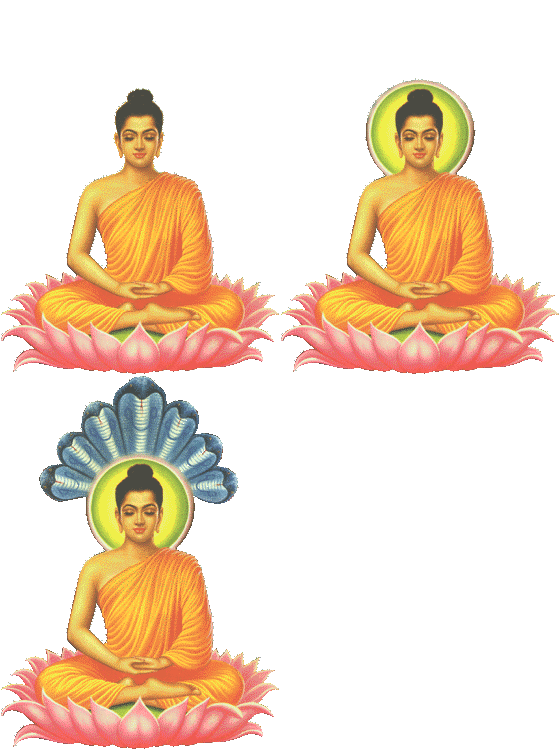
Scent of lotus heightens religious devotions Aryans who invaded ancient India believed in Brahmanism, but as they expanded their reign, they were compelled to incorporate other indigenous beliefs. Images of Brahmanic divinities became fused with those of the Indus civilization, and the lotus came to be worshipped as "Mother of all creations," since divine figures were thought to be born from the lotus. Likewise Brahma, the Hindu ruler of all gods, is also believed to have emerged from the lotus. In Buddhism, lotus symbolizes "a state of total selflessness," which is fundamental to Shakyamuni's teachings. The lotus is considered sacred mainly for the purity of its flowers that emerge beautifully from muddy waters. It also is representative of Nirvana. The Indian worship focusing on the lotus eventually spread to many other cultures, and became the base of religious doctrine such as the Buddhist Lotus Sutra, which continues to be highly influential spiritual teaching. In addition to the beauty of its blossom, the exquisite aroma of the lotus has also enhanced this sacred image. Religious devotions seem to be heightened by its sweet, slightly medicinal scent that floats about in the hot summer air.

E-Mail me!

This page has been visited times according to

