
Nature's Oddities & Furies continued
Hurricane
A severe cyclonic storm originating at sea in the tropics. In the Pacific, it's called a typhoon, in India, it's called a cyclone, and in Austrailia, it's called a willy-willy. A tropical storm is officially classified as having hurricane force when it reaches a speed of 73 mph. Hurricane winds can reach 150 mph with gusts upto 200 mph. Thunderstorms, waterspouts, or tornados may develop on a hurricane's fringes. Hurricanes usually form during the the warm season (summer and early autum). A hurricane moves slowly westward, then curves northward in the northern hemisphere (or southward in the southern hemisphere), gains speed and then breaks up as it turns eastward. The eye of a hurricane ranges from 5 to 40 miles in diameter while a hurricane's over all diameter ranges from 200 to 500 miles. Hurricanes have the most destructive winds on earth because they carry an arsenal of destruction; airborne missiles, flash floods, storm surges. Hurricanes rotate counterclockwise. Some of the worst hurricane devastation is:
Hurricanes . . .
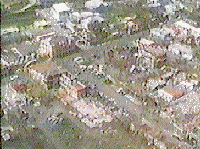
destroy cities, |
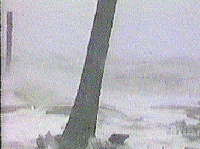
cause massive storm surges, |
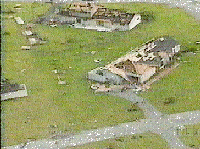
flatten buildings, |
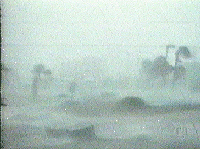
and prevent escape. |
Did you know: Hurricanes are given male and female names in alphabetical order for each season. Hurricanes are ranked in catagories called 1, 2, 3, 4, or 5, the most powerful.
Landslide
A mass of dirt and rock moving rapidly down a mountain slope. A landslide occurs when a mass of dirt and rock becomes unstable or saturated with water. They are often triggered by the fall of heavy rain, strong winds, earth tremors, and even violent sound waves, such as those caused by explosions. In descending, a landslide may grow to enormous size by picking up additional dirt, rock, and debris. Landslides are sudden, violent and destructive. They can occur in oceans as well. Speeds and depths vary by terrain travelled and consistency of materials.
Landslides . . .
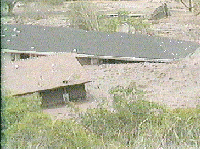
bury buildings, |
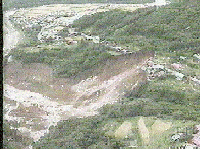
wash away land, |
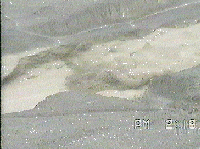
turn like rivers, |
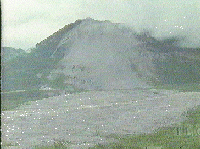
and wipe out civilization. |
Did you know: A landslide can move as fast as 60 mph. In 1920, in the providence of Kansu, China, a series of disastrous landslides killed 100,000 people. In most years, landslides cause more damage than all other disasters combined.
Lightning
A giant discharge of static electricity occuring in the atmosphere, usually during storms. Lightning is caused by opposite charges inside thunderclouds when discharged which heats the air. Thunder is produced when the rapid heating causes the air to expand with an explosion. When lightning strikes close by, thunder is heard as a loud, sharp crack, or thunderclap. Static electricity build-up on the ground indicates a lighnting strike.At any given point and time, there are 2,000 thunderstorms raging across the earth's surface. Lightning comes in several forms:
Lightning . . .
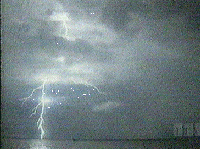
strikes anywhere, |
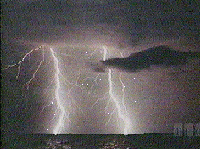
anytime, |
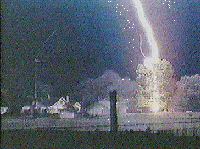
and anything |
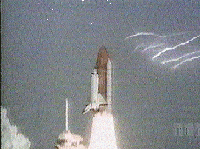
that attracts it. |
Did you know: It's estimated that lightning strikes the earth at least 100 times a second. A bolt of lightning can carry a current of more than 10,000 ampheres at more than 100,000,000 volts. At its peak, lightning can reach 50,000 degrees. Lightning strikes about 400 people a year. Lightning moves at 100,000 miles per second.
This page hosted by Get
your ownFree Home Page
Get
your ownFree Home Page