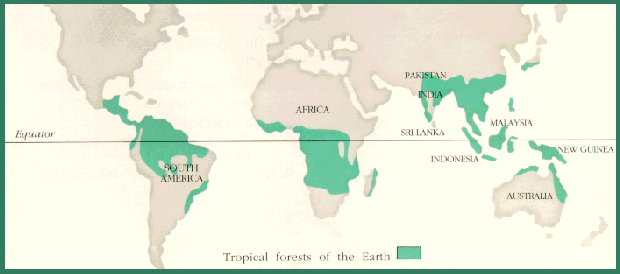
The map below shows the distribution of the tropical rainforests:-
The temperatures in the rainforests do not vary appreciably throughout the year. For instance, in a particular site in the forests of Java, the mean temperature was found to be 24.3oC in February and 25.3oC in the month of October. On cloudy days, only negligible variations in temperature are observed. However, when the weather is sunny, temperature variations of up to 9oC have been recorded. The foliage can heat up to 10oC above atmospheric temperature. The elevated levels of atmospheric humidity leads to the formation of dew on the vegetation, and this serves to reduce the temperature of the plants. Naturally, the flora are well adapted to thrive in the hot temperatures typical of these regions. Some of the plants keep transpirational losses to a minimum by the possession of a thick, waxy cuticle or by the closure of their stomata.
The thick canopy of trees only allows little sunlight through. In fact, only about 0.5% to 1% of full sunlight reaches the forest floor. Indeed, a value as low as 0.1% has been recorded.
If total deforestation of an area of rainforest occurs, and the topmost layers of nutrient-deficient soil are removed by erosion, the virgin forest can once again be regenerated by a new primary succession. However, this is not possible, if the underlying rock (such as weathered sandstone and alluvial sands) is highly deficient in nutrients. In this case only a much simpler ecosystem develops, such as a heath-population or a sparse savannah.
As described above, seasonal changes in the rainforest are practically non-existant. The forest is therefore ever green. This does not mean that the trees never shed their leaves. Indeed, a tree may shed its leaves all at once. Periodicity in growth and flowering has been reported in rainforest tree species, but these phenomena are not likely to be effected by environmental conditions. It is not unusual to observe two adjacent trees of the same species, one of which lacks flowers completely, whilst its neighbour is in full bloom. One may conclude that these plants have an autonomous periodicity. 2-4 month, 9-month and 32-month cycles have all been observed in the rainforest. Most trees are dicotyledonous, and are of taxonomically distinct groups. An impressive variety of tree species occurs in the rainforest. Typically, 40 species may occur on 1 hectare. As many as 100 tree species have been counted on a hectare, in certain studies. Most of the species are pollinated by animals, such as bats, birds and insects. The flowers are often highly coloured in order to attract potential pollenators. Notably, many of the tree species are leguminous.
Stilt or buttress roots are a common feature of rainforest trees, which provide the larger trees with greater stability.. Various monocotyledonous palm species occur, although such trees are not normally a major feature of the typical rainforest habitat.
The tree-stratum may be 50-55 metres high. Three stories may be recognizable:- an upper, a midddle and a lower story. The upper story is not compact, but consists of solitary giants which reach far above the other trees. The dense leaf canopy consists of the middle and the lower stories.
The taller trees have to invest considerable quantities of energy in order to attain a hieght suitable for the optimum harvesting of light. However, lianas have "discovered" another way of reaching ideal light conditions, which is simpler, and less expensive in terms of energy. Lianas attach themselves to the rigid tree trunks, and only have to develop a soft, flexible stem. In a similar way, epiphytes can grow on the higher branches of the trees in the rainforest, and are therefore exposed to favourable light conditions. Adequate amounts of light are essential for the efficient growth of lianas, and these are therefore often abundant in forest clearings, where they grow simultaneously with the trees, as the forest regenerates. For this reason, lianas are more abundant in secondary, rather than virgin forests. Notably, 90% of all the species of lianas in the world are to be found in the tropics.
Epiphytes grow abundantly on rainforest trees. These include cacti, orchids and ferns. Although they are exposed to adequate amounts of light, water may not be easily available to them. For this reason, epiphytes are commoner in montane forests and cloud forests, where the leaves are constantly dripping. Researchers such as Coutinho (1964, 1969) have observed Crassulacean Acid Metabolism (CAM) in various epiphytes in the brazilian rainforest. In such cases, stomata open at night time, rather than at day time, and hence the plant absorbs carbon dioxide at night. This helps the plant to conserve water, since the stomata are closed when the ambient temperatures are higher. Ferns are often present as epiphytes; these plants do not tolerate much drought, and make their own soil, by collecting litter, using specially shaped leaves.
As described in an earlier section, the soil is deficient in nutrients. Yet, this seems to be contradictory to the fact that the rainforest ecosystem is the most productive one known. How, therefore, can this huge turnover of biomass be explained? It is known that the trees in the rainforest harvest the low levels of nutrients in the soil very efficiently. One way they do this is through a symbiotic association with fungi, to form what is known as a Vesicular Arbuscular Mycorrhiza (VAM) . The fungal hyphae penetrate the root hairs of the trees, whilst being in contact with the decaying litter (Went and Stark, 1968). In this way, nutrients can be efficiently transferred from the litter to the trees.
The tropical rainforests are fast disappearing. It is estimated that every minute, 150 acres of virgin forest are destroyed. Due to this massive loss of habitat, it is thought that about 120 species are being lost every day. Evidently, we are heading towards a catastrophe. What, therefore, are the factors contributing to this mass destruction?
Deforestation is one major cause of rainforest destruction. World famous fast-food producers are seriously threatening the health of the forest and that of our planet by clearing large tracts of the Amazonian Jungle. The land is used to rear cattle, whose meat will be used to make hamburgers. Remember therefore: by eating at certain, well-known, fast food outlets, you would be contributing to the accelerated destruction of this wonderful habitat. Other companies, such as Mitsubishi are also the culprit of much of the deforestation we are witnessing today. Mitsubishi is one of the leading consumers of tropical hardwood! Write to Mitsubishi today, asking them to stop this practise, which is causing irrepairable damage to the rainforests!
Gold mining is another serious threat to the rainforests of the world. The Madre de Dios area of the Peruvian forest was invaded by more than 400 front-loading earth moving machines in 1996. These are wreaking havoc in the forest, destroying trees as tall as 45 metres as they move a 30 metre depth of sub-soil. Mercury costs only 9 a kilo, and is therefore liberally used to extract gold from the earth. The gold adheres to the mercury, and is collected by buring off the latter. This is giving off highly toxic fumes, causing severe air and river- pollution. In March of 1996, Mobil Oil signed a contract with the Peruvian Government, for rights to gas and oil exploration in the forest. This is depriving the indegenous people of the land which is theirs by right. In 1996, Peruvian economist Dr. Guillermo Mosquera said: "... In five years, the region will be a desert - a graveyard for rusting machines...."
TOP
The Soil
The rainforest soil is often of a reddish colour, rather than brown. Nutrient levels in the soil are very low. This can be attributed to:
The root systems of the trees are confined to the topmost layers of the soil. This is not unexpected, since the deeper layers of the soil do not contain appreciable quantities of nutrients.
TOP
The Rainforest Community
TOP
Threats to the Rainforests.
TOP
References
TOP