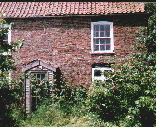
1999
Very successful this year with the asparagus, cherries and strawberries. A good crop of raspberries and blackcurrants were largely enjoyed by the birds - nets next year for definite. Egg production patchy owing to hens going more free range than intended after damage to the fence, and laying in secret nests. All produce spoken for locally.
This essay appeared in the UK press in August 99
2000
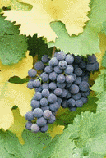
2000 saw a good apple crop, no nets and all the soft fruit once again nicked by the birds. Just two elderley hens now with the run of the place (both laying well). 20 geese also with the run of the place.
2003
The heatwave of 2003 produced the best crop ever. Aubergines and water melons (for the first time), corn-on-the-cob, several varieties of squash and beans, tomatoes by the bucket, all the usual salad stuff, peppers, chillis, asparagus, apples, pears, cheries, berries of all colours. And all the usual onions, root veg, cabbage, sprouts and on and on. Even the birds didn't manage to steal it all.
On the subject of GM crops
This article appeared in August 99
The LTF orchard grew a sizeable crop of oilseed rape and wheat in 1999 - unintentionally. The nearest oilseed rape field last year was several hundred yards away and the nearest wheat had a "buffer zone" of 40 acres of oilseed rape.
More independent (but reversible) trials needed quickly while the politicians still have a bit of clout and before the multi-nationals give up the pretence of not being in full control of all world markets and economies.
Didn't we learn anything from BSE?
But these are just stray observations from a personal perspective. For a more detailed look at the subject, see Chrissy and Katies' site.
History of LTF (including ecological waste disposal)
LTF is reputed to be the second oldest building in the village (the Hall is the oldest). LTF was originally far bigger than it is now. It was once a substantial farm and is now a small-holding.
It is approximately 200 years old and the farmhouse appears once to have been two separate dwellings. It is built on clay with hardly any foundations, but has weathered the droughts and floods. It has its own well which was used for the animals as recently as 1997. There is no mains drainage or gas in the village. LTF has a gas supply via LPG (Liquid Propane Gas) from a tank in the garden supplied and maintained by the gas company. Drainage and sewage disposal is via a septic tank - a very ecologically friendly way of disposing of waste.
A septic tank, in good working order will theoretically never need to be emptied. The filters and bacteria deal with all the waste and process it. Any overflow will be clean water. Owners of septic tanks are more careful in what goes down the drains (after all, it is not shipped away to become someone else's problem) but with a bit of care a septic tank is no trouble at all. The one at LTF was last opened a couple of years ago when some pipework was being replaced, and it was working just fine. It has been emptied once in the last 30 years (when the filters were partly blocked by rags) but has needed no attention in the last decade.
A more modern problem is blockage of the land drains near the road from cars parking on the grass verge. The LTF elf was installed to combat this problem. He held up a banner with his message in verse (see The Poetry Club).