Electrical Outlet Safety Evaluation
by Albi
Are you afraid of doing your own electrical work?
But you and your loved ones may be living in ignorance of the risk of
bad electrical work.
Doesn't that seem a little illogical? At least you can look for
and test many unsafe conditions.
Look at your outlets
Lets take a look at outlets or recepticals. You know, the place you
plug things in.Most outlets come in pairs that are side by side, or above
and below. Take a close look at one half of the pairs. Does
it have holes for two prongs (hot and neutral)
or three (hot, neutral,
and ground)? 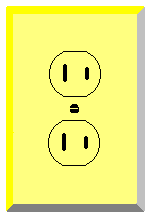
Three are safer for appliances that have three hole plugs.
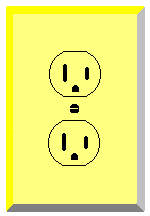
I know the screw in the center of a two hole outlet is often connected
to ground, but
many times an adapter is used to convert a three prong plug to a two prong
plug. I can count on one hand the number of times I've seen a three
prong to two prong adapter that had the grounding lug properly attached
to the ground screw on the outlet. You just
know you're not going to bother to make sure that appliance is grounded,
just like most people don't.
Remember, proper connection to ground, especially in appliances, helps
prevent shock and
fire. You should replace any two hole outlet with a three hole outlet,
unless you are sure the circuit will only receive two prong plugs (Click
here to see examples of appliances that use two and three prong plugs).
Then you won't need adapters.
Two Prongs and Three Prongs
Why don't you take a look at one of those two prong plugs?
Notice that one of the prongs is wider than the other? That means
the plug can only go into the outlet one way and its called a "polar plug". Why can it go in only one way?
Appliances can have their internal wiring arranged in the safest possible
way for the way the electricity is delivered.
For example: a simple incandescent lamp with a regular 75 watt bulb.
Lets say you don't turn off the switch when you start to change the bulb.
Its hard to tell which switch setting is off, anyway, if you weren't there
when the bulb blew. So when changing the bulb, which would you rather
be hot (carrying the electricity)? The threaded metal sleeve that
receives the metal thread at the base of the bulb or the small central
metal contact way inside the bottom of the receptacle. It isn't that
hard to touch the sleeve, or even the metal base of the bulb as it touches
the sleeve. But you'd have to try hard to touch the small central
metal contact which is way in, at the base of the receptacle.
In other appliances, similar safety measures are taken. And with
a three prong plug in a three hole outlet, even more connections to ground
are provided.
Another Threat?
However, even with both these protective measures there is still a big
threat. If your body completes a circuit from something that's hot
to ground, you still can receive a life threatening shock! Sounds
like something to prevent, doesn't it?
You can protect your loved ones from this kind of shock with a Ground
Fault Circuit Interrupter (GFCI). You may have seen one in a motel
bathroom. They look like a regular outlet with a couple of buttons.
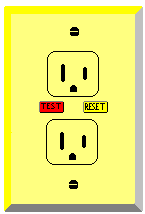
Inside they have a way of sensing the flow of relatively small amounts
of electrical current, such as through your body. The worst threat
of such an incident is in locations where someone's body can connect to
ground the best, such as at plumbing fixtures, and wet areas, so kitchens,
baths, basements, garages, and outdoors are the minimum locations you should
put them.
Finishing Your Visual Inspection
In case you haven't noticed, there are some things you should do about
your electrical outlets:
Look to see if you have these safety features, at all.
If you don't, install or have them installed.
And if you do have, them, test them to see if they are correctly installed.
Testing Outlets
Now you've seen what to look for in a visual inspection, its time to learn
how to test outlets.
First, there is very low cost, low cost, and moderate cost.
However, the first two have disadvantages.
Circuit testing light.
For about three dollars you can purchase a simple light with leads that
you can insert into the holes in a recepticle.
With a guide book, you can check to see if the hot, and neutral holes
are reversed, or if the ground, hot, or neutral is disconnected.
But it takes a bit of time, and using the guide. Also, if you want
to check the GFCI, you can do that at the particular GFCI unit (outlet
or circuit breaker) by pushing the test button on the unit. The disadvantage
of this is that other outlets protected by a GFCI can't be tested at those
outlets.
Circuit testing plug with LEDs.
For about eight dollars you can purchase a unit that looks like a long
plug with several small lights on it that plugs into all three holes in
a recepticle.
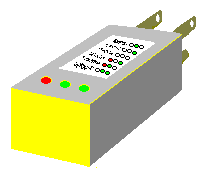
By looking at the arrangement or color of lights, you can quickly check
to see if the hot, and neutral holes are reversed, if the ground, hot,
or neutral is disconnected. This is so convenient its probably worth
the extra bucks. Just like the circuit testing light, you can push
any GFCI test button, and can't individually test any other outlets protected
by another outlet that is GFCI.
Circuit and GFCI tester with LEDs.
For about twenty five dollars you can purchase a unit that is similar to
the above circuit testing plug with LEDs, but equiped with a GFCI tester.
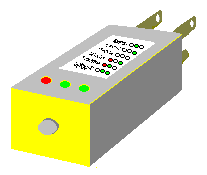
It tests the connections in the same way, but to test the GFCI you
push a button on the tester and see if that triggers the GFCI. Since
this can plug into any three hole outlet, you can test outlets that are
protected by another GFCI. This is my personal favorite.
Fixing whats wrong
Finally, what do you do when your testing finds something wrong with a
circuit?
Well, electric work is a learnable skill, and becomes simple if you
read enough or are taught enough, first. But I'll admit, it can make
you sweat with apprehension more than most other home repair tasks.
You have to learn it right, and after you know it, you have to do it right
each and every time. Lets face it, electricity can threaten life,
health, and property.
If you're going to investigate and repair, or newly install some wiring,
start small, and try to get a more knowledgable friend check your work.
Also, there's no failure in hiring someone else to do it for you.
I know some VERY handy people, who won't touch electrical jobs. Just
make sure you hire an expert.
Either way, purchase a tester, and check your system out. After
everything is OK, you can sleep well, knowing your loved ones are safe!
Albia Ice House Home
I was late putting this counter up,
so at least

interested readers have also read this wonderful article!
