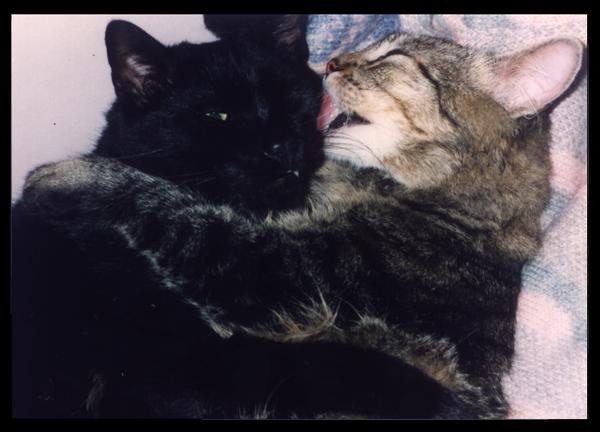
Two of my cats were afflicted
with FLUTD six years ago and I would like to share my experience and findings
with all cat owners. FLUTD is a general term for all lower urinary
tract diseases but I will only talk about the the occurence of crystals,
or urolithiasis. The most frequently seen crystals are struvites
(around 70% of cats with urolithiasis) and calcium oxalate (around 15%
of cats with urolithiasis).
Understanding FLUTD
Two very simple experiments can help you understand exactly what goes on inside your cat when he develops urolithiasis. You will need a glass cup, some water, a lemon, and about a cup of baking soda.
Take the glass cup and add an inch of water to it. Now add a coffee spoon of baking soda and stir well. You will see the baking soda disappear, in other words, it dissolved. Now add one more coffee spoon of baking soda and stir again. Repeat until the baking soda no longer dissolves. The moment you see the baking soda building up on the bottom of the cup, you have reached the saturation point of baking soda in water. No matter how much you stir, it will no longer dissolve. Now cut the lemon in two and drop one drop of lemon juice inside the cup. Stir well. Keep adding one drop at a time (always stirring well) until all the baking soda on the bottom disappears. What you just did is increase the saturation point by changing pH. This is exactly what prescription diets do. They dissolve crystals and inhibit new ones by changing urinary pH. If the cat has struvites, the recommended diet will lower urinary pH. If the cat has calcium oxalate crystals, the recommended diet will raise urinary pH.
Now lets repeat the same experiment again with a minor difference: this time we will not use the lemon. Take a clean glass cup, add an inch of water and a coffee spoon of baking soda. Stir well. Keep adding baking soda until it no longer dissolves, that is, until you reach the saturation point. Now, instead of adding lemon juice, add one spoon of water and stir well. Add another spoon of water and stir well. Keep doing that until you see all the baking soda on the bottom of the cup disappear.
From the experiment above
you see that two possible ways to deal with FLUTD are using prescription
diets or re-educating your cat to drink more liquids. Prescription
diets do work for some time but since they do not correct the concentration
of the urine, it is very common for the problem to recur on the other extreme:
a cat who had struvites will have oxalates and a cat who had oxalates will
have struvites. Low ingestion of liquids also cause a number of other
problems being chronic renal failure the worst of them. Therefore,
a cat who had FLUTD and was not re-educated to drink plenty of liquids
is likely to have chronic renal failure later in life.
Why is FLUTD so common among domestic cats?
First, because many of
us have substituted their natural diet, prey, which is roughly 70% water,
for dry feeds, which are at most 15% water. Second, because we neuter
them. Intact cats mark their territory with urine and to do so they
need to drink plenty of water. Once we neuter them, the need to spray
is gone as is the need to drink that extra water.
How to get the cat to drink more?
There are a few very effective ways to improve your cat's water intake:
If you have never experienced urolithiasis, these are the most common symptoms:
These are the first two cats to enter my life. Their mother was a street cat who had her litter on the roof of my house. She had four kittens, two males and two females. I kept the males and gave the females and mother to a friend of mine who has them all to this day. They both had urolithiasis - struvites - at three years of age. For two months they had recurring urinary blockages since they refused to eat the prescription diet. I had to do a lot of research in order to cure them and I did. Today they are nine years old and in these six years they never had a recurrence. Water is all it takes. Perhaps FLUTD should be renamed Feline Chronic Sub-hydration Disease!