These are some of the questions that we are frequently asked. Hopefully, these answers will help you to understand this breed a little better.
1) Are Curlies hypo-allergenic? Although you will be told that this is so, it is not. We have sold Curlies to folks with allergies and they have not reacted, but they take appropriate precautions. They dog is not allowed in their bedrooms and after playing with the dog, they wash their hands before touching their faces. If you have severe allergies, I would not guarantee that you would not react to a Curly.
2) Do they shed? Yes. Due to the nature of the coat (tight curls close to the body), the coat that sheds has a tendency to stay where it is until you remove it. Therefore, you don't usually get clumps of hair all over the house; rather, tumbleweeds. The Curly is a single-coated breed so this eliminates the shed of the downy undercoat that some of the other retrievers have (i.e: Goldens and Labradors).
3) Do they require a lot of grooming? No. You do not brush a Curly. To do so would make the coat frizzy and remove the curl. Grooming usually consists of a spritz bottle with water and a good massage with your hands. If a Curly has a tendency to grow copious amounts of hair on the tail, ears and back of the legs, a quick snip with a pair of scissors usually has the dog looking tidy again in no time. Further to grooming, the oil in a Curly's coat is what keeps him impervious to rain and snow. The absence of the need to brush the dog means that he can look a little 'dusty' at times. You will probably find that you bathe a Curly more often than the other retriever breeds. The upside is, Curlies usually like it!
4) How much exercise do they need? This is an individual 'dog' thing; not a breed thing. My dogs do several laps around the yard and this seems to suffice. If you enjoy a brisk walk through ravines or your neighbourhood, so will your dog. If you are, on the other hand, a basic couch potatoe and your dog has a lot of energy, going out in the yard and throwing various toys to help the dog use up some of that energy just might be enough. This doesn't really answer your question but this might help; in my experience, small dogs seem to have a lot more energy, and require an energetic outlet for it, than do large dogs. All that said, it's an individual dog thing more than anything else.
5) Are they good with kids? We probably hear this question more than any other. And, it's one of the most frustrating questions we are asked. "They" is a breed and in a very general statement, the answer would probably be, "Yes." However, each dog has his own individual personality. Basically, whether your dog is good with children depends on you and your children. Children, by their very nature, are abusive to dogs. They don't mean to be, but they are. Children must be taught how to act around the dog and how to interact with the dog. Conversely, the dog must be taught how to act around children and how to interact with children. This is YOUR responsibility. The breeder's responsibility is to produce dogs with sound temperaments. That does not mean that it is the breeder's responsibility to produce a dog that will tolerate any and all behaviours inflicted on him by children. That is not realistic. All dogs and children must be supervised by an adult. One thing to keep in mind; whenever there is a problem with kids and dogs, an adult is absent. When kids are asked what they were doing, inveriably, the answer is, "Nothing." I would seriously doubt it. However, kids don't realize that what they are doing is unacceptable to the dog and is provoking a reaction. Dog reactions to situations and dog bites are never unprovoked. As humans, we don't always understand the provication, but I guarantee that the dog's behaviour (good and bad) IS ruled by provication. So, I'll answer your question with a question: "What are your kids like with dogs?"
6) How are Curlies like Goldens and Labradors? They pick up anything that isn't nailed down and bring it to you. Depending on your point of reference, the similarity ends there. Goldens are Goldens. Labradors are Labradors. Curlies are Curlies. If Curlies were supposed to be like Goldens, they would be Goldens. If they were supposed to be like Labradors, they would be Labradors. They are Curlies. They have great senses of humour and find fun in almost everything they do. They are wickedly intelligent and don't see the need for you to keep repeating an obedience exercise once they "get" it. They learn very quickly so become extremely bored if you keep repeating something. They really start to wonder how stupid you really are. You have to be one step ahead of them all the time. If you like a challenge and a dog that will keep you on your toes, you'll like a Curly. If you like a lazy dog who doesn't do too much of anything, you won't like a Curly. If you like a dog that is "in your face", you'll like a Curly. If you want a dog that finds you to be the focus of their whole existance, you'll like a Curly. If you want a dog that will be somewhat protective of you, you'll like a Curly. If you want a fairly large dog - one that is bigger than a Golden or a Labrador, you'll like the size of a Curly. Are they like Goldens or Labradors? No. They're like Curlies!
7) Why are Curlies so rare? Curlies are really the best kept secret in the dog world. And, when people think of retirevers, they think of Goldens and Labradors; two breeds that are readily available. Due to the fact that there are very few breeders in Canada, Curlies are a rare breed. If you decide that a Curly is the breed for you, it is likely that you will be required to wait from 6 months to a year before one will be available. Most people will not commit to that amount of time and settle for a breed that is more readily available to them. Curlies may be "the best kept secret in the dog world" but they are also a breed that you must live with to really appreciate. Once you've been owned by a Curly, you'll be hooked. And, I guarantee you'll have a hard time explaining that feeling to anyone!
8) What breed problems to they have? The health problems that a Curly can be predisposed to are really 'dog' problems; not Curly problems. This includes, but is not limited to, hip dysplasia, elbow dysplasia, idiopathic epilepsy, heart anomalies, eye anomalties and coat problems. These problems are not necessarily life-threatening. Understand, these are not CURLY problems. They are, in fact, dog problems so the Curly is not exempt. Some of these issues are genetically controlled and, as breeders, we do our best to avoid them or, at the very least, to minimize them. No breeder that I know sets out to produce a litter of puppies that is not sound in mind and in body. Mother Nature, however, sometimes has a larger plan. The question, then, should be, "In the event that a genetically controlled problem manifests itself with my puppy, how do you, as the breeder, take responsibility for this? What are our options?"
9) Do you guarantee your puppies? Yes, we do. We give all our puppy people a limited, 2-year warranty on hips, eyes and temperament. Any results of screenings done on your puppy must be attested to by a specialist to make the warranty valid. Regarding temperament, we insist that the puppy and the owners attend puppy socialization classes and, at least one session of beginner obedience classes. For any other anomaly, in consultation with other breeders and canine specialists in that particular field, each case is assessed on its own merit.
10) Do you put any restrictions on your puppies when you sell them? Yes, we do. All our puppies are sold on a non-breeding agreement that is signed by the purchaser and filed with the Canadian Kennel Club. The buyer is also asked to sign an agreement to abide by the conditions for voiding the non-breeding agreement at a later date if that becomes an option. All puppies sold as pets are required to be spayed or neutered.
11) How does the choosing of a puppy happen at Riverwood? At Riverwood, we choose the puppy for you. This is not negotiable. However, let me explain our philosophy. We spend about 8 weeks nurturing and playing with the puppies. We know these puppies. If you live close to us, you can spend some time with the puppies but you could not possibly know them the way we can. When it comes time for the puppies to leave us, it's important to us that personalities are matched - puppy to family: that expectations are matched - puppy to family. We feel that we are in the best position to access that. We know who the boisterous puppy is. We know who the quiet puppy is. We know who the curious puppy is. We know who the hellion is. In short, we know who is best suited to you, your expectations for this dog and which family is best suited to the puppy. You may think that the puppy that runs over and chews on your shoelaces is as cute as a bug's ear but we know if this puppy accepts being told that this is unacceptable ... or not! If it's, "not", this puppy may be too much of a challenge for you. At the end of the day, all puppies are cute but, if you can't live with him, it wears thin ... quickly! Trust us on this issue. We've been doing this for 20 years; we know puppies!
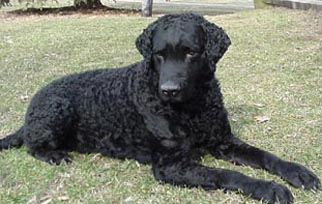 4) How much exercise do they need?
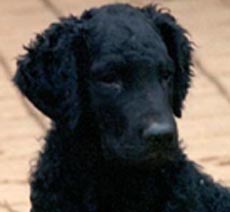 7) Why are Curlies so rare?