
ALL ABOUT CURLIES
___________________________
(History of the breed / History in Canada / Purpose & Versatility /
Is a Curly for you? / How to buy a puppy)
_____________________________________________________
HISTORY OF THE BREED:
A breed of British origin, the Curly is the first known retriever, being depicted in sporting� prints dating back 300 years.� The Curly was the first breed to be trained to retrieve game, especially waterfowl, and carry it carefully to the huntsman's hand.� From all reports, he was so good at his job, the Curly-Coat became the gamekeeper's favourite.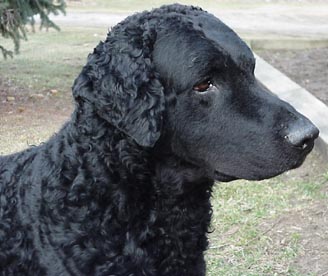
However, because he was a 'finished' breed long before stud books and breeding records were maintained, his ancestry must rely on a series of educated guesses.� His general conformation and typically curled coat provide clues.� It is assumed that the St. John's Newfoundland dog (a breed similar to the modern Labrador Retriever), the English Water Spaniel, the Poodle, and possibly various types of setters combined to produce the Curly-Coated Retriever.�
The Curly-Coat was first shown in England in 1860 and in 1896 a Specialty club was organized in England to promote the interests of the breed.� In this, they were successful until about the year 1914, when the popularity of both the Labrador and Golden Retrievers superceded that of the Curly-Coat.� While the breed has never been able to recapture great public interest, it does have a faithful, but limited, following around the world.
HISTORY OF THE BREED IN CANADA:
The Canadian Kennel Club stud book shows that the first Curly-Coated Retrievers were registered in Canada for the first time in the years 1912-1913.� At that time there were four Curlies registered.� The first Curly registered with the CKC was a bitch called, Dinah, born December 29, 1911.� History shows us that in 1914, there were eight Curlies registered; in 1915, one; then no Curlies were registered until 1927 with seven; 1928, nine; 1931, one; 1933, four; 1937, two, 1938, eight and 1939, two.� As you can see, Curlies have never enjoyed great popularity!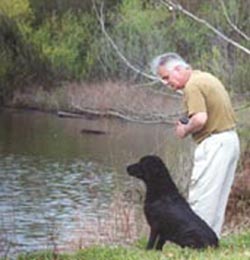
PURPOSE & VERSATILITY:
The Breed Standard for the Curly states that he should be "a strong, smart, upstanding dog showing activity, endurance and intelligence."� Curlies were created as a hunting companion.� That means that they like to be with people.� Curlies DO NOT do well being relegated to the back yard without company.� They are very sociable dogs and NEED human companionship.� Curlies have gentle dispositions, are very adaptable and eager to please their humans.� However, they can be headstrong and need training early to know their place in the scheme of things.� Curlies have a tendency to 'bond' to one member of the family although their loyalty to the whole family is never in question.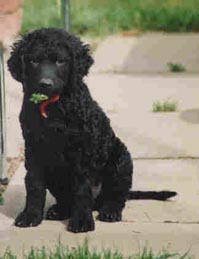 IS A CURLY FOR YOU ?
The Curly is a happy, active dog that loves to be with people.� The Curly ranges in height from 23 to 28 inches at the shoulder.� This is not a lap dog!� Curlies are not a popular dog so you will spend a good amount of your time explaining to people what your Curly is ... or isn't!� You will, however, meet a lot of people this way.� Because a Curly is a happy, busy, eager dog, they need a lot of attention right at the beginning of your association as a puppy, to channel all that joy and exuberance.� The Curly was bred to be gentle, but he is trained to be gently obedient!� Curlies, and all dogs for that matter, need obedience training ... early!� The time that you devote to training your puppy is not only time that ALL responsible dog owners owe their dogs, but it is a bonding time that will reap a two-way flow of love and understanding.
If you think that being owned by a Curly might be fun, ask yourself these questions:
~� Curlies NEED companionship.� Do you have the time the dog requires to develop into a mentally well-balance adult dog?� If your lifestyle is such that you're on the go a good portion of the time, your dog is probably alone a great deal.� NO dog does well under these circumstances.� They become bored and with boredom comes trouble!!� Chewed furniture, shoes, doors - you name it.� You can't be alone with your own company for hours on end, day in and day out, and neither can your dog!
~� Do you have time to train your dog?� It is time well spent, but do you have it to give?� From the time your puppy enters your life, he's learning his name, who the 'soft touches' in the family are, where he is allowed to be in the house, who's the boss (hint - it BETTER be YOU!).� If you don't take the time to train that cute, tubby little curly thing, he'll become a huge, uncontrollable 90 lb. nuisance!� And, there will be no-one to blame but YOU!� You are going to spend a considerable sum of money for the privilege of owning a Curly.� It is your responsibility to make the most of the expenditure.� Obedience training, for you and your dog, is often the difference between a long, happy and fulfilling experience and a relatively short and frustrating one for all concerned.
~� Why do you want a Curly?� Curlies are nice dogs, but they are not for everyone.� They are big.� They do shed.� Their tails will clear a coffee table with one swipe!� They need to be loved.� They eat a fair amount of food.� They need to be groomed.� They need to be trained. They need exercise.� Think about these things; your dog's future depends on it!
In summary, dog ownership brings with it a tremendous responsibility.� Dogs are not a 'throw away commodity'.� With a little commitment on your part, you'll have a happy, well adjusted pal.� Remember, you will get back from your dog only what you are prepared to give!!�
HOW TO BUY A PUPPY:
Curlies are definitely a 'rare' breed.� Because of that, it is important to buy from a breeder.� Buy from a breeder who knows what they are talking about.� Buy from a breeder that can talk to you knowledgeably about the breed.� Curlies, like all pure-bred dogs, are prone to some skeletal and/or health problems.� Those problems are, in some cases, genetically controlled and are well-known by the knowledgeable breeder.� ALL breeding stock should be screened for specific hereditary problems.� You, the buyer, are privy to that information.� If the breeder will not, or devises some lame excuses for not producing the results of any x-rays or eye examinations or anything else pertinent, "buyer beware".� You must be convinced, before you buy your puppy, that the breeder you are dealing with is knowledgeable about his breed, approachable after the sale and is concerned with YOUR motives for wanting this puppy.� Is the breeder warranting the puppy?� Does the breeder want you to enter into a non-breeding agreement?� Does the breeder have complete records of identification, vaccinations, worming and puppy care sheets to take home with you?� Is the operation clean?� Are the adult dogs clean and tidy?� Are the puppies in a clean and tidy environment?� Are the adult dogs friendly and glad to see you?� If you do not feel comfortable about the people that you see, keep looking.� A reputable breeder will want to know that you are sure of your purchase because they are, after all is said and done, promoting an entire breed, not just their puppies.