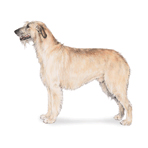

The Irish Wolfhound is thought to be the descendent of the large, rough-coated Cu which resided in Ireland before the introduction of Christianity. In fact, the breed is a most ancient one as is evidenced in its frequent mention throughout recorded history.
"And all their manners do confess,
That courage dwells in gentleness"
16th Century poem
Irish Wolfhound Time Line
c600 B.C. � Delphi, a city in Greece, is sacked by the Celts. A survivor writes an account of the huge dogs which fought alongside the invaders expressing how impressed he was with the beasts.
c273 B.C. � ancient woodcuts and writings describe the great Cu of Ireland
c. 4 A.D. � Gaelic bard Ossian writes a poem describing the original Irish Wolfhounds.
An eye of sloe, with an ear set low,
With horse�s breast, with depth of chest,
With breadth of loin, and curve in groin,
And nape set far behind the head �
Such were the dogs that Fingal bred391 A.D. � Roman Consul Quintus Aurelius Symmachus receives a letter from his brother, Flavinius, in which his brother thanks him for the gift of seven Irish Wolfhounds.
1210 A.D. � King John of England gives his son, Llewellyn, Prince of Wales, a gift of an Irish Wolfhound. Llwellyn charges the wolfhound (which he has named Gelert) to watch his young son Owain, while the prince was out hunting. Upon his return the prince found Gelert covered in blood, and the baby crib turned on its side empty. Suspecting the worst, Llewellyn turned on the hound in a fit of rage and killed it. Soon after, he found his son calmly playing close to the remains of a large wolf. Gelert had killed the wolf saving the baby�s life. Grief over what he had done compelled Llewellyn to build a statue, and memorial of the Great Hound. It is said that he never smiled again his entire life.
1652 A.D. � A directive was issued banning the transportation of Irish Wolfhounds from Ireland.
1700 A.D. � wolves have practically disappeared from Ireland, and the great dogs that hunted them had also begun to die out.
1735 A.D. � German naturalist, Reidinger, draws what is felt to be the most authentic drawing of the early Wolfhounds.
1750 A.D. � Lord Chesterfield (then Lord Lieutenant of Ireland) writes in a letter that he had been trying to procure some of the large dogs in Ireland, but that they had become extremely rare and difficult to acquire.
1751 A.D. � First detailed description of wolfhounds was written "The Irish are not without wolves and Greyhounds to hunt them, bigger of bone, and limb than a colt."
1770 A.D. � Oliver Goldsmith writes in his book Animated Nature: "The last variety and most wonderful of all that I shall mention is the great Irish Wolfdog, that may be considered as the first of the canine species�bred up to the houses of the great�he is extremely beautiful and majestic in appearance, being the greatest of the dog kind to be seen in the world�they are now almost worn away and only very rarely to be met with."
1786 A.D. � The last Irish wolf is said to have been killed by Irish Wolfhounds in County Carlow.
1803 A.D. � a quote from the Sportsman�s Cabinet (a very well known book on dogs) says: "The dogs of Greece, Denmark, Tartary [indefinate area of eastern Europe and Asia overrun in the Middle Ages by the Tartars] and Ireland are the largest and strongest of their species. The Irish Greyhound is of very ancient race, and will be found in some far remote parts of that kingdom, though they are said to be reduced even in their original climate. They are much larger than the Mastiff, exceedingly ferocious when engaged."
1805 A. D. � Hamilton Rowan presents to Lord Nugent a Wolfhound of which he refers to as the last of his race. This dog was a large, iron-grey rough Greyhound which bore a close resemblance to the Wolfhounds of today.
Additional Tidbits
** The Coat of Arms of early Irish Kings was composed of the shamrock, the harp, and the Irish Wolfhound, underneath was written the motto "gentle when stroked, fierce when provoked."
** Irish lords, very proud of their national dogs, where offering them most generously to peers and nobility, gaining favour. This trading, along with the extermination of wolves and the great famines in Ireland caused near extinction of this magnificent hound.
MORE SOON!

This page hosted by Get your own Free Home Page