You should have your mouse's home (cage, tank, whatever) perfectly
ready before getting the mouse to live there. At the very latest, you
should buy the home when you buy the mouse. Consider very carefully what type of home will
best suit your mouse and your needs. Getting a cage hastily may end up costing you more in
the long run, if you find that what you bought is unsuitable for your mouse and you are
forced to buy something else.
There are many kinds of mouse homes available. It's up to you to
choose the most suitable one. If you are able to create your own mouse house, it should
fit the following requirements:
It should be safe for the mouse. There must not be anything in the
house that mice could hurt themselves on.
- It has to be escape proof. However all the lids or doors should be easy to open by you
- You have to be able to take the mice out of the house with ease. Doors which are too
small are very inconvenient.
- The house has to be easy to clean
- Feeding your mice has to be easy
- There should be enough ventilation
- There has to be enough room for the mice and their equipment
- The house should last longer then an individual mouse's life span (about 2 years)
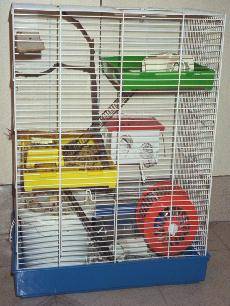
There are many different kinds of cages around. Of
these, most suitable for mice are hamster and bird cages. There are many different sizes
of hamster cages and the best for mice is one with many levels. Do not buy one of those
pitifully small "mouse cages" or tiny hamster cages that are suitable only for a
stuffed toy animal. A mouse cage should have very small space between the bars, as a
mouse can squeeze through unbelievably small spaces! Small pet mouse may be able to escape
from almost every cage available.
Wire Cages
Wire cages sold specifically as mouse cages usually
have closely-spaced bars or mesh, so that the inhabitants cannot escape. However, most
'mouse' cages are tiny, and would not provide a suitable permanent home. Many cages sold
for hamsters or birds can make good mouse homes, and they can often be bought cheaply
secondhand. Alternatively, you could wire together two or more small 'mouse' cages, to
make a larger home which still had the advantage of narrow-spaced bars
| Good Points |
Bad Points |
- Mice love to climb, and wire-sided cages provide good opportunities for this. Climbing
is a very good exercise; as well as keeping them physically fit, it helps to stop them
getting bored.
- Great ventilation - mice are prone to respiratory problems which are aggravated by
ammonia build-up in poorly ventilated cages. Interesting smells are constantly drifting
through the mouse cage, giving them something to think about.
- Large hamster cages (multi-storey are the only ones worth considering) are fairly cheap
& easy to find.
- Multiple-storey cages allow the mice plenty of floorspace whilst taking up little of
yours.
- You can feed and interact with your mice through the bars. It's great to see a group of
little noses appear at the wire every time you pass the cage. You will get a lot more fun
out of your mice - and they will become more friendly - if you encourage them to take food
from you regularly like this.
- Easy to fix lots of pieces of cage furniture up to the bars - eg ladders, nestboxes,
bird toys etc..
|
- If an adult human can get a finger through the wire, a young mouse can get out. Single
mice are more prone to try to escape than mice which live in groups. Sometimes a mouse may
try to squeeze through the bars, get stuck halfway and hurt itself. You can cover wire
cages with 1/2" x 1/2"(1cm x 1cm) wire mesh to stop any escapes, or keep the
cage in an empty bathtub or on a shelf out of reach of danger for the first month or so
until the mice are too big to escape. Often when a mouse escapes from the cage it becomes
lonely and wants to get back in; I find that most escapees only try to escape once or
twice, before deciding that life is much better if they stay in the cage!
- Predatory pets like rats, dogs and cats may attack mice through the bars; make sure that
the cage is out of their reach. You cannot rely on mice having the sense to stay away from
the bars when other animals are about.
- If any levels in the cage have wire floors or ladders, they will be corroded by mouse
urine and your shiny new cage will be dingy and hard to get clean within a year. Scrubbing
the floors with wire wool helps. Alternatively, you can cover wire floors with linoleum
,cardboard, or similar, and simply remove the floor covering to clean or throw away.
- Bird and hamster cages usually have only one or two small doors. This can make it hard
to catch mice - if you have to chase them around the cage to catch them, they will panic.
You need to be able to reach all areas of the cage easily.
|
Wooden Cages
Some mouse books will recommend that you keep your mice in
wooden boxes with a wire ventilation grille. These boxes are normally used by fanciers for
breeding mice, and they provide a very secure environment for a mouse to give birth and
rear her litter in. However, wooden boxes do not make good permanent homes for pet
mice. They absorb urine and become smelly very quickly. They provide a very limited
environment for the mice - they cannot climb, there is little room to add a wheel or other
toys, and sometimes they cannot even see out. You cannot even see into them to check your
mice without removing the lid. Leave these boxes for breeding use only.
Back to Top
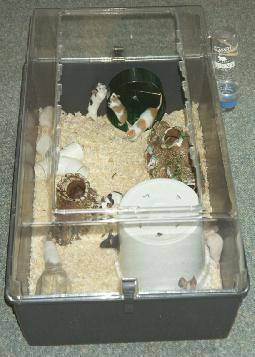
There are all kinds and sizes of plastic tanks available
from tiny show boxes to Ferplast Duna -boxes. "Habitrail" hamster homes with all
kinds of different rooms and tubes can also be included in this section. When choosing a
tank you should pay attention to the floor space available. The height is not that
important (although the mouse has to be able to stand up tall and preferably climb), but
it is much easier to build additional floors and ladders to a higher tank.
Plastic tanks are light to move and easy to clean. Furthermore, they
come with lids. You are able to put a large amount of beddings in a tank for the mice to
play in and hide small cardboard boxes and tubes under the beddings.
However, the small plastic tanks are unsuitable for mice as homes
and if the tank is not high enough, the mice can gnaw their way out through the lid. A
determined mouse can even chew itself to freedom through the wall. With a tank you should
make sure that sun does not shine in the tank - sunshine can raise the temperature in the
tank to deadly hot. If the beddings get even a bit too dirty, the ammonia levels in the
tank get so high it will damage the respiratory tracts of your mice. In the long run, the
bottom of a plastic tank may get a bit stained from the mouse urine.
| Good Points |
Bad Points |
- Square or rectangular plastic tanks are easy to clean - just wash them in the sink
- Light and portable.
- Mice love tunnels, hiding places, and exploring, so modular systems provide a lot of
opportunities.
|
- Modular systems can be fiddly to dismantle and clean.
- Ventilation may be inadequate - a few holes bored in the plastic will not induce much
air circulation. Better to replace the lid with wire mesh if ventilation is poor, or fit a
mesh panel.
- If you have a determined chewer it may escape.
|
Back to Top
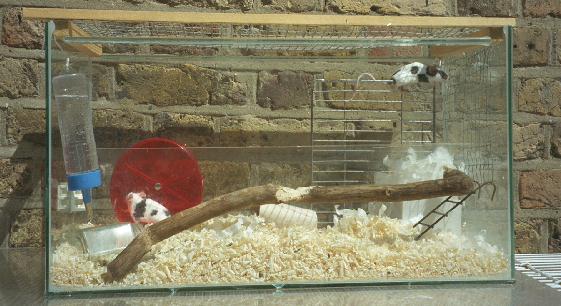
Rather large, wider than high glass tank (usually former
aquarium) is pretty suitable for mice. Reptile tanks are not as suitable, as they often
lack ventilation. A glass tank needs a wire mesh lid, escape proof and durable. Used glass
tanks are usually easy to find for cheap prize, as a mouse tank doesn't have to hold
water. However, a mouse tank should not have cracks.
Glass tanks have the good points of plastic tanks. Furthermore, they
don't get stained and a mouse can't chew its way out.
However, glass tanks are rather heavy and especially the larger ones
are too heavy to carry in the bathroom for wash ups. The dangers of plastic tanks are
present with the glass ones as well; sunshine is dangerous and you have to remember to
clean the beddings in time. Furthermore, a glass tank can get broken very easily, if you
happen to drop it.
| Good Points |
Bad Points |
- No danger of escape, as long as you make a suitable lid.
- Mice are protected from other pets which might attack them through cage bars.
- Bedding can be piled really deep so the mice can burrow through it and play in it
without hoofing it all over your carpet. They love deep bedding, and they love throwing it
out of the cage.
- Keeps the smell in as well as the bedding!
- You can easily watch your mice being excessively cute and playing in the bedding etc..
- Warm and protected from draughts
- Cheap and easy to find second-hand; leaks don't matter for mice.
- Lots of floorspace to arrange toys and furniture on.
|
- You have to be careful cleaning them - I shovel out used bedding in a dustpan, scrape
the corners out with a paint scraper, them spray the inside with disinfectant spray. After
this you need to wipe over with clean water so the mice don't have to inhale disinfectant.
- Heavy, and break if you drop them.
- To provide maximum ventilation you need to make a lid of wire mesh, no more than
1/2" (1cm) square or youngsters will squeeze through (even large show mice up to 8
weeks old can squeeze through 1" x 1/2" mesh) and they can jump a long way up to
grab the wire. If you can be bothered to make a proper wooden frame for the lid, it looks
nicer.
- Mice can't climb up the sides, so you need to put in lots of toys and 'furniture' like
pieces of wood for them to climb over - they really love scrambling over different levels.
You can make a climbing frame for a tank by simply hanging a piece of wire mesh against
one side.
- Even with a wire mesh lid, aquaria give poor ventilation. Ammonia and unpleasant smells
build up in them very quickly.
|
Back to Top
Storage Bin Cages
These make wonderful cages for mice. They are clear, lightly
frosted, tough plastic, and the mice can be easily seen through the sides. They come with
a plastic lid that snaps down firmly, and does not allow the mice to escape. This is ideal
if you need a larger cage, but do not have the money to spend on an aquarium that is heavy
to carry. These storage bins, as most do, have a lip about 3 inches from the top rim of
the bin. In other brands, this lip is close to the bottom, thus allowing the mice to chew
a hole in the side of the cage. Sterilite's bin has this lip close to the top, so the mice
can neither climb to it, not chew it. The design is perfect for rodent caging.
- How-to: Converting Bin Covers to Cage Lids: Now that you have your newly
converted storage bin cage, how do you make the lid breathable and safe? You will need:
- Sharp Knife: Swiss Army knife saw blades are ideal for this
- Large Kabob Skewer: metal only
- Gas Stove: gas burners also work
- Tape Measure
- Large Scissors: butcher scissors are ideal
- 1/4" Galvanized Hardware Cloth: one piece 16" long and 11" wide
- Instructions:
- Turn your gas stove burner on high and place your kabob skewer with the tip in the flame
for heating.
- Using your tape measure, measure a space 15" long and 10" wide on your
Sterilite� brand plastic storage bin lid. Make sure the measurements are symmetrically
placed in the center of the lid.
- Open a window in the room for ventillation. A mask can also be worn to avoid inhalation
of fumes. If your stove has an overhead exhaust system that sucks smoke outside, turn this
on now.
- Remove the skewer from the flame carefully (it's VERY hot!), and melt a hole in each
corner of of the rectangle you measured off. (At this point, you should have the lid with
a rectangle measure off and marked out in the middle with a hole at each corner of the
rectangle.)
- Turn off the burner and place the skewer in the sink to cool down.
- Take your Swiss Army saw blade or sharp knife and cut along the edges of the rectangle
that you cut out. (The holes in the corners of the rectangle are to keep you from
overcutting the plastic at the edges of the shape and weakening it.)
- You should now have your plastic lid with a clean rectangle cut out of its center. Now,
you have two options. You can either, a) solder a piece of 16"X11" galzanized
hardware cloth to the lid, or, b) if your mice do not chew, you can duct tape the wire to
the lid. If you choose to solder the wire to the lid (which makes it much more durable if
a cat sits on top), you can follow these easy guidelines.
- How-to: Making the Storage Bin Mouse Cage LID
- From the plastic rectangle that you cut out from your lid, cut strips about 1 to
1-1/2" wide lengthwise with scissors (this is why heavy-duty scissors come in handy).
- Place the piece of wire mesh over the rectangle with one inch overlapping the plastic on
all sides (do this from the bottom of the lid).
- With the same burner, light one strip of plastic on fire and hold it over the 1"
overlap where the wire will be soldered to the plastic lid. The plastic will melt off
fairly quickly and run down onto the wire, fusing it to the lid. Do this on all 4 sides of
the rectangle until the wire is securely soldered to the plastic lid.
- Once you're finished, run the newly soldered cage lid under cold water to set the
plastic. You should now have a very durable cage lid that snaps down tight to your storage
bin.
Back to Top