 |
 |
| Food Bowl & Water Bottle | Nest & Wheel | Cubby Houses | Tubing | Other Toys |
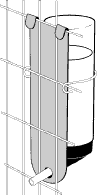
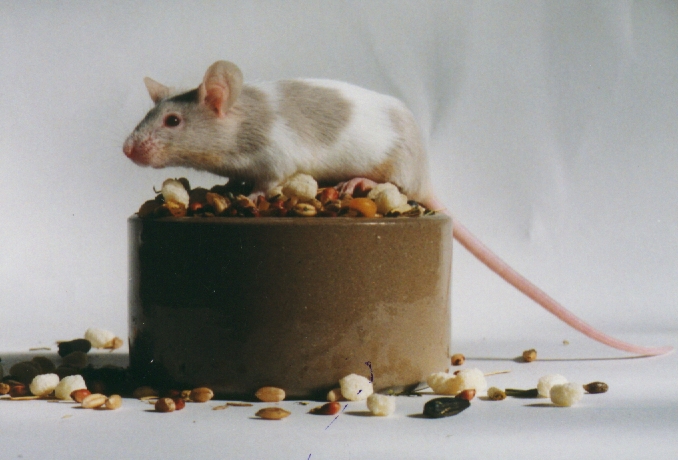
Most important equipment are food bowl and water bottle. Make sure, that the water battle you buy actually works. There are huge differences between bottles from the same manufacturer. Some can't hold water at all, while some don't let any water out no matter how hard to poor mouse tries to drink. For a food bowl a ceramic cup will do, these are available from pet shops. There are also cheaper alternatives - small glass baby food jars as well as cheap tiny coffee cups suit well. Some mice think it's great fun to throw all the food out of the bowl and use the bowl as a toilet. In this occasion you will have to wash the bowl carefully every single day before feeding your mice. If your mouse is one of those who don't care to throw the food out before using the bowl as a toilet, it is better to put the food directly on the beddings. Plastic bowls get chewed up quickly, so they are not as good an alternative.
|
|
Mice need a box or house for a nest and preferably a wheel to run in. You can use your imagination with the nest box, as long as you remember that plastic parts are not safe, the mouse toys should not have sharp edges and of course there should not be anything poisonous in them (paint, for example). There are several different alternatives available in pet shops; wooden, ceramic and plastic. The problem with wooden nest is that the mouse urine will soak in it and therefore you should wash a wooden nest often. Ceramic nests are expensive, but they do last a lifetime - and not just your mouse's lifetime! Plastic ones can collect humidity inside the nest and mice tend to chew holes in them. Splinters of plastic are not healthy for mice if they happen to swallow them. You can construct a mouse nest yourself as well. Earthenware flower pots make great nests and the mice love them. Make a little hole in the side of a flower pot and turn the pot upside down. Be careful when making the hole, as the pots go easily into little pieces. Empty shell of a coconut is a good and fun nest too, especially if you hang it from the ceiling of the cage / tank.
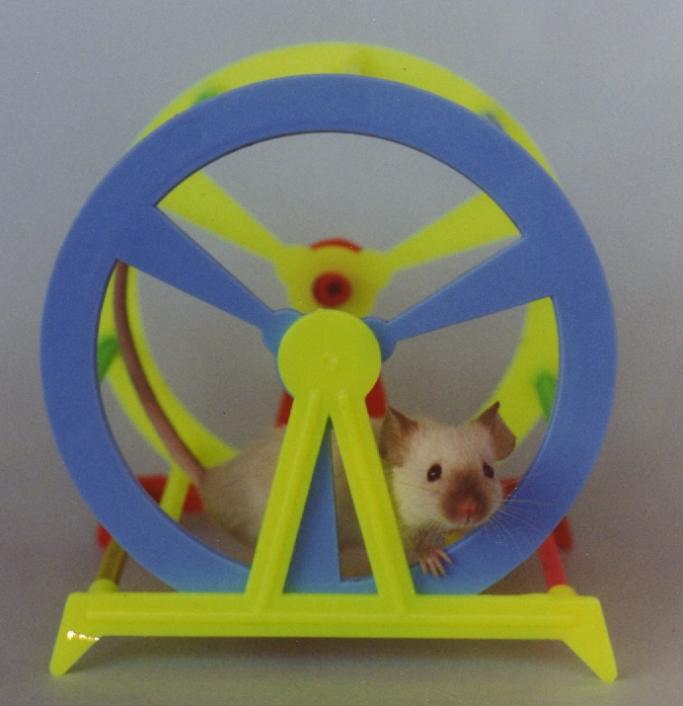
The wheel has to be a safety wheel. The wheel shouldn't have bars, spaces or holes on the running area. The wheel should stand on a "leg" attached to one side only so that the mouse's tail won't get squeezed. There are plastic as well as metal wheels available and both do fine. Metal ones tend to get rusty after a while and they tend to make more noise. There are also wheels that are attached straight to the wall of a cage. The wheel must be large enough, surprisingly large. This is important, as the mouse's tail can get permanently curved over its back if the wheel is too small. Proper size for a wheel is one where the mouse can run without its back curving too much. With a group of mice you need a large wheel, as mice love to run together with other mice.
Mice enjoy these not only for sleeping quarters, but also for larders to hide their stash. There are plastic cubby houses available, which are known as Hamster Igloos. The smaller types are suitable for mice and they split in half lengthwise and therefore easy to clean, although they are prone to being chewed and will eventually be destroyed.
There are cane cubby houses which are available from the NSWFRMC, these might be sold in pet stores as bird nests. These are fairly quickly chewed by mice, which will provide entertainment in itself. A down side to these types of houses is that they are difficult to clean.
Bird breeding boxes can also be a good cubby house for a mouse. These are fairly resistant to chewing but the main disadvantage is that they will be eventually stained by urine. The main advantage of this type of house is that they usually have a flip top lid for easy access to pets and are easily cleaned.
Another type of house that may be found in the bird section is coconut nests. There are two types of these - one is the husk which actually surround the coconut. This usually has a hole at one end and a segment which is removable to look inside. The second one is the hard coconut shell itself. This type usually have a single entry hole drilled into the coconut and the flesh has been removed. The husk type nest is prone to be chewed and may eventually become smelly. It is most suitable for rats. The coconut shell is quite small and is suitable for mice. This nest is quite resistant to chewing and fairly easy to clean.
There are also many types of homemade cubby houses available and these can often work out quite cheep which is good when you are replacing them regularly. The first most obvious homemade cubby house is a cardboard box. These can be boxes you find, tissue boxes (remove the plastic flaps), cereal boxes, boxes from packaging of toys, etc. None of these last very long. Generally they are chewed or get smelly very quickly.
Plastic screw-top jars can also make good cubby houses. They are easy to clean and can be attached to the side of a cage. Make two screw holes in the lid. With the top of the lid facing to the outside of the cage, screw the lid to a small piece of wood. The wood should be on the outside of the cage, the lid on the inside. Cut a hole in the bottom of the jar. Screw the jar to it's lid. The animals enter through the hole in the bottom of the jar. The jar needs only to be unscrewed and it can be cleaned and washed.
Commercial tubing can be bought at a hardware store. PVC pipe is very strong and easy to clean and is available in a wide range of diameters from 5cm for mice. Corners can be made by buying elbow fittings. Ends can be bought to seal up the pipe. PVC piping is not flexible. Flexible tubing can be bought in the form of Ag-pipe from the hardware store. The disadvantage is that it must be usually bought in long lengths. It is usually black and has small holes along its length. Flexable tubing for mice can be made from vacuum cleaner hose.
Commercial tubing made from cardboard is also easy to find/buy. Postpak tubes from your local post office. The cardboard rolls from carpet can form tubing for your mice. You can ask your local floor covering store. The disadvantage with cardboard , is that it starts smelling from urine and the animals love to chew it. You will have to replace it regularly.
You may find that you have tubing from things such as toilet paper and ching wrap at home, these are suitable for your mice. You may consider taping some together, or cutting holes in the sides to form mazes.
Mice love to have lots of toys around. All kinds of tubes and ladders are very popular among mice. Ordinary toilet paper rolls are more than suitable for mice. Biscuit and other small cardboard boxes are very suitable for mouse toys. You can attach several small boxes together and hide them under the beddings. Don't use glue, adhesive tape or metal to attach the boxes together, your mouse might hurt itself. Just make a hole on the side of the box and stick a slightly smaller box a bit through that hole to attach the boxes together. Mice will also chew on the boxes and make more and more little doors in them until the whole box is one big hole! Always remember to remove all plastic parts from the boxes.
Ladders can be bought ready made or you can make them yourself. Non poisonous branch of tree (willow, for example) from unpolluted area is also a nice toy to climb on.
That mousy smell (and mice do smell, at least to a non mouse fan's nose) can be diminished by giving the mouse / mice glass jars. Take a jar, jam jar for example and wash it thoroughly. Place the jar on one side and put a little amount of bedding in it. Mice use this kind of glass jar as a toilet. The jar is very easy to clean up daily. Mice can also learn to use a litter box, that is a small box with kitty litter in.