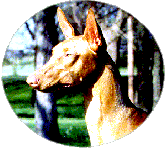
 Breed Information
Breed Information
Breed Information | The Pharaoh Hound is one of the oldest domesticated dog breeds in recorded
history, tracing it's lineage to roughly 3000 B.C. Through the paintings
and hieroglyphics of the Ancient Egyptians, we have learned that this
unique dog was treasured as a great hunter, protector and companion, and
was a favorite hound of the young King Tutankhamen. The Pharaoh Hound was
described in a translation of a letter from the XIX Dynasty of Egypt: "The
red, long-tailed dog goes at night into the stall of the hills, he is
better than the long faced dog. He makes no delay in hunting, his face
glows like a god and he delights to do his work." Even today the Pharaoh
Hound will glow or "blush", it's nose and ears turning a bright rosy hue,
when excited or happy.
The Pharaoh Hound is a sort of canine fossil, a living Egyptological survival. It is believed that Phoenician traders carried the Pharaoh Hound from Egypt to the islands of Malta and Gozo well before the birth of Christ. Once established, these hounds were cut off from the outside world, and thus maintained a purity of breed type for over 2000 years. The Pharaoh Hound was and is highly prized as a hunting dog on the islands, and is known there as "Kelb-tal-Fenek" or the Rabbit Dog. The breed itself was probably developed by careful selection and cross-breeding, a practice which began in very early times: the ancient Egyptians were skilful stockmen. The dog which was the familiar companion of the Kings of Egypt was probably the product of well-matched stock from the gentle-eyed feral dogs (canis familiaris), which can still be found in Upper Egypt, and the small Egyptian or golden jackal, producing a cross-breed called, by one Egyptological authority, canis lupaster domesticus. Of this type the very ancient god Wepwawet, a predecessor of Anubis, is the most familar example.
The dogs probable descent from the jackal is suggested by several factors: its distinctive
red-gold colour, its capacity as a scavenger, and its very curious practice of 'calling'.
This seems to be another jackal inheritance, for in the close family unitys of the
animals in the wild, jackal parents will always recognize and respond to the call of
one of their pups.
Pharaoh Hounds were first imported to England sometime between 1920 and 1930, but did not become established there until the mid 60's. They were imported to the U.S. from England in 1967, and became established here during the 70's. The Pharaoh Hound was accepted into the Hound Group by the American Kennel Club in 1984. General AppearanceThe Pharaoh Hound gives a striking impression of elegance, power, and grace. A medium sized dog, they should range from 21 to 25 inches at the shoulder, and weight 40 to 60 pounds.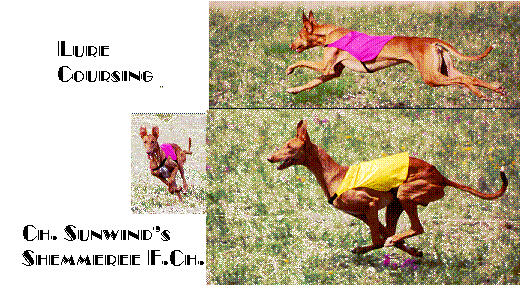
The ears should be large and erect, with a broad base, and are mobile like those of a horse. A Pharaoh with ears which will not stand ("soft ears") should not be used for breeding. The eyes are amber colored and oval in shape. The head is elegant, the neck long and slightly arched, and the body is graceful and powerful. The tail is long, whiplike, and carried in a high upward curve when the dog is moving. The coat is short and glossy, and may range in color from tan to dark chestnut. A white tip on the tail is strongly desired, but not required. Small amounts of white are allowed on the chest and toes, and a slim white snip is allowed on the center of the face. Any solid white spot on the neck, shoulder, or any part of the back is a disqualification for showing and breeding purposes. The nose, eye rims and lips are flesh colored to blend with the coat. The Pharaoh Hound as a CompanionThe Pharaoh Hound is an intelligent, playful, and attractive companion. Their character is gentle, affectionate and in the household, biddable. Their short coats make them enjoyable as housepets, as does their lack of "doggie odor" ...even when wet. They are particularly fond of children, and seem to never tire of romping and playing since they love human attention. While at play, many Pharaohs have an amusing habit of "smiling", showing off their pearly teeth in a mock snarl to display their delight with you or themselves. That Pharaoh is an excellent watchdog, possessing keen eyesight and acute hearing, and barking upon the approach of strangers. Their great speed, alertness, and agility make them able hunters.Do not, however, be misled into the belief that the Pharaoh Hound is for everyone. Temperamentally they tend to be rather independent, and are often described as being catlike. In the work for which they were bred, they had to think for themselves, and the Pharaoh of today seems unwilling to give this up. Because of this, the Pharaoh can be cautious when faced with new situations or people. To the outsider, they may appear suspicious or a bit timid, but they are quite devoted to their masters. The same alertness which makes the Pharaoh Hound an excellent hunter and watchdog can sometimes cause problems with unwanted barking. Plenty of exercise, toys and attention can help keep barking to a minimum. A secure fenced yard is a must for proper exercise, and care must be taken to prevent the Pharaoh from sneaking off to go hunting on his own. If you would enjoy a dog which prefers to be NEAR you, but not ON you, and has an exotic and regal appearance with a spirited and playful personality, the Pharaoh Hound could be for you. Buying a Pharaoh HoundPuppies are best purchased from a reputable breeder and should not be taken from home prior to eight weeks of age. To allow for pack socialization some breeders prefer to wait till 12 weeks of age. A reputable breeder usually belongs to a local or national dog club, and follows the code of ethics set forth by the club. They should be happy to allow you to see the sire and dam of the litter when possible, and allow you to inspect their facilities.It should be noted that the Pharaoh Hound is born with blue eyes which change from green to amber. Pharaoh eyes and coat color darken with age. They are born with flop ears, but the ears generally stand up by themselves by 16 weeks of age, requiring no cropping, bracing, or other assistance. Dewclaws are usually removed. Questions to AskDO NOT BE MISLEAD! A seller who promises "papers" later or asks you to pay extra for them is being dishonest. If the breeder cannot provide the registration application, insist upon a signed sales contract which identifies your dog (breed, color, sex, markings), and gives his birth date, the full names and registration numbers of the sire and dam, and the name of the breeder. If the seller refuses, DO NOT buy the puppy.Pharaoh Hound Club of America (PHCA)PHCA motto: "..a great responsibility..to keep faith with 5,000 years of true breeding..they must shun man's natural tendency to 'improve' which so often in dog breeding terms means to alter out of recognition."PHCA Club Objectives: Official AKC recognized Parent Club of the Pharaoh Hound Breed in the United States. This club is governed by the Board of Directors of the PHCA which includes nine members from which officers of the club are filled. The PHCA holds one National Specialty a year and supports Regional Lure Coursing and Bench events. The PHCA Corresponding Secretary is the contact for Breed Information to the general public and interested judges of the Pharaoh Hound breed. Corresponding Secretary to the PHCA is: Rita Sacks (904)357-8723. Pharaoh Hound Appreciation Society of TexasThe Pharaoh Hound Appreciation Society of Texas' purpose: To encourage members, breeders and owners to protect and advance the interests of the breed by promoting sportsmanlike conduct, acceptance of the AKC Breed Standard as the standard against which all Pharaoh Hounds should be judged, ethical breeding practices, and the humane treatment of all animals. To support and promote competitions for Pharaoh Hounds at shows and field events, and to educate the public about this rare and unusual breed.Regular meetings are held of the second Thursday of February, April, June, August, October and December. Guests are welcomed at these meetings. Secretary PHAST is: Gordon Davis, (903)536-2115 voice/FAX |
This page hosted by  Get your own Free Home Page