
KB-3 Jadran
After WW2 Slovenia was still part of Jugoslavia with it's 1000 km (620 mi) of sea shore that rises steeply to over 1500 m (5000 ft) high peaks. Sun, water, maestral wind and steep slopes give beautiful soaring conditions. But rocky Karst ground does not allow for off field landings. The only safe possibility would be to land on water. So the work was started the main trouble being lack of data about
hull design. And when that problem was solved it was necessary to design
wing float retract mechanism. In seven months the plans were finished
and the plane was built. |
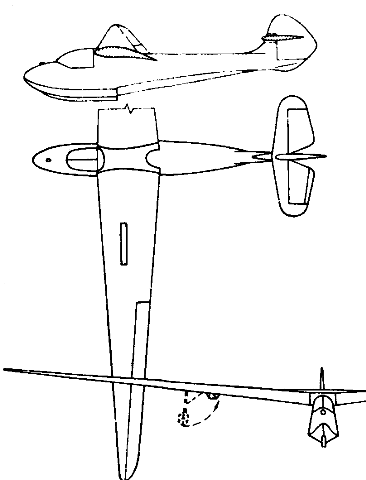
First there was a floating test on Ljubljanica river. When this test was passed with flying colours the first flight took place at Lesce airfield and shortly afterwards the first water landing was performed on nearby lake Bled. And water landings were very good indeed - landing speeds of up to 120 km/h (65 kt) were tried with no problems whatsoever. In summer the plane was taken to the Adriatic sea. There it was towed into the air by an Aero-2h water plane and showed excellent results in thermal flying over Velebit and Osor mountains. In 1950 Nationals in Ruma it even managed cross country flight of 270 km (168 mi). Wing design is equal to that of the KB-1 Triglav with flaps
omitted. A retractable float is built in each side of the wing, in
retracted position half of the float it sticking out of the wing. Air
brakes are of DFS type and are highly effective. Plywood covered
fuselage has a hydrodinamically formed hull with reinforced sides and
bottom. The skid is protected against salt water. The towhook is
situated on top of the fuselage in front of cockpit. The cockpit has
lots of room with the air brake lever and trimmer wheel being mounted on
the left side and below them is the handle of the air pump for operating
wing floats. It took five movements of the handle to extend or retract
the floats. There is a paddle mounted on the cockpit side - to be used
in case of emergency. |
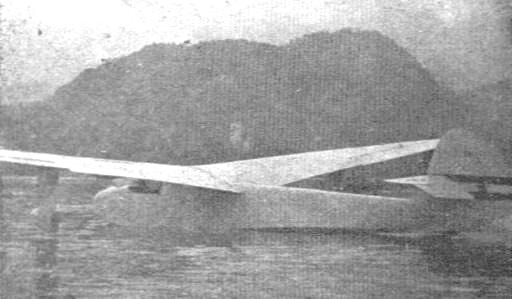
Wooden tail surfaces are covered with plywood and fabric. The horizontal stabiliser is mounted at the top of the vertical stab to ensure adequate distance from water. The plane was very stable beacuse of it's low center of gravity and it was easy to fly, even for unexperienced pilots. But it was mobile enough to defy rough air. A total of six KB-3 Jadran's were built. |
| Data | Production aircraft |
|---|---|
| Wing span | 15.00 m (49 ft 2 1/2 in) |
| Length | 7.00 m (22 ft 11 1/2 in) |
| Wing area | 13.32 m2 (143.2 sq ft) |
| Aspect ratio | 17 |
| Dihedral | 4.50o |
| Wing section | Goettingen 549-16%, M-6 |
| Empty weight | 195.00 kg (430 lbs) |
| Max weight | 280.00 kg (617 lbs) |
| Wing loading | 21.1 kg/m2 (4.32 lb/sq ft) |
| Best glide ratio | 25 at 70 km/h (38 kt) |
| Min sinking speed | 0.75 m/sec at 63 km/h (2.5 ft/sec at 34 kt) |
