|
|
FLIGHT PAY The 1999 National Defense Authorization Act (NDAA) was signed by the President on 17 Oct 98. The Act made changes to Aviation Career Incentive Pay (ACIP) and approved the 1999 Aviation Continuation Pay (ACP) Program. Two changes were made to ACIP: Change 1 – The flight pay increase to $840 at the "over 14" point is effective for all eligible officers and warrant officer as of 17 Oct 98. If you have completed 14 years of aviation service, expect to see the raise in your EOM November paycheck. Your Nov check should include a partial payment for Oct. Change 2 – Years of Total Federal Officer Service (TFOS) was changed to aviation service. This change means that officers who meet the 18 year gate are entitled to receive flight pay for a longer period of time. There are several officers whose flight pay entitlement stopped when they reached 22 years TFOS. If you are one of these officers and you have not reached 22 years aviation service you are once again entitled to receive flight pay. Your entitlement started again effective 17 Oct and will continue at the rate of $840 a month until you reach 22 years aviation service. You should see this entitlement in your November paycheck along with the amount due for 17-31 Oct (approx $406). The updated pay chart is depicted below:
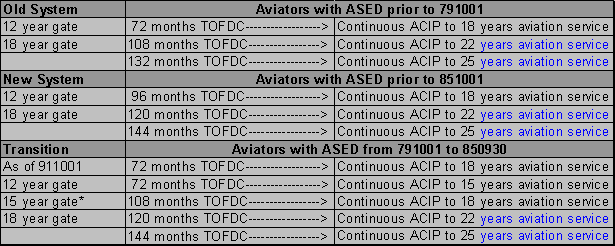
Aviation Continuation Pay The Army’s FY99 ACP program was approved by the Assistant Secretary of Defense on 30 Sep and signed into law on 17 Oct 98. The program will be offered to all AH-64 Warrant Officers between their 6th and 13th years of aviation service who meet the criteria for the program. Eligible pilots who agree to remain on active duty and serve until 14 years of commissioned service will be paid $12,000 lump sum per year until their 14th year of commissioned service. A message announcing the details of the program will be released by mid November and offers will be sent to the commanders of all eligible warrant officers by 31 December. Eligible officers who sign the agreement to remain on active duty until their 14th year of commissioned service will receive the bonus effective 17 Oct 98 if they were eligible on that date or on their date of eligibility if eligible after 17 Oct 98. Gate Criteria for Continuous ACIP Gate criteria for continuous ACIP has not changed. It is still very important for all aviators to know what "system" or category they fall under to determine their eligibility for continuous flight pay. The table below shows these categories:
NOTE: Transition 15-year gate applies only to aviators who have less than 72 months as of 1 Nov 91. For officers, flight pay begins to decrease at the 22nd year of aviation service. The Financial Management Regulation (DoD Pay Manual) defines officer service as all active and inactive service as a commissioned, warrant or flight officer. Flight pay continues to decrease at the 23rd and 24th year and stops at 25 years of aviation service. The ACIP entitlement is continuous to 22 years of aviation service only if the 12th, 15th and 18th-year gates, as appropriate, are met. At 22 years aviation service, pay is continuous to 25 years only if 132 and 144 months of total operational flying duty credit (TOFDC), as appropriate, are met. For an aviator to accumulate TOFDC, he must (1) be in aviation service, (2) assigned to a position coded for operational flying on a unit MTOE or TDA, and (3) meet all flying requirements. Extended TDYs more than 90 days and PCSs to non-operational flying duty positions will cause the TOFDC credit to be turned off. Aviators who are concerned about their TOFDC should request an audit, in writing, through their assignment officers. Continuous ACIP ceases after 25 years of aviation service, except for warrant officers. Officers (other than warrant officers) below pay grade O-7 with more than 25 years of officer service who are qualified for aviation service and required by legal orders to perform operational flying duties are entitled to monthly (conditional) ACIP. TOFDC Waivers: Prerequisites for a waiver include completion of no less than 72 months of TOFDC by the twelfth year of aviation service and submission of the request for waiver no earlier than 12 months prior to the loss of ACIP. Officers who have received an approved waiver are not eligible to receive continuous ACIP to 25 years of aviation service. "Needs of the service" assignments, for ACIP waiver purposes, are defined as:
(2) Army education requirements board schooling and utilization tour. (3) USAREC/ROTC/USMA cadre assignments. (4) Aviation officer positions (coded 15 or 67J) on the table of distribution and allowance of the ARSTAF in the National Capital Region or MACOM headquarters without assigned aircraft. (5) Medical disqualification, but subsequently enabled to requalify for aviation service. ACIP waivers are submitted through command channels to U.S. Total Army Personnel Command (PERSCOM), ATTN: TAPC-OPE-V (officers), TAPC-OPW-AV (warrant officers), TAPC-OPH-MS (medical service corps officers), or TAPC-OPB-E (acquisition corps officers) as appropriate, for verification of the waiver criteria. PERSCOM forwards favorably considered requests to HQDA, ATTN: DAPC-PRP-CA. Final approval authority is the Secretary of the Army. Aeromedical Waivers and Permanent Disqualification: A June 95 HQDA message, entitled "Notice of Change to AR 600-105, Regarding Temporary Medical Incapacitation," changed the regulation to afford the aviator every opportunity to regain flying status before permanent disqualification. The message stated that effective 15 Dec 94, aviation officers medically incapacitated will be considered qualified for aviation service unless such incapacitation continues for more than 12 months. The message also says: "Disqualification for aviation service by reason of medical incapacity is effective on the first day following a period of 365 days that coincide with the date of incapacitation, or on the date a competent medical authority determines the medical incapacitation to be permanent," whichever is earlier. Based on that language, the previous policy of continuing ACIP for 180 days after permanent disqualification no longer applies. When an aviator is medically terminated from aviation service, the following actions occur: (1) Termination of continuous or monthly ACIP. (2) Termination of authority to pilot Army aircraft (to include SFTS). (3) Change in PSC from PSC-1 to PSC-2 termination of flying duty credit toward meeting the 12-, 15-, or 18-year gate. (4) Termination of time creditable toward award of a senior or master aviator rating. Medically disqualified officers may be evaluated by a flight surgeon for consideration of requalification with or without an aeromedical waiver. If U.S. Army Aeromedical Center concurs, a recommendation requesting requalification for aviation service will be forwarded to PERSCOM (TAPC-PLP-A and TAPC-OPH-MC) for approval. This information should provide aviators answers to many questions they might have concerning AR 600-105. Questions concerning the Aviation Act or DA waiver policy should be addressed to LTC Owen, Aviation PERSSO, ODCSPER, DAPE-PRP-CA, DSN: 227-5864, COML: (703) 697-5864 or MAJ McClelland, PERSCOM (TAPC-PLP-I) at DSN: 221-5098 or COML: (703) 325-5098. More information about flight pay and waivers can be found in AR 600-105. |