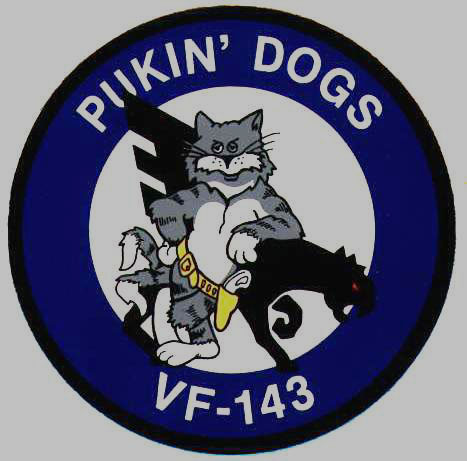
 Squadron History
- The History of the VF-143 World Famous
Pukin’ Dogs.
- The world Famous Pukin’ Dogs were
originally commissioned in 1949 as VF-871, a reserve squadron, and were known
as the “Griffins.” From their home at NAS Alameda, the Griffins were
called to active duty on 20 July, 1950. The squadron took the F4U-4 Corsair to
war in Korea from the decks of the USS PRINCETON (CV 37) in early 1951 and the
USS ESSEX (CVA 9) in 1952. During the next eleven years, the squadron changed
aircraft and designations twice; designated as VF-123, flying both the F9F-2
Panther and F9F-8 Cougar, and then as VF-53, flying the F3H-2 Demon. On 20
June, 1962, the squadron was redesignated VF-143 and transitioned to the F4H-1
Phantom II ( later redesignated the F-4B). VF-143 first went to sea aboard USS
CONSTELLATION in February 1963, for a WESTPAC cruise. Operating as part of
CVW-14, the following year, the squadron became involved in the Gulf of Tonkin
incident and flew in the Pierce Arrow attacks on North Vietnamese naval
facilities on 5 August 1964. In the succeeding years, the Pukin’ Dogs
moved on to the F-4J and recorded seven combat deployments to Vietnam. The
squadron, stationed at NAS Mirimar, CA, flew massive air strikes and Combat Air
Patrol (CAP) missions before trading in their Phantoms for Tomcats.
- On April 1, 1975, after completion of F-14A
Tomcat transition training, the Pukin’ Dogs permanently moved to their
present home at NAS Oceana, VA. As part of CVW-6, VF-143 made its first F-14
carrier deployment aboard USS AMERICA from 15 April to 25 October 1976. During
this Mediterranean deployment, the squadron participated in “Operation
Fluid Drive”, providing CAP for the evacuation of American citizens from
Beirut in 1976. After a subsequent south Atlantic cruise (10 June to 19 July
1977) and Mediterranean cruise (29 September 1977 to 25 April 1978), the
Pukin’ Dogs moved on to a new carrier and airwing.
- In the fall of 1978, VF-143 joined USS DWIGHT D.
EISENHOWER (CVN 69) and Carrier Air Wing SEVEN. In 1979, they made IKE’s
first major deployment to the Mediterranean Sea from 16 January to 13 July.
VF-143 and the IKE spent 152 days continuously at sea after replacing USS
NIMITZ during the 1980 cruise. The squadron then made a brief Norlant cruise,
between 17 August and 7 October, and participated in NATO’s Exercise Ocean
Adventure. During the following 1982 Mediterranean deployment, the Pukin’
Dogs, with three Tactical Air Reconnaissance Pod System (TARPS) equipped
aircraft, once again provided CAP for the evacuation of American citizens from
war-torn Beirut in June of that year.
- During the 1983 MED deployment, VF-143 TARPS
played a vital role in providing the Multinational Peacekeeping Forces in
Lebanon with invaluable intelligence of enemy troop movements and artillery
positions in the mountains outside of Beirut. The Dogs completed 45 combat
TARPS missions over Lebanon. VF-143 then made two Caribbean and Norlant cruises
before returning to the IKE and the MED on 11 October 1984 where they again
found themselves involved in a worsening Lebanon situation. After a lengthy
break from sea operations, VF-143 returned to the IKE for a MED cruise from 29
February to 29 August of 1988. In 1989, the Dogs made the transition to the
Navy’s newest Tomcat, the F-14B, with the new GE F110-400 series engines
capable of producing up to 30,000 pounds of thrust each.
- The Pukin’ Dogs found 1990 to be a highly
successful year as they won the FFARP trophy for the second consecutive year
and achieved the highest score in FFARP history. VF-143 also won the Tactical
Reconnaissance (TACRECCE) trophy, an unprecedented dual victory in the same
year. The squadron was also nominated for the Navy’s 1990 Arleigh Burke
Award and the 1990 Department of Defense Phoenix Award for aviation
maintenance.
- The successes of 1990 became more evident in
early 1991 when VF-143 was awarded COMNAVAIRLANT’s 1990 Battle
“E” as the Atlantic Fleet’s finest fighter squadron. In
addition, the Pukin’ Dogs were awarded the Chief of Naval Operations Rear
Admiral Joseph C. Clifton Award which designated VF-143 the Navy’s finest
fighter squadron. Making history in May 1991, during the Air Wing’s second
detachment to NAS Fallon, NV, the Dogs became the first fleet Tomcat squadron
to drop live air-to-ground ordinance. In September, the squadron deployed to
the Arabian Gulf in Support of Operation Desert Storm where new standards were
set in joint operations between the Navy, Air Force, and numerous coalition air
forces.
- The Pukin’ Dogs returned to the Gulf in
October of 1991. The cruise took them into the North Atlantic and Norwegian Sea
where NATO forces and the IKE Battle Group teamed up above the Arctic Circle
for cold weather operations during “TEAMWORK 92”
- In August 1992, the Pukin’ Dogs and the
rest of Carrier Air Wing SEVEN were reassigned to the USS GEORGE WASHINGTON
(CVN 73), the Navy’s newest aircraft carrier. VF-143 deployed on the GW on
her maiden “shakedown” cruise, and then again for her very first
Mediterranean deployment in May 1994, where she took part in the 50th
anniversary commemoration of the D-Day invasion and Operation Deny Flight. This
cruise was highlighted by the stellar performance of the squadron in both
Bosnia-Herzegovina and the Arabian Gulf, particularly for the crucial TARPS
imagery it provided.
- In December 1995, the World Famous Pukin’
Dogs completed their turnaround training cycle and departed on their second
cruise in fifteen months. The preparation quickly paid off as the Dogs found
themselves flying over Bosnia in support of Operation Decisive Endeavor and the
Arabian Gulf in support of Operation Southern Watch. Carrier Air Wing SEVEN
relied heavily on the Pukin’ Dogs to fill every role providing aircraft
and personnel for TARPS, FAC(A), air superiority, and air-to-ground missions.
Additionally, the Pukin’ Dogs participated in joint exercises with the
Netherlands, Spain, France, Bahrain, and Saudi Arabia. The Pukin’ Dogs
returned to Oceana in July 1996, having flown over 1400 missions while enjoying
an unprecedented 99.3% sortie completion rate. These extraordinary successes
are a tribute to the professionalism and pride of all Pukin’ Dog
personnel.
- The Pukin’ Dogs recently returned from the
maiden deployment of the USS JOHN C. STENNIS (CVN 74). Over 131 days were spent
in the Arabian Gulf in support of Operation Southern Watch. VF-143 played key
roles using LANTIRN, night vision goggles, and digital TARPS.
 Back to the Homepage!
This page hosted by  Get your own Free
Homepage
Get your own Free
Homepage