Lesson Objectives
502.1 Comprehend the relationship between the Department of
State (DoS) and the Department of Defense (DoD) within a country
during war and conflict resolution.
502.11 Explain the ambassador's relationship with the country
team.
(From Cady: The Country Team) To handle the foreign relations of the US, the DoS is divided into regional and functional bureaus.1 The six regional bureaus oversee the embassies that fall within their jurisdiction. Within the bureaucratic scheme, the regional bureaus enjoy relatively more power than the functional bureaus, which serve the whole department through their issue-specific taskings. Issues such as narcotics, human rights, and international economics, among others, occupy the functional bureaus.
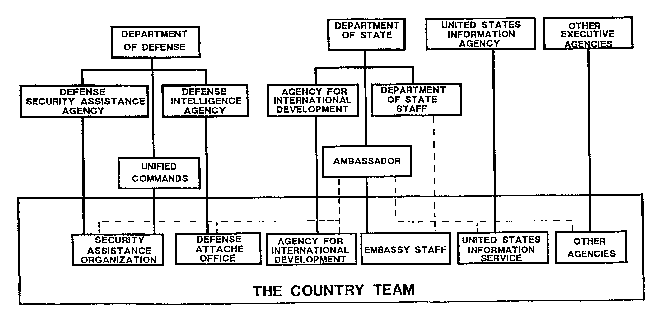
The primary interface between the DoS and
the DoD occurs in the country team, an interdepartmental group
that serves as a conduit for joint action. Depending on the situation
in the country, the country team can take many forms.2 The
ambassador determines the composition that best fits his or her
needs. Typically, the country team will include the ambassador
or chief of mission, who is either a career foreign service officer
or a political appointee; the deputy chief of mission, who functions
as a chief of staff; the political counselor, who heads a section
devoted to assessing political and social trends within the country;
and the economic counselor, who handles trade issues as well as
issues dealing with the general economy.
502.12 Identify the differing perspectives of the DoS and
the DoD during war and conflict resolution.
(From Cady: The Country Team) During war, the country team will have probably departed the area of battle. More often than not, US nationals will also have departed. The combatant CINC will have primary responsibility for all US activities in the area. This does not mean that the usefulness of the country team has expired.
If the team departs, it leaves with a great amount of information.
The country team, if it was operating successfully, was America's
corporate eyes and ears. The CINC and his staff must make every
effort to continue the process of coordination with the ambassador
and his country team, irrespective of its location or locations.
In conflict resolution the DOS representative is in charge.
502.13 Explain the different areas of responsibility for
each department within a given country.
(From Cady: The Country Team)
The Ambassador or Chief of Mission-He or she may be either a career foreign service officer (FSO) or a political appointee and is appointed by the President with the advice and consent of the Senate.
Representing the Department of State
The Deputy Chief of Mission (DCM)-Always a middle grade to senior foreign service officer (FSO), he or she is the formal second in command and usually has the diplomatic title of "minister" or "minister-counselor." As "charge d'affaires, ad interim," he directs the mission in the ambassador's temporary absence from the country and between ambassadorial tenures, and is the only officer other than the ambassador with mission-wide responsibilities. The DCM functions as a chief of staff, managing all the day-to-day operations of the embassy on the ambassador's behalf and according to his guidance
The Political Counselor-Also a FSO, he or she supervises the activities of the political section. This section is concerned with virtually all facets of the host country's foreign and domestic affairs, especially as they relate to its relations to the US and the achievement of US foreign policy goals and objectives.
The political section's core responsibilities are to monitor, interpret, and report to Washington on significant political and social events and trends in the host country, and to enunciate, explain, and seek host government support for US foreign policy goals and initiatives.
Representing the Department of Commerce
The Chief of the Commercial Section-The commercial counselor or commercial attaché. Staffed by the department of commerce's foreign commercial service (FCS), the commercial section represents US business and commercial interests in the host country. Specializing in US export promotion and investment facilitation, the FCS assists the US private sector by arranging appointments with local businessmen and government officials, providing information and advice on local trade regulations, laws and customs, and identifying potential importers, buyers, agents, distributors, and joint venture partners for US firms.
Representing the Department of Defense
The Defense Attaché (USDAO)-The senior ranking service attaché at the mission, he or she represents the Chairman, Joint Chiefs of Staff but reports to and is directly supervised by the Defense Intelligence Agency (DIA), a component of the DoD. His or her primary responsibility is to collect and report to DIA significant information concerning the host country's military capabilities and intentions-leadership, command structure, weapons systems, order of battle, etc. The defense attaché is a member of the ambassador's staff and functions as his chief military advisor, and is also expected to support overall DoD objectives, including security assistance programs and other interagency activities.
Representing the United States Agency for International Development
The United States Agency for International Development (USAID) Mission Director-The director carries out assistance programs designed to help the people and institutions of developing countries advance their productive capacities, improve the quality of life, and promote sustainable economic growth accompanied by stable, democratic governance. The Foreign Assistance Act of 1961 authorized USAID to administer, normally on a bilateral basis, two basic types of foreign assistance: Development Assistance (DA), which must be justified on development grounds, and Economic Support Funds (ESF), whose allocation is more politically determined. USAID, through its Office of Foreign Disaster Relief Assistance (OFDA), also conducts humanitarian natural disaster relief activities.
Representing the United States Information Agency
The Counselor for Public Affairs, or the Country Public Affairs Officer-As chief of the local United States Information Service office, the public affairs officer (PAO) is responsible for the US Government's overseas information and cultural programs. He or she serves as director of the American Cultural Center or Binational Center (if one exists), and his or her staff fulfills press liaison, informational, educational, and cultural exchange functions.
The PAO's purpose is to strengthen foreign understanding of and support for US policies and actions, particularly among key host-government officials and influential media and private sector opinion makers.
Representing the United States Agency for International Development
The United States Agency for International Development (USAID) Mission Director-The director carries out assistance programs designed to help the people and institutions of developing countries advance their productive capacities, improve the quality of life, and promote sustainable economic growth accompanied by stable, democratic governance. The Foreign Assistance Act of 1961 authorized USAID to administer, normally on a bilateral basis, two basic types of foreign assistance: Development Assistance (DA), which must be justified on development grounds, and Economic Support Funds (ESF), whose allocation is more politically determined. USAID, through its Office of Foreign Disaster Relief Assistance (OFDA), also conducts humanitarian natural disaster relief activities.
Representing the Central Intelligence Agency
The Central Intelligence Agency (CIA) Chief
of Station-The chief is the senior CIA representative
in country. He or she is under the direction of the President,
the NSC, and the Director of Central Intelligence (DCI) and is
responsible for the gathering and evaluating of foreign intelligence
information vital to the security of the US. At the Washington
DC level, the DCI is also charged with coordinating the work of
the entire intelligence community, including the National Security
Agency and the Defense Intelligence Agency, in the collection,
production, and dissemination of foreign intelligence and counterintelligence
information.
502.14 Describe the interaction between the DoS and the
DoD when the ambassador's team re-enters the country in a post-hostilities
environment.
During war, the country team will have probably departed the
area of battle. More often than not, US nationals will also have
departed. The combatant CINC will have primary responsibility
for all US activities in the area. The key DoS role will be to
negotiate local arrangements as required at the time and within
the framework of presidential and cabinet decisions. The point
here is that the US military commander must take the initiative
early to avail himself of the advice and support of US diplomatic
missions concerned or depend upon the closest POLAD for advice
and assistance just as he would rely upon the other members of
the combined or joint headquarters staff. War is part of politics;
it cannot be waged effectively and terminated appropriately without
the involvement of political professionals. The country team will
certainly be part of this coordination process.
502.2 Comprehend the organizational framework within which
joint forces are employed. [I.1(b)]
502.21 Explain the organizational framework within which
joint forces are employed during war and conflict resolution.
The organization of a multinational force is up to negotiations
by the DoS in consultation with the CINC.
502.3 Comprehend the purpose, roles, functions, and relationships
of the National Command Authorities (NCA), National Security Council
(NSC), Chairman of the Joint Chiefs of Staff, Combatant Commanders,
Service Chiefs, and Joint Force Commanders (JFC)s. [I.1(c)]
502.31 Summarize the responsibilities of the Department
of State and the Department Of Defense.
(From Cady: The Country Team) At the national level, the National Security Council (NSC), the DoS, and the DoD comprise our national security structure. The Department of State's primary objective in the conduct of foreign relations is promotion of the long-range security and well-being of the United States. This department advises the President in the formulation and execution of foreign policy. The Secretary of State, the President's principal foreign policy advisor, is responsible for the overall direction, coordination, and supervision of US foreign relations and for the interdepartmental activities of the US Government overseas.
At the Department of Defense, the office of the Assistant Secretary
for International Security Policy (ISP) is responsible for the
military and defense-related aspects of foreign policy in Europe
only, while the office of the Assistant Secretary for International
Security Affairs (ISA), sometimes known as the Pentagon's "little
state department", is organized by geographic regions to
cover military security policy for the rest of the world.
502.32 Explain the duties of the DoS negotiator.
502.33 Explain the role of the CINC in negotiations.
(Form Maxwell: The Department of State and the Role of Negotiations) The CINC is the DoD official responsible for conducting the military operations. He has a political advisor (POL-AD) from the State Department on his staff. The POL-AD advises the CINC in courses of action, and coordinates on potential war plans. There are only five POL-ADs in the DoS, and they are considered experts in their fields. Before, during, and after conflicts, the POL-AD serves as the liaison between the two departments.
The CINC determines the military culminating point and chooses when to reach a ceasefire with the opponent. At this point, the CINC will "lateral pass" to the POL-AD to conduct actual negotiations. The POL-AD in turn will pass off to the presidential appointee (ambassador, special ambassador, or the POL-AD as a special ambassador) to conduct negotiations. At this point, the CINC moves into a supporting advisory role.
The decision to start negotiations rests with
the President. He informs the Departments of State and Defense,
who then notify the POL-AD and the CINC respectively. The POL-AD
and the CINC will work together during negotiations, with the
POL-AD (or the President's selected ambassador) conducting actual
negotiations. The CINC's responsibility is to provide advice
to the negotiators from a military perspective, but he does not
have any veto power over the actual negotiated settlements. During
negotiations, the military is responsible for maintaining the
status quo on the battlefield, and can sometimes aid negotiations
by staging demonstrations.
502.4 Comprehend the relationship between military objectives
and how they support national objectives by reviewing wars, campaigns,
and operations with a concentration on conflict termination. [I.3(d)]
502.41 Describe the impact negotiations have on campaign
planning.
Negotiations can impact military campaigns through imposition
of restrictive ROEs. The military may also be called on to put
on demonstrations of force that have limited military value, but
may be necessary to put political pressure on the enemy. Mostly
negotiations occur toward an end of a war: Military planners must
factor in the desired end state so that the national objectives
are obtained prior to ending hostilities through the negotiations.
(Form Maxwell: The Department of State
and the Role of Negotiations) To
make negotiations work, a state must isolate the enemy from outside
support, whether it be international political support, outside
sources of weapons and technical support, or direct military support.
Some states will fight as long as there is hope of achieving their
objectives or they are at least able to continue fighting. Fighting
may replace the end state if the end state cannot be achieved
until the leadership accepts the fact that they have lost their
cause.
502.42 Explain the challenges to planners presented by negotiated
settlements.
The impact of negotiated settlements is in conflict resolution.
The fighting may be over, but if the conflict itself or any other
conflicts developed during the war are not resolved then the seeds
are sown for a future war/conflict.
502.43 Know selected definitions and basic concepts used
in negotiations.
Checking with ACSC??
| Means of Conflict Termination | Explicit Agreement | Status of Peace |
| Negotiated before Armistice (NB) | By both belligerents | Both parties remain |
| Negotiated after Armistice (NA) | By both belligerents | Both parties remain |
| Negotiated by Third Party (NIO)* | By both belligerents | Both parties remain |
| Unilateral - Capitulation (C) | Imposed by victor | Both parties remain |
| Unilateral - Extermination/Expulsion(E) | None | One party remains** |
| Unilateral - Withdrawal (W) | None | Both parties remain*** |
* Agreement drafted by third party (either another state or an international organization like the UN).
** Both parties remain at the end of the war, but conditions may impose removal of defeated government.
***The defeated political entity and
force are destroyed or expelled as frequently occurs in civil
wars.
502.44 Give examples of negotiations that have impacted
conflict resolution.
When it is credible, threatening the use of
escalation may be a better alternative than escalation itself.
For example, President Eisenhower threatened to escalate the Korean
War against the Peoples Republic of China (PRC) by three means:
by widening the theater, permitting the National Chinese to reenter
their conflict, and considering the use of artillery delivered
nuclear weapons. This escalation is credited with convincing the
PRC to conclude negotiations and agree to a cease-fire.30 The
key to any threat is to make it believable and probable. If the
promise of additional force fails to achieve the desired effect,
a state may be forced to use it.
502.45 Comprehend the positive
impacts made by airpower in the negotiations terminating America's
involvement in Korea, Vietnam, and Iraq (Desert Storm).
(From: Planning and Execution of Conflict Termination) Negotiations will not be effective until the outcome of the war has been militarily determined and accepted by both belligerents.25 Both China in the Korean War and North Vietnam in the Vietnam War believed they could still achieve their objectives through military operations and did not perceive a need to negotiate in good faith. It took two years to convince China that United Nations Combined (UNC) forces had the resolve and military capability to deny a Communist unification of Korea. Similarly, North Vietnam initially believed the United States would unilaterally withdraw and only concede to a negotiated settlement after the heavy bombing campaign conducted against them in Operation LINEBACKER II.
The Versailles Treaty set the stage for German nationalistic fervor to regain lost glory and reverse the humiliating results of defeat. As victors, the British and French on the other hand, desperately wanted to avoid confrontation of any kind due to enduring memories of the bloodbath of attrition warfare.
Reconciliation and early negotiations can be a step toward a more lasting peace. According to Kissinger, "As a general rule, countries striving for stability and equilibrium should do everything within their power to achieve their basic peace terms while still at war.... If this principle is neglected and the key issues are left unresolved until the peace conference, the most determined power ends up in possession of the prizes and can be dislodged only by a major confrontation."53 As we learned in WWII, this idea applies not just to negotiations with the opposition but also to agreements with partners.
Pacification and Vietnamization strategies
were successful. American policies had forced the North Vietnamese
to change their warfighting strategy from guerrilla warfare to
conventional war.74 Our diplomacy with the Soviet Union and China
unnerved the North Vietnamese. Our troops were winding down. The
LINEBACKER II air offensive was the final straw that brought Hanoi
to the negotiating table. Hanoi abandoned demands for a unilateral
American withdrawal and agreed to a cease-fire in place.75
Course Objectives
Reading
Maxwell, "The Department of State and the Role of Negotiations"
Bade, Bruce C., War Termination: Why Don't We Plan For It?
(Review pages 10-11)
Whicker, Carl, Concepts of Campaign Termination (Review
pages 1-4)
Cady, Steven E., The Country Team: The
Critical Interface Between the Department of State and the Department
of Defense (This reading is in the Course Book)
Reading Rationale
Maxwell's essay gives a thorough description of the country
team, the ambassador's and CINC's interaction with that team,
and the team's role within a country. In addition, the essay explains
the role negotiations play in campaign planning. Bade's and Whicker's
articles review pertinent aspects of the state department's role
in military operations. Cady outlines the
structure and responsibilities of the ambassador, the country
team, and how the military can interact with the two.
Lesson Outline
Thesis: This lesson introduces the special relationship
between the DoD and DoS during war and conflict resolution. This
often ill-defined and misunderstood relationship is essential
to war and conflict resolution, and the relationship between the
military, the ambassador, and the country team, can help or hinder
delicate post-hostilities recovery. Effective planners must be
well-informed and prepared to facilitate the relationship. In
addition, negotiations have never-ending importance before and
after the cessation of hostilities. Negotiations affect campaign
planning and the post-war planning process. To be effective planners
we must know what the interface is between the negotiators, the
DoD planning staffs, and what roles the DoS and DoD have in negotiations.
Main Point I: The ambassador's relationship with the country
team.
a. Department of State.
b. Department of Defense.
c. Other Agencies.
Main Point II: Differing perspectives of each department during
war and conflict resolution.
a. Differing responsibilities of each department may result
due to differing perspectives, responsibilities, and objectives.
b. Impact of differing perspectives on successful hostilities
termination.
Main Point III: Interaction of DoS, DoD, and other agencies
in post-hostilities environments.
a. Knowledge of other's responsibilities and capabilities.
b. Impact on post-hostilities environment and country's return
to "peace."
Main Point IV: Basic negotiating definitions.
a. Cease-fire:
b. Negotiated Peace Settlement:
Main Point V: Negotiation responsibilities of the Departments of State and Defense.
a. What is the interdepartmental relationship?
b. What influence does the CINC have on negotiations? What influence
does the Ambassador have on negotiations?
c. What is the responsibility of the military during and
after negotiations.
- What is the integration with campaign planning?
- How does preplanning the end-state affect the campaign planning
and postwar outcomes?
- What post war military taskings are required?
Main Point VI: The military instrument of power can influence the outcome of negotiations.
a. Korea, Vietnam, Desert Storm.
b. Today
Lesson Integration and Rationale
War and Conflict Resolution: WR-501, War and Conflict Resolution and End State; WR-503, Role of Non-governmental Organizations, and WR-504, Role of the Military.
Civilian agencies, especially the State Department, play a critical role in war and conflict resolution. If they are brought into the war and conflict resolution planning process early enough, these agencies can make a difference in whether the US achieves its desired end state. Negotiations can be used either as a ploy or as a serious tool for conflict resolution, either way, the impact on the military is substantial.
Lesson OPR: War Theory and Campaign Studies Department