LESSON OBJECTIVES:
503.1 Comprehend the various levels of war and how these levels
change in a conflict situation.
503.11 Describe levels of war in terms of total versus
limited, intensity, type of war, and as a spectrum of conflict.
Total versus Limited
The concept of unlimited(total) versus limited war
is partially based on a decision on the part of the belligerents
to fight for limited political objectives. In some cases,
one of the belligerents may fight for limited objectives while
the other fights for unlimited objectives. Where total war
is the commitment of all resources toward complete destruction
of the enemy's military forces and government. Three periods
of modern Western history are generally identified as periods
of limited warfare: the years between the Peace of Westphalia
(1648) and the French Revolution (1792), between the Congress
of Vienna (1815) and World War I (1914), and since World War II.
Although there were exceptions (e.g., the American Civil War),
for the most part objectives remained limited during these periods.
The political objective of war may be broad and ambiguous (contain communism) or it may be very specific (expel the Iraqis from Kuwait). In contemporary American experience, there are three criteria for a "good" political objective:
Unless an objective is considered vital, Americans are reluctant
to commit lives and resources on a large scale or for a long term
to attain it.
Level of Intensity
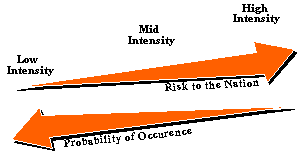
The intensity of war is never constant and certainly
depends on your perspective. The level of intensity largely depends
upon the means available and the objective intent. If either of
these are limited, the overall level of violence will likely be
limited. While wars that have been generally viewed as limited
have included acts of extreme violence, these acts were limited
in number, time, and location. The most common spectrum identifies
three levels of intensity: high, mid, and low.
High intensity is generally characterized by continuous
engagement and exchange of lethal blows between nuclear or conventional
forces.
Low intensity is generally characterized by the use
of subversion, terrorism, and guerrilla tactics often found in
insurgent warfare. However, what may be low intensity for
one belligerent may be an all out struggle for survival for the
other.
Type of War
International Crises: Four sets of circumstances
prevail:
International crises may be considered a type of negotiation or
communication between international actors that arises when neither
side desires war or violence, but considers its own goals important
enough to risk war or violence. The concept of "brinkmanship"
offers a useful description of crisis; it is the art of being
willing to move closer to the brink of war than one's potential
opponent.
Low Intensity Conflict: Limited
either in frequency or in level of violence. May be used as a
tool of policy by a state actor or a nonstate actor, or it may
on some occasions spontaneously erupt.
Low-intensity conflict importance has only been recognized in
the relatively recent past. A number of reasons exist for its
newfound notoriety:
Terrorism: Lenin says "The purpose
of terrorism is to inspire terror. Terrorism must be listed
in any typology of war and international violence, either as a
subset of low-intensity conflict or as a separate category. In
many cases the difference between a freedom fighter and terrorist
depends on one's perspective. As a form of international violence,
terrorism actually causes relatively few casualties. Nevertheless,
terrorism has a psychological impact far beyond the death and
destruction that it causes. Terrorism is an extremely useful
tool for those elements of international society that find themselves
unable to influence events in the way they desire. For the most
part, terrorism is therefore a tool of violence used by nonstate
actors against state authority.
Civil War/Revolution: Civil wars are conflicts within a state between two or more groups fought because of disagreements over the future of that state. At least one of the groups at war must be a nonstate actor; the other group(s) may be either the state's government or additional nonstate actors. Civil wars may be massive upheavals including millions of men and women, as were the American Civil War and the Chinese Revolution, or they may be more limited in scope. All levels of violence may also be included. Since World War II, state authority has been challenged more often from inside the state than from outside it.
Civil wars often have international dimensions, either because
one or more of the parties involved in the war receives support
from external sources or because an external actor is vitally
concerned with the outcome of the war. Civil wars occupy a curious
place in any typology of wars and violence. On the one hand they
are quite often destructive. On the other hand, civil wars have
been defended as the last recourse of action against corrupt,
outdated, or unyielding social systems and governments
International War: Conflict between or
among states carried out by their armed forces. It is an accepted
form of conducting relations between and among states, and has
been accepted by international law as an inevitable if not desirable
element of state interaction. It is distinct from low-intensity
conflict only in its level of violence. For our typology,
all declared wars and all periods of extensive military engagement
between and among states even if not declared as war will be considered
war. A state may have a number of reasons for not declaring a
major military conflict a war. A declaration of war may break
treaties a state is committed to, prove constitutionally illegal
or politically unpopular within the initiating belligerent state,
reduce or eliminate the element of military surprise, draw forth
neutrality and neutrality regulations from other states, or widen
rather than localize a conflict. Plato thought that just wars
were those fought for the benefit of the state and that war against
non-Greeks was acceptable regardless of purpose. Aristotle accepted
three types of wars as just-wars of self-defense, wars to control
others for their own benefit, anal wars against peoples that deserved
to be enslaved.
Spectrum of Conflict
503.2 Comprehend that Clausewitz' concept of the trinity of war impacts the level of war through the actions of the people, the military and the government.
503.21 Describe how the people, the military, and the
government affect the levels of war.
The three elements heavily impact the levels of war. The Government declares the war or commits troops to fighting and should determine the national objectives of the war. The government should decide what level of war is appropriate and communicate that clearly to the military. The Military should execute the appropriate level of war. The military makes plans to achieve the national objectives and then carries those plans out at the operational and tactical levels. The People provide "support" (or lack of support) for the effort. This support can come in many ways, by emotional support for the military and the government, by working in war related industries, by volunteering time to support military organizations. The people also can show lack of support by protesting, by violence, by elections, and by refusing to serve.
503.3 Comprehend the key actors and issues in war and conflict
resolution and end state accomplishment.
503.31 Explain the particular issues in war and conflict
resolution that can affect end state accomplishment.
| State actors: | Funding | |||
| Governments | International Law | |||
| Military Forces | Humanitarian Issues | |||
| Media | Occupation | |||
| IGOs: UN, Alliances | Civil-Military Operations | |||
| Non State Actors | Nation Assistance | |||
| NGOs | Prisoners of War | |||
| Ethnic/religious groups | ||||
| Participants | ||||
| People | ||||
Americans think that war and conflict resolution takes care of
itself and therefore there is no need to plan for it. We have
used a strategy of overwhelming force which has been effective
in defeating our enemies (e.g. Civil War, W.W.I, W.W.II). Korea
and Vietnam were limited wars which reinforced our thoughts that
using overwhelming force is the only reliable solution. The Weinberger
Doctrine and comments by Samuel P. Huntington also supports the
idea that war and conflict resolution will take care of itself
if only we get in and win. In reality there have been limits to
the Cold War and even to the recent Gulf War. Any future conflicts
requiring the use of force will be limited what with exceptional
demands and constraints thus making it all so very important that
war and conflict resolution be included in planning our military
strategy.
503.4 Comprehend that there are a variety of patterns of war
and conflict resolution.
503.41 Explain the patterns of war and conflict resolution
including negotiation and capitulation.
Wars are terminated by one of two means: through a negotiated
settlement or through unilateral action.
Negotiated settlements: An agreement reached by both sides to terminate hostilities. They include the following:
Formal Peace Treaties: The primary method of war and
conflict resolution up to WW II. There have been no formal
peace treaties since WW II. A major reason for this is the emergence
of organizations such as the UN. Their involvement aimed at brokering
peace agreements has revolutionized the patterns of war and conflict
resolution emphasizing negotiated settlements rather than military
defeat of one of the parties.
Armistice or Truce: Originally a temporary cessation
of hostilities, but the break has often been used to negotiate
a permanent peace settlement. If lasting negotiations are not
successful, the interim agreement may become the de facto peace
settlement and can even change the borders relative to the position
of troops at the time the truce becomes effective. Some experts
believe that the armistice or truce has taken the place of the
formal peace treaty as the normal means of war and conflict resolution.
Stalemate: Reached when neither side is capable of achieving
a significant advantage on the battlefield, resulting in an informal
or even a formal agreement to terminate hostilities. Often results
in very little change in the post war arrangements.
Unilateral Means of Termination:
Capitulation or surrender: One belligerent imposes the
solution on the other. Normally a military decision made by
the commanders. Extreme form of this pattern is "unconditional
surrender" which results in total military defeat of
one side giving the victor the option to occupy territory or make
other demands of the loser.
Withdrawal: One or both sides cease fighting
and withdraw from the battlefield. This may be due to military
disadvantage, exhaustion of resources, or most often, to avoid
surrender or capitulation.
Extermination or Expulsion: One belligerent simply ceases
to exist. Although rare today, extermination and expulsion
were common in ancient times. Surrender often meant the slaughter
of all males and enslavement of all women and children. An all
out nuclear attack would probably fall into this category.
503.5 Comprehend the relationships between military objectives
and how they support national objectives by reviewing wars, campaigns,
and operations with a concentration on conflict termination [I.3(d)].
503.51 Determine how past conflicts have terminated,
what was good and bad, and apply those lessons to today's challenges.
"Virtually every study of war termination concludes that
failure to define objectives is the most common obstacle to rational
war termination."
Future wars will have constraints on them due to objectives being limited, the use of coalition forces, international norms, limited resources, legal or moral considerations and the potential for mass destruction with nuclear weapons. It is not just up to the political leadership to determine the end of a war. Strategists need to know the limitations to help achieve those objectives. If one does not have clearly defined objectives how will they determine when their objectives have been met? As a strategist if one does not have a way in which to obtain a quick victory or the ability to prolong the war, then war fighting strategies should be developed that make negotiation possible and likely.
Domestic political pressures sometimes undermine willingness to pursue limited objectives rather than all out war.
Allied pressure put on to not state objectives because it might undermine their positions.
Conflicts arise between military and political leaderships over war aims that may limit the use of military might.