SE 524 PROLIFERATION
PURPOSE:
This lesson provides a quick look at domestic concerns
in India and Pakistan and how it relates to this fragile regions
nuclear weapons concern. The assigned readings focus on two regional
adversaries and de facto nuclear powers, India and Pakistan, and
how their nuclear programs give dimension to the strategic environment.
LESSON OUTLINE:
Thesis: The Asian Subcontinent
is home to over 1.3 billion people, and increasing. The incredibly
daunting issues of population growth, economic modernization,
and social fragmentation combine with the issue of nuclear proliferation
to give the strategic environment a character unique to the region.
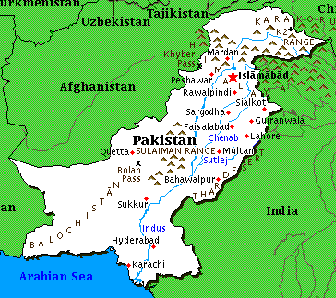
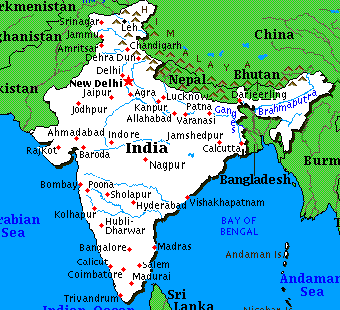
Main Point I: India and
Pakistan face tremendous social, political, and economic problems,
but their security concerns and regional rivalry over issues like
the Kashmir region complicate efforts to deal with these larger
issues.
a. Consider the current Indian attitude towards
security concerns and the nuclear question in light of current
internal politics.
India faces serious social, economic and political
problems
- Security concerns:
- Growing economic and military threat/influence
of China
- Ongoing conflict with Pakistan as nuclear rival,
Muslim-Hindu ideology, Kashmir conflict
- Nuclear weapons provide measure of stability;
use "vague" stand on use for deterrence
- India-Pakistan Past Wars; Continued Distrust
- Both nations Refuse to Sign Non Proliferation
Treaty
- Implemented relatively successful economic liberalization
program to avert economic collapse
- Hindu fundamentalists and "hawks" push
for tougher, self-sufficient India
b. Consider the current Pakistani attitude towards
security concerns and the nuclear question in light of current
internal politics.
- Pakistan confronts host of domestic problems
as well
- Secessionist movements, Islamic fundamentalism,
economic recession, rising debt, falling revenues, widening gap
between rich and poor, and widespread corruption
- Cold War Exists Between India & Pakistan
- India & Pakistan both have Nuclear Capability
to Enhance their Security & Deter the Other
- India's Conventional Forces are Superior
- India-Pakistan Past Wars; Continued Distrust
- Pakistan Growing Relationship with China; tied
to Islam
- Pakistan's Support for Kashmir Insurgency
- Indian SR Missiles along the Pakistani Border
- Both nations Refuse to Sign Non Proliferation
Treaty
- The nuclear question will undoubtedly persist
as a contentious issue in India's/Pakistan's relations with many
of the advanced industrial states and the US in particular.
Main Point II: The regional
rivalry between Pakistan and India has dominated the strategic
environment of the region.
a. The pursuit of nuclear weapons by India and
Pakistan has complicated the rivalry.
- Both Nations Rely on Nukes to Deter the Other
- Pakistan's Conventional Weaknesses May Prompt
Early Use of Nukes in War
b. The nuclear policies of both India and Pakistan
have caused problems with the greater international community.
- US non-proliferation efforts: froze Pakistan
military arms support
- Any Nuclear Attack May Bring China into Conflict
- Risk of Inadvertent Nuclear Detonation or Nukes
Falling into Hands of Terrorists
- Concerns Over the Strategic Impact of Nuclear
Capable Ballistic Missiles
- Both nations Refuse to Sign Non Proliferation
Treaty
LESSON OBJECTIVES:
524.1 Understand how the issue of nuclear proliferation
interacts with state, regional and international forces to affect
the strategic environment of South Asia.
524.11 Compare how the Asian view of nuclear proliferation
issues differs from that of the West (particularly the United
States).
India/Pakistan:
- India and Pakistan are in their own "Cold
War", even if world cold war is over
- Nuclear weapons raise national power and regional
position. For India and Pakistan, as for
all nuclear powers, maintaining the nuclear option is the ultimate
insurance policy in an unpredictable international system
- Paksistan and India not in arms race or trying
to distribute nuclear technology
US:
- Stop all proliferation
- Maintain or reduce number of existing nuclear
states
- Prevent threats to US regional interests and
national security
- Prevent threats to regional/international stability
from aggressor states/terrorists with nukes
524.12 Recognize the real nuclear dangers associated
with some countries having nuclear weapons.
- May throw off regional power balance
- May cause other neighbors to pursue nuclear
arms development
- Tough to control use, strategy, safety in unstable
developing countries
- Greater access by terrorists
- May draw confrontation from other nuclear power;
wider conflict
READING RATIONALE:
The articles by Ganguly and Rashid examine the internal
politics of Indian and Pakistan and how this influences their
attitude towards each other, their many internal problems, and
the nuclear question.
India:
- THE POST-COLD WAR THAW
- With the collapse of the Soviet empire and
the subsequent end of the Indo-Soviet security and arms transfer
relationship, India moved to repair its relations with the US
and China.
- Bharatiya Janata Party (BJP)-led coalition government
could imperil the economic liberalization program, and would certainly
damage relations with Pakistan and the Arab world. The BJP
has promoted a brand of xenophobic nationalism with two important
components: strong anti-Muslim (and therefore anti-Pakistani)
rhetoric, and a militaristic, belligerent international image.
- Liberalization and Its Discontents
- push toward economic liberalization may well
become its most important liability as elections approach.
- The BJP's strategy of casting aspersions on economic
liberalization notwithstanding, India cannot afford to retreat
from liberalization
- THE KASHMIR QUESTION
- Insurgency result of rapid political mobilization
and institutional decay. New Delhi misread Kashmiri demands for
greater autonomy and federalism as incipient secessionism and
systematically tampered with democratic process in the state.
With all avenues of legitimate political dissent blocked, Kashmiris
turned to violence. And once the rebellion ensued, India's longtime
adversary, Pakistan, stepped in to provide sanctuaries, training,
organization, and weaponry to the insurgents.
- the government has yet to hold concerted, organized,
and extensive negotiations with the insurgents
- And the Nuclear Question
- India is, along with Israel and Pakistan, one
of the three countries believed to have nuclear weapons outside
the NPT framework. It has come under considerable pressure from
the US and other major powers, such as Japan and Germany, to forswear
the nuclear weapons option
- Given the degree of popular support that exists
within India for maintaining the status quo, it is doubtful
that there will be significant shifts in Indian nuclear policy
in the foreseeable future.
Pakistan: the rift between
rich and poor is widening, a trend that in turn fuels fundamentalist
fervor. The debate over whether the state should be secular
or Islamic has only intensified in the past decade
- THE TENUOUS TROIKA
- Since 1988, power has been divided among the
president, the prime minister, and the military. Tensions
between the three, however, have led to 8 changes of government
and three elections. No elected leader has ever completed a full
term in office.
- Much of Pakistan's intransigence stems from a
legacy of rule by a small coterie of perhaps 300 families.
Through blood ties, marriage, and business they have dominated
the military, the bureaucracy, and the still largely feudal political
elite
- Since 1993 the country has undergone the deepest
economic recession in its history, with high unemployment
and inflation (officially set at 13 percent but independent economists
and bankers put it at over 25 percent). The economy grew only
4.7 percent between 1994 and 1995, compared to a thirty-year average
of 6 percent.
- Hostage to Anarchy
- Bhutto's promises to reform the judiciary, the
bureaucracy, and the police-an institutional framework that has
survived from the British Raj-have not materialized. Instead,
she has further politicized these institutions by making arbitrary
appointments based on favoritism and loyalty.
- By posing as a political alternative to the feudal
elite, Islamic fundamentalists have become a major factor in destabilizing
both the military and the political system
- Islam Rising
- Western diplomats admit that Pakistan is high
on the list of those countries where an Islamic movement and resulting
anti-Americanism is possible in the near future unless the country's
ruling elite mends its ways. As in other parts of the Muslim world,
Pakistan's Islamic movement is being driven more by poor social
conditions and a break down of law and order than by pure
ideology
- The Wages of War
- Islamic fundamentalism, smuggling, and the breakdown
of law and order in the NWFP and Baluchistan province are part
of the backlash from the fifteen-year civil war in Afghanistan
- Government's attempts to curb fundamentalism
and terrorism halfhearted, intermittent, and controversial.
- Western strategic concerns about fundamentalism
in Pakistan center on the fact it is already the epicenter
of three civil wars raging around it-in Afghanistan, Tajikistan,
and Indian Kashmir. All three wars involve the spread of Islamic
fundamentalism and have been clandestinely fueled by Pakistan's
Islamic parties and sometimes by the army's Interservices Intelligence.
- Revitalizing Relations
- The Bhutto government scored a major success
by improving relations with Washington. When Bhutto became prime
minister in 1993, US-Pakistan relations were at rock bottom because
of the cutoff of all US aid to Pakistan in 1990 after the US determined
that Pakistan possessed a "nuclear explosive device
- American and Pakistani analysts warn that renewed
US support is not sufficient to keep Bhutto in power. She must
tackle the problems at home
- The Military Factor
- Pakistan's right-wing politicians and some sections
of public increasingly looking to the military for solutions.
- Fears about a possible Indian nuclear test or
the deployment of India's short-range Prithvi missiles on the
Pakistan border have led to an unprecedented growth in tension
with Pakistan's main rival. If India tests a nuclear device, Pakistan
will quickly follow suit, further escalating arms race in region
and destabilizing the global effort to limit nuclear weapons.
- Forecasting Forbearance
- Pakistan's survival into next century depends
on a greater devolution of political and economic power from the
center to the provinces and cities; the pull of ethnic and sectarian
conflict cannot be resolved unless this happens.
- The election commission should also he empowered
to ensure that the government does not pressure the bureaucracy
to favor its candidates
The article by Devin Hagerty examines the nuclear
equation in the subcontinent and the complicated questions this
potential proliferation raises.
- OPACITY WITHOUT APOLOGY
- Indian and Pakistani leaders stridently deny
their countries are nuclear weapons states, but do admit they
can produce nuclear weapons. Each nation derives deterrent security
from this "opaque" nuclear posture
- neither country feels secure enough to reverse
its nuclear course. For India and Pakistan, maintaining the
nuclear option is the ultimate insurance policy in an unpredictable
international system
- New Delhi and Islamabad have refused to sign
the NPT
- Between Deterrence and Disaster
- per most analysts in the United States: the three
Indo-Pakistani wars, the festering Kashmir conflict, and India's
and Pakistan's small, technologically unsophisticated nuclear
weapon capabilities are a recipe for nuclear disaster on the subcontinent
- This "first strike uncertainty" bolsters
mutual deterrence
- the main nuclear danger in South Asia today-involves
nuclear accidents and the unauthorized use of nuclear weapons
or material, perhaps by terrorists
- deploying reasonably accurate invulnerable missiles
would increase the likelihood of India and Pakistan adopting preemptive
nuclear doctrines in the future
- The United States: Tactics But No Strategy
- Pressler Amendment:
Non-proliferation law lifted on Pakistan during Afgan-Soviet war
then reinstated at war's end. F-16 sale situation - Pakistan paid
and didn't receive aircraft. Pressler waiver (Brown Ammendment)
in 1994 opens door to US arms support but may create false hopes
in Pakistan of an ongoing military supply relationship with the
United States. Brown Amendment's main effect may be to inhibit
Indian concessions on nuclear and ballistic missile proliferation
- Outlining an American Role
- Issues America must consider:
- First, India and Pakistan
are not nuclear outlaws.
- Second, India and
Pakistan derive deterrent security from their nuclear capabilities,
and are as unlikely to give them up as were Washington and Moscow
at the height of the Cold War.
- Third, American policymakers
should recognize and help to build on the arms control measures
that have already evolved between India and Pakistan
- Washington's overall goal should be to help stabilize
the subcontinent's nuclear status quo by maintaining regional
nuclear deterrence and preventing nuclear accidents and unauthorized
nuclear use
- Finally, American policymakers should work to
scrap the Pressler Amendment, a Cold War anachronism
Ashley Tellis' article provides interesting analysis
on role nuclear weapons might play in easing each nations security
concerns and helping to militarily stabilize region.
- India sought to transform a multicultural empire
into a unified secular state governed by liberal principles, while
Pakistan attempted to consolidate linguistically and ethnically
disparate groups into a single state based on a common religion,
Islam.
- disappearance of U.S.-Soviet competition, which
both India and Pakistan exploited.
- Both states have begun to decontrol the internal
economy and to increase linkages with the global economy in the
hope of securing both capital and high technology for civilian
and military purposes
- Toward that end, India has sought to position
itself as a buffer against rising Islamic "fundamentalism;"
a constraint on Chinese hegemonic aspirations; a source of support
toward those of America's Southeast Asian allies potentially threatened
by China; and a satiated "status quo" power that seeks
to defuse the global problems of nuclear addiction and proliferation,
terrorism, and diffusion of weapons of mass destruction.
- It (Pakistan) still seeks the best of both worlds-continued
American assistance in maintaining robust conventional capabilities
while pursuing its nuclear option-even though this is impossible
to obtain
- First, the use of nuclear weapons would provide
increased incentives for expanded Chinese involvement in South
Asia, possibly including a Chinese military intervention of some
kind or another. Further, it would make U.S. allies in Southwest
and Southeast Asia more insecure, simultaneously providing additional
incentives to Iran and the Central Asian republics to nuclearize.
Finally, and perhaps most importantly, it would break the taboo
against nuclear use and encourage other states to acquire, deploy,
and contemplate using the only class of weapons that could threaten
U.S. security on a large scale