SE 523 SCARCITY OF RESOURCES
PURPOSE:
This lesson focuses upon the scarcity of natural
resources, and the global impact which ensues as nations become
increasingly concerned over the issue.
The Middle East is used as a backdrop for discussion. This
region provides an excellent stage for demonstrating how
one issue can provide the opportunity for regional cooperation
or contention. The subsequent effects hold great importance for
other world actors dependent on Middle East oil.
LESSON OUTLINE:
Thesis: We tend to see
the main geo-strategic issue in the Middle East in terms of access
to oil. Yet we know people can live without oil whereas they cannot
live without water. Access to, and the sharing of water is
bound to determine the future shape of the regional politics in
ways that may lead either to the fragmentation or the integration
of the regional state system thereby affecting regional stability.
This lesson focuses on the scarcity of water as a factor impacting
the interactions of various actors in the global community.
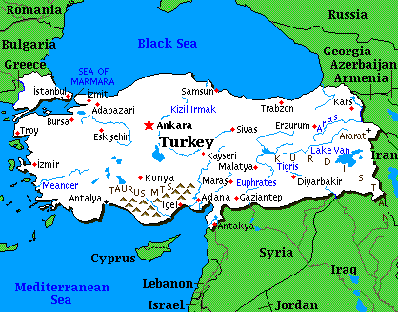
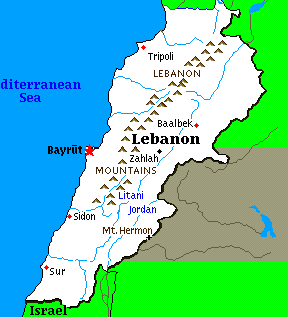
Main Point I: Hydropolitics
play a preponderant role in determining the use of water in the
Middle East the largest reserves of which are to be found on the
Anatolian plateau and in the Litani river valley.
Main Point II: Contesting
political powers and groups in the region use water as a point
of pressure against secular powers, but this does not necessarilty
have to lead to political fragmentation. The possiblity for integration
based on a regime of equitable use of resources is always an option.
Main Point III: Whether
hydropolitics leads to integration or fragmentation of the regional
actors, it is safe to say that the political character of the
region will be profoundly affected and thus have an important
impact on the global strategic environment.
LESSON INTEGRATION & RATIONALE:
This lesson provides thought provoking information
on the major resources issues affecting the future of Middle Eastern
political stability. This lesson complements the other lessons
dealing with regional issues and provides yet another way of viewing
the strategic environment.
LESSON OBJECTIVES:
523.1 Comprehend the connection between the scarcity
of resources and regional stability.
523.11 Summarize resource-related trends in the
Middle East and how those trends
influence regional actors.
Hydropolitics is that element of politics related
to a government's management of water-related policies, goals,
and affairs
Your readings discussed a number of issues which
fall under the general umbrella of hydropolitics, an intricate
topic comprising many of the same issues frequently encountered
in the "typical" world of politics. Economics, resource
allocation, development of infrastructure, and international disagreements
are standard issues encountered in the world of hydropolitics.
The issue is so critical that the involved countries
and regions will eventually arrive at an "either-or"
position: Either they will cooperate to resolve the potential
crisis, or a conflict will ensue over access to water.
Scarcity of water in region, pollution, growing water demand (population/agriculture/industry),
and cross boundary water resources impact the situation. Because
of the presence of another precious commodity indigenous to the
region, oil, the ramifications of the resulting regional behavior
have great importance to the rest of the global community.
The manner in which the Middle East nations resolve
their difficulties carries great importance for other nations
around the world for a number of reasons:
Perhaps the most important reason is that many
nations of the world rely on the unimpeded flow of oil from the
region. An integrative approach to solving the Middle East's
water problem indicates a positive environment, and reduces world
tension over access to oil. However, an environment marked by
conflict leads to greater world tension .
Additionally, any large-scale war could prove
economically disastrous for other areas of the world. Any
crisis affecting such a large percentage of the world's population
will draw attention, participation, and eventual economic contributions
from other nations to prevent carnage. A cooperative environment
may draw equal attention, but for positive means.
READINGS:
Gallegos and Kinner, "World Water:
War or Peace?": provides
basic information on the state of global water resources; enhance
understanding of the critical nature of the world's water shortages,
to reveal the potential impacts of attacking water-related targets
in war, and to offer an available option to help solve this mounting
problem.
Fresh water is a prerequisite to human existence,
yet its scarcity is a problem of global proportion. In arid regions
such as the Middle East, the difference between supply and
demand for water resources has reached a crisis level.
FRESH WATER RESOURCES
- Fresh Water Uses
- According to a recent World Resources Institute
report, less than 1 percent of all fresh water is available to
satisfy human needs with the greatest share coming from surface
water (i.e., lakes, rivers, and streams) and ground water (i.e.,
aquifers).
- The amount of fresh water available for man's
use at any one time is dependent upon the amount of precipitation
(source of all fresh water), the rate of water use, and the quality
of the available water
- Second factor affecting
the amount of fresh water available to a country is the rate
at which the water is withdrawn from its source for agricultural,
industrial, and domestic uses
- Third factor affecting
the amount of fresh water available is water pollution.
Agriculture is the leading source for water pollutants such as
sediments, pesticides, and nutrients.9
- Water Scarcity
- Water shortages occur where the demand for
water exceeds the available water supply;
Water use by continent is increasing at dramatic rates-the
result of population growth and development
- The effect of agricultural, industrial, and domestic
uses on the total water available per capita varies widely. Malin
Falkenmark, a noted Swedish hydrologist:
- Studies basis for determining water scarcity
in countries. From her study she defined what she calls "water
competition intervals: limited water problems, water stress
,chronic water scarcity, water barrier ." When a
country passes the "water barrier," the needs of
the population, for all uses, exceeds the current supply of water
available to the country.
- Clarke, another noted
hydrologist, expanded on Falkenmark's work in 1991. In his global
study he excluded waters entering the country and all nonrenewable
water sources (i.e., deep water aquifers which can take thousands
of years to renew), because such water was not controllable by
the host country. Ex of potential impact: If
the Nile's waters were dammed or significantly reduced by upstream
countries like Sudan or Ethiopia, Egypt's agricultural base, which
used 98 percent of Egypt's total water supply, would collapse.
- WATER AS A SOURCE OF CONFLICT
- Water source of numerous conflicts throughout
history, e.g. Gulf War, Iraq positioned
"human shields" at its own dam facilities and destroyed
all of Kuwait's desalinization plants.
- Where a river has been used as a boundary
between nations, the shifting of the water has caused conflict
over lines of political demarcation
- Where waters drain and flow across political
boundaries, as it does in 246 out of the 253 river basins
in the world, conflict often results when significant changes
occur in water quality or quantity.
- Downstream nations often find themselves in
a weak position to negotiate formal agreements
whereas nations controlling the water resources of neighboring
nations can wield formidable power. Worldwide situation intensifying
as limited resources come under increasing pressure from growing
populations.
MIDDLE EAST WATER PROBLEMS
- Water Crisis
- Middle East water problem has become a crisis
because of world demographic trends and a scarcity of water;
term Middle East must include all the river basins from Egypt
through Turkey.
- Middle East remains, as it has been since the
Nabateans first settled in the region, one of the most arid regions
in the world.28 This low rate of precipitation has
exacerbated chronic water shortages.
- Rapid growth in population within the region
is not matched with a concomitant growth in food production, so
poverty is worsening.
- Using the lowest available estimates, per capita
consumption rates could increase 20 percent, putting almost all
Middle East countries, in Falkenmark's terms, beyond the "water
barrier."
- problem of scarcity versus increasing needs is
compounded by the international nature of existing supplies
within the Middle East.
- In addition to water shortages, much of the
fresh water is now polluted; Increasing water-quality problems
have magnified the water crisis
Potential Conflicts: By
the end of the 1990s, water problems in the Middle East will lead
either to an unprecedented degree of cooperation, or a combustible
level of conflict.
- Jordan River basin
presents the Middle East's most intractable water management
problem. Users of this 360 kilometer basin include Israel
(including the Occupied West Bank), Jordan, Syria, and Lebanon
- Aftermath of 1967 war had a direct impact on
management of Jordan River basin. Israel's occupation of Golan
Heights prevented Arab nations from diverting headwaters of the
Jordan
- Israeli occupation of the West Bank: Without
any water guarantees currently forthcoming, water rights
in this area will remain a source of tension between the PLO
and Israel.
- Control of the Golan Heights also gives Israel
rights to the Yarmuk River. The Yarmuk
River, which enters the Jordan River from the east, is of great
importance not only to Syria, its source, but also to Israel and
Jordan. Jordan has already overreached its renewable supply
and water rationing is in effect
- Israel's third source of water is the coastal
aquifer bordering the Mediterranean.
- Tigris and Euphrates Rivers both flow from headwaters
located in Turkey through Syria, then join in Iraq to form the
Shatt-al-Arab about 200 cubic meters from the Persian Gulf.
- The Ataturk Dam is only one of a series of
22 dams, 25 irrigation systems, and 19 hydropower stations Turkey
is constructing as part of a massive economic development project
called the Grand Anatolia Project (GAP). Syria and Iraq fear
GAP will reduce Euphrates flow into Syria by 35 percent
- A third major basin within the Middle East
where tensions are running high is the Nile River Basin.
The Nile provides water for nine countries. The last country in
line and the one most dependent upon the waters of the Nile is
Egypt, which is already beyond the "water barrier."
Kemal Abbas Awar, "Environmental Warfare:
Water in the Middle East"
Kemal Abbas Awar: articluates
the tensions between Israel and Lebanon regarding the sharing
of water resources and catalogues the possible causes of regional
destabilization over their inequitable distribution
Water is scarce in this region. This scarcity has
led to severe conflicts on the international rivers to secure
this strategic asset for survival on both the individual and state-economy
levels. These conflicts have been exacerbated by the following
factors:
- Population growth needs demanded additional
amounts of water for domestic, industrial, and agricultural uses.
- Unilateral developments of water plans by
states on international rivers that mostly denied or disregarded
the rights of other riparians.
- Traditional societies and ideological beliefs
that led to the agricultural expansion irrespective of the amounts
of water available.
- The emergence of basic rights with modern
upstream states based on territorial integrity versus basic historical
needs of downstream countries.
- Political disputes, ethnic, and religious
hostilities.
CURRENT AND FUTURE CONFLICT CAUSING ENVIRONMENTAL
ISSUES
- Population Growth, Desertation, Low-Quality
Water, Deforestation, Climate Change
SOLUTIONS
- Reallocation or apportionment of shared water
resources of international rivers, on
the basis of equitable utilization (or water sharing) by political
agreements shared by all parties concerned; states and under creation
states (Palestine) is required for hydropolitical stability.
- Peace Process: The
peace process hydrologically followed two tracks. The bilateral
talks to define water rights while the multilateral talks to organize
water supply
- Measures of Equitable Utilization
- International Water Law
- "The most important principle defines equitable
utilization as follows: Each basin state is entitled, within its
territory to a reasonable and equitable share in the beneficial
uses of the waters of an international drainage basin" (Helsinki
Rules in 1966)
- The International Law Assembly (a body of UN)
was directed by General Assembly in 1970 to study "codification
of the law on water courses for purposes other than navigation."
The general principles being codified include:10
- Common water resources are to be shared equitably
between the states entitled to use them, with related corollaries
of
- A limited sovereignty, Duty to cooperate in development,
Protection of common resources
- States are responsible for substantial transboundary
injury originating in their respective territories
- Needs-Based Equity?
- Based equity usually depends on geography; i.e.,
where the river or aquifer originates and how much of that territory
falls within a certain state. Needs equity depends on chronology;
i.e., who has been using the water longest
- Economic Equity
- This measure allocates water resources according
to its economic value. The idea is that different uses and users
of the water along a given waterway may place differing values
on the resource. Therefore, equitable utilization should take
into consideration the possibility of increasing the overall efficiency
of water utilization by reallocating the water according to these
values.
- Nile Basin
- Nile 2002 conference held in Khartoum in February
1994 was a smart step in the right direction. A joint management
committee called "Tecconile" has been set up by the
nine riparians to prepare multilateral agreement for the year
2002, Ethiopia abstention so far from Tecconile is a big disappointment
- Euphrates and Tigris Basins
- countries along the Euphrates and Tigris enjoy
the good fortune that with almost 3,000 centimeters of water per
capita each year are good enough for municipal, industrial, and
agricultural uses if used sensibly and efficiently ought to suffice
for all three countries
- Syrian-Iraqi Agreement in 1990, which called
for Syria to keep 40 percent of the flow of Euphrates within its
borders and allow the remaining 60 percent through to Iraq, was
a very reasonable move
- The Jordan Basin
- It is too early to appoint joint management for
Jordan Basin as long as Lebanon and Syria did not reach to peace
treaties with Israel
- Better Management and Administration
- Better management is to prioritize the use of
water by reallocating it for more valued uses in return for more
economic benefits. This shift has to consider the minimum water
requirement for individual water rights that can meet equitable
utilization. Better administration of water is to make best efficient
use of it.
- Efficiency in Water Use
- Increasing the efficiency of water use in all
the countries of the region may be the most economical and the
least controversial of all proposals
- New Supplies
- Desalinization: Current
prices make desalinization an expensive alternative for domestic
use, and may be only affordable for industrial use
- Med-Dead or Red-Dead Canal Plan: convey
sea water from the Mediterranean or the Red Sea to Dead Sea, which
lies 400 meters below sea level. This large elevation drop would
permit the generation of hydroelectric energy sufficient to run
desalinization plant.
- Peace Pipeline: Peace
Canal originates from Tigris River (any point on Tigris north
of the confluence of Tigris with the Euphrates) to the East Gulf
states. To provide the amount of water proposed by the eastern
canal of peace pipelines and probably more.
- Other Transfers: Tankers,
Towing icebergs from North or South Pole Floating bags or medusa
bags of capacity 1.6 million cubic meter