OS-505 -- US Navy
LESSON OBJECTIVES
505.1 Comprehend the capabilities and limitations of
US military forces [I.1(a)].
505.11 Describe the roles and missions of the US
Navy.
MISSION: To be organized, trained, and equipped primarily for prompt and sustained combat, incident to operations at sea. (Title 10 USC)
ROLES: (1) Strategic Deterrence, (2) Forward Presence, (3) Power Projection, (4) Sea Control/Maritime Supremacy, (5) Strategic Sea Lift (FORWARD … FROM THE SEA)
JOINT ROLE: "Enable and Support the campaign ashore."
505.12 Describe the organization of the US Navy. (Battlegroup according to Maj Williams of ACSC)
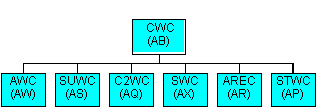
The Battlegroup uses a system called the COMPOSITE WARFARE COMMANDER (CWC) CONCEPT to exercise command and control. The roles are as follows:
CWC (AB) - The Admiral in charge of the group (0-7/8 with staff on the carrier)
AWC (AW) - The Air Warfare Commander (0-6 on an AEGIS Cruiser)
SUWC (AS) - The Surface Warfare Commander (0-6 CO on the Carrier)
C2WC (AQ) - The C2 Warfare Commander (0-5 on the Battelgroup staff)
SWC (AX) - The Subsurface Warfare Commander (0-6 staff on the carrier)
STWC (AP) - The Strike Warfare Commander (0-6 CVW Commander on carrier)
AREC (AR) - The Air Element COORDINATOR (0-6 CO on the carrier
)
505.13 Describe the capabilities, composition, and
missions of a carrier battlegroup
CAPABILITIES: Just look at the missions of the Navy and
you have it. C4I, Battlespace Dominance, Power Projection, Force
Sustainment. A CVBG can do them all. The Battlegroup is made up
of: (generally)
505.14 Describe the expeditionary capabilities of
the US Navy.
Key EXPEDITIONARY capabilities of the navy are C4I, Battlespace
Dominance, Power Projection, and Force Sustainment. These
fall into the roles and missions of the Navy. It should be remembered
that every ship in the U.S. Navy is sovereign US territory and
therefore does not need permission to operate in international
waters. "EXPIDETIONARY" implies a mind-set, a culture,
and a commitment to forces that are designed to be deployed forward
and to respond swiftly. 0FORWARD … FROM THE SEA)
505.2 Comprehend the relationship between Service doctrine
and joint doctrine [I.2(d)].
505.21 Describe the current doctrines in use by the
US Navy in support of the National Security and National Military
Strategies and objectives.
There are six volumes that have been promulgated by the Navy Doctrine Command
(NAVDOCCOM) since its establishment in 1992. The Navy recognized that future operations were going to be in the littoral (big surprise) and that they would be joint. (HASTINGS) The doctrine publications developed are:
505.22 Explain how the Navy envisions the employment
of naval forces in support of a theater campaign/operation today.
The most important role of naval forces in situations short of
war is to be engaged in forward areas, with the objectives of
preventing conflicts and controlling crises. Building on the
normally deployed forces, we can mass, if the situation requires,
multiple aircraft carrier battle groups into carrier battle forces,
amphibious ready groups with embarked Marine expeditionary units,
and as needed project our naval expeditionary forces ashore using
the afloat maritime pre-positioning force. Such a massing of naval
units can be complimented by the deployment of Army and Air Force
units to provide a joint force capable of the full range of combat
operations that may be required. (FORWARD … FROM THE SEA)
505.23 Explain how the Navy envisions the employment
of naval forces in support of a theater campaign/operation in
the future.
The new direction for the naval service remains focused on our ability to project power from the sea in the critical littoral regions of the world. (FORWARD … FROM THE SEA)
In the event of a future regional conflict, US naval forces will
assume critical roles in the projection of vital sealift along
the strategic lines of approach to the theater of conflict, including
the airports and seaports of debarkation. Our success in a major
regional contingency will depend upon the delivery of heavy equipment
and the resupply of major ground and air elements engaged forward.
Sealift is the key to force sustainment for joint operations.
(FORWARD … FROM THE SEA)
1. Comprehend the capabilities and limitations of US military
forces across the range of military operations, to include command
relationships, force development and organization, and the concepts
of deployment, employment, sustainment, and redeployment (OPMEP
Learning Area).
READINGS
OPTIONAL READINGS (non-testable material): None
READING RATIONALE
The Navy toolbook lays the foundation for US Navy doctrine and outlines the principles upon which the Navy/Marine Corps team organizes, trains, equips, and employs naval forces. The Navy toolbook also provides information on the capabilities, composition, and missions of the carrier battlegroup and Naval Expeditionary Forces. The "Forward ... From the Sea" white paper discusses the basic strategy and directions to be followed by the Navy/Marine Corps team as they prepare for service in the 21st century. Admiral Dur's article reviews the requirements for forward presence in support of the National Security Strategy and discusses the options available. It also emphasizes the flexibility and sustainability of naval forces to meet our nation's forward presence commitments. The Hastings article reviews the history of US Navy doctrine and provides a sailor's view of the importance of developing and effectively promulgating this doctrine to be on par with the other Services.
LESSON OUTLINE
Thesis: United States Navy forces provide the National Command Authority and theater commanders with unique capabilities for rapid and prolonged response to a wide variety of crises. Full understanding of the roles, functions, capabilities, and doctrines of the US Navy is essential to joint staff operational and campaign planners in responding to regional crises that arise.
Main Point I: Review and discuss the roles, functions, capabilities, and doctrine used by the US Navy to support the National Security Strategy, National Military Strategy, and theater commanders.
Main Point II: Review and discuss the future roles, missions, capabilities, and doctrine that may be used by the US Navy into the 21st century.