| A TYPICAL CORPS - | 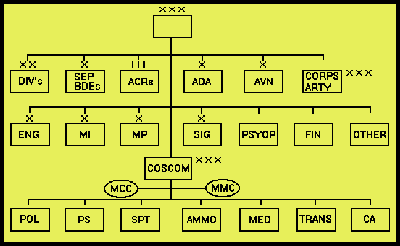 |
| COMBAT/MANEUVER - | |
| COMBAT SUPPORT - | |
| COMBAT SERVICE SUPPORT - |
OS-504 -- US Army
LESSON OBJECTIVES
504.1 Comprehend the capabilities and limitations of US military
forces [I.1(a)].
504.11 Describe the roles and missions of the US Army.
Title 10, U.S. Code "... organized, trained, and equipped for prompt and sustained combat incident to operations on land" specifically to (1) defeat enemy land forces and (2) seize, occupy, and defend land areas
By public law and Department of Defense directive, the role of the Army is to conduct prompt and sustained operations on land. Within the Army, that role is traditionally reformulated to the phrase "to fight and win the nation's wars."
The Army is the nation's force for conducting prompt and sustained land combat, which has been its role throughout our history. Combined with air and naval forces, the Army provides the nation with the ability to employ its military might in support of national policy. The Army's unique contribution to the joint team, however, is its ability to dominate the land, including populations and other resources. While all forms of military force derive their power from the capability to inflict violence, it is the conduct of sustained land operations, which forms the core of the nation's ability to implement a desired policy.
The following strategic roles reflect the realities of the new national military strategy--decreased overseas presence and the resulting requirement for a versatile army capable of force projection.
Army Strategic Roles
Provide support to allied and friendly nations through peacekeeping,
nation-building assistance, security assistance, and army-to-army
initiatives.
504.12 Describe the principles of war, US Army operational
tenets, and METT-T in support of US Army doctrine.
First, a remainder of what doctrine is: Fundamental principles
by which the military forces or elements thereof, guide their
actions. It's definitive enough to guide specific operations,
but Adaptable enough to address diverse & varied
situations worldwide. It's authoritative, but requires judgment
in application. Doctrine describes how army forces think about
applying the basic principles of war. It permeates the entire
organizational structure of the army, sets the direction for modernization
and the standards for leadership development and soldier training.
We train the way we intend to fight--doctrine is constantly in
use...at all levels. METT-T and doctrine work together in determining
what forces are required to accomplish a mission.
The enduring principles of war are: Objective, Offensive,
Mass, Economy of Force, Maneuver, Unity of Command, Security,
Surprise, and Simplicity. They provide guidance for the conduct
of war--bedrock of army doctrine.
Army operational tenets are: Initiative, Agility, Depth, Synchronization, and Versatility. They are the characteristics of successful operations.
Both the principles of war and the operational tenets provide
a doctrinal checklist for use during planning. They should
be used near the beginning and at the end of any planning session
to do a common sense check of the plan. If a principle is violated--so
be it...but the decision should be conscious, not something done
by default.
METT-T simply encompasses critical planning considerations:
504.13 Describe the organization of the US Army Corps.
| A TYPICAL CORPS - | |
| COMBAT/MANEUVER - | |
| COMBAT SUPPORT - | |
| COMBAT SERVICE SUPPORT - |
Corps are the largest tactical units in the U.S. Army,
the instruments by which higher echelons of command conduct maneuver
at the operational level. They are tailored for the theater and
the mission for which they are deployed. Once tailored, they
contain all the organic combat, combat support, and combat service
support capabilities required sustaining operations. Corps
may be assigned divisions of any type required by the theater/mission.
They possess support commands and are assigned combat/combat support
units based on their needs for a specific operation. Corps are
the link between the operational and tactical levels of war. They
plan/conduct major operations and battles. They synchronize tactical
activities. While corps normally fight as part of a larger land
force (e.g., an army), they may also be employed in a contingency
operation as the land component of a joint force.
Corps normally have 2 to 5 divisions. Armored cavalry regiments,
field artillery brigades, engineer brigades, air defense artillery
brigades, and aviation brigades are the nondivisional units commonly
available within the corps structure to weight its main effort
and to perform special combat functions. Separate infantry/armor
brigades may also be assigned to corps. Signal, military intelligence,
military police, civil affairs, and chemical brigades are the
usual combat support (CS) organizations present in a corps. A
psychological operations battalion may also be present. The combat
service support (CSS) organizations are the personnel group, the
finance group, and the corps support command. METT-T drives what
units are deployed to support Corps operations and where they
emplace. A corps can have 50,000 to 150,000 soldiers.
504.14 Describe the five different types of US Army Divisions,
their organization, and their capabilities and limitations.
Three of the five types of divisions are "LIGHT." Operational
missions for these light maneuver forces include:
| Attack key C2 nodes | Attack key enemy armor forces | |
| Attack key logistics centers | Exploitation/pursuit | |
| Interdict LOCs | Breach critical enemy obstacle systems | |
| Secure key choke points or mobility corridors | ||
| Economy of force | Defend against enemy armor forces | |
| Deny enemy use of close or restricted terrain | Counterattack | |
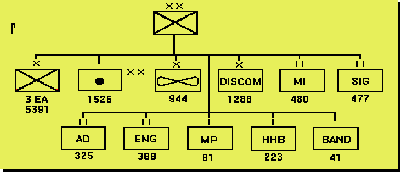
10,813 SOLDIERS
1,650 VEHICLES
44 TOW---162 DRAGON/JAVELIN
54 105mm HOW(T)---8 155mm HOW(T)
41 AH58D---PLUS 43 OTHER HELO's
| Capabilities: | Limitations: | |
| Strategic mobility (500-650 sorties) | Tactical mobility | |
| Suited for close terrain/mountain | Anti-armor firepower | |
| Night operations | Logistics sustainment | |
| Infiltration | ||
| MOOTW |
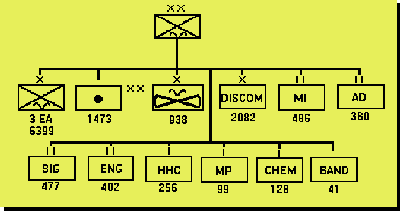
13,149 SOLDIERS
2,573 VEHICLES
54 SHERIDAN
188 TOW---162 DRAGON/JAVELIN
54 105mm HOW(T)
49 AH-58D---PLUS 56 OTHER HELO's
Only one in the force structure.
Similar to a light infantry division--but a chemical company has been added to assist in decontamination. Its common equipment is also longer range (e.g., it has satellite capability).
XVIII Corps has the Sheridan, which is in a unit that is normally chopped to the Airborne Division. The Sheridan is a lightly armored vehicle that can be air dropped. This division also has parachute riggers and pathfinders.
About 75% of the division's vehicles are 1 1/2 tons (e.g., HMMWV).
| Capabilities: | Limitations: | |
| Strategic mobility (1250 + sorties) | Tactical mobility | |
| Forced entry | Weather (Airlift limitations) | |
| Suited for close terrain/mountain | Anti-armor firepower | |
| Night operations | Logistics sustainment | |
| Infiltration | ||
| MOOTW |
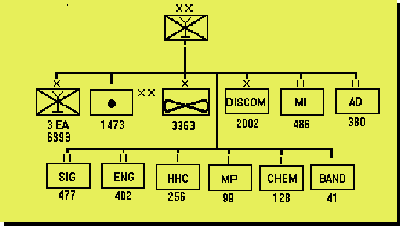
15,739 SOLDIERS
3,350 VEHICLES
180 TOW---162 JAVELIN
54 105mm HOWITZER (T)
72 AH64 & 32 AH58D--plus 229 other helos
| Capabilities: | Limitations: | |
| High tempo operations | Strategic mobility (1650 + sorties) | |
| Suited for close terrain/mountain | Weather (Airlift limitation) | |
| Night operations | Enemy air defense | |
| Anti-armor firepower | Logistics sustainment | |
| MOOTW |
Two of the five types of divisions are "HEAVY." Operational missions for these heavy maneuver forces include:
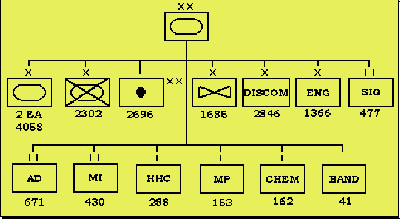
17,538 SOLDIERS
5,908 VEHICLES
317 TANKS---282 BRADLEYS
72 155 SP HOWITZERS---18 MLRS
24 AH-64 & 16 AH58D---PLUS
63 other helos
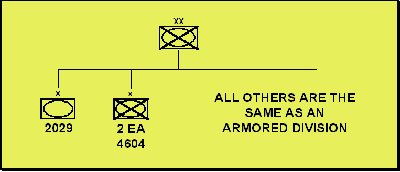
17,776 SOLDIERS
5,335 VEHICLES
259 TANKS
331 BRADLEYS---60 TOW
72 155 SP HOWITZERS
18 MLRS
24 AH64/16 AH58D
PLUS 63 other helos
| Capabilities: | Limitations: | |
| Tactical mobility | Not suited for close terrain | |
| Armor protected firepower | Logistics sustainment | |
| Survivability | Strategic mobility | |
| Decisive counterattack | ||
504.2 Comprehend the relationship between Service Doctrine
and joint doctrine [I.2(d)].
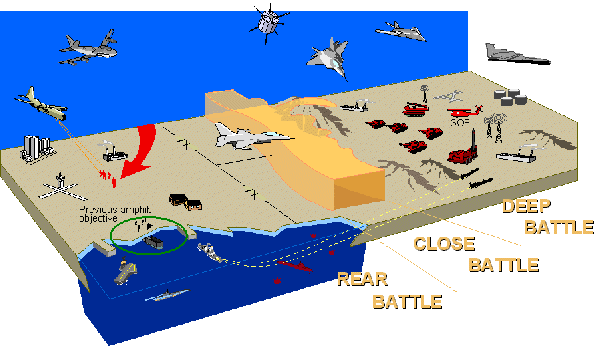
504.21 Describe the term "battlefield framework."
A battlefield framework helps commanders relate their
forces to one another and to the enemy in time, space, resources,
and purpose. This battlefield framework establishes an area
of geographical and operational responsibility for the commander
and provides a way to visualize how he will employ his forces
against the enemy. To understand this framework is to understand
the relationship between the area of operations, battle space,
and battlefield organization (operations in depth). Proper
relationships allow for simultaneous operations and massing of
effects against the enemy.
504.22 Describe the meaning of "tailored force packaging"
and "force projection" and how they apply to US Army
operations.
Tailored force packaging refers to the Army's ability to tailor combat units as required for the mission by simply selecting desired components of heavy, light, airborne, and air assault units and placing them under a single division, corps, etc. to create a custom made combat force. For example, the Army "threw together" a force comprised of corps C2, mechanized infantry, armor, aviation, air assault, Patriot, MLRS, and ATACMS for Operation Desert Storm.
Force projection is the demonstrated ability to rapidly alert, mobilize, deploy, and operate anywhere in the world. It is a key element of power projection-the ability of the nation to apply all or some of the elements of national power to act in crises, to contribute to deterrence, and to enhance regional stability. Force projection is inherently joint in nature. The Army participates in force projection in both war and operations other than war.
To ensure a rapid response capability, yet retain the flexibility
to contend with situations requiring a larger military response,
the Army designates units as forward presence, crisis response,
initial reinforcement, follow-on reinforcement, and reconstitution.
504.23 Describe the current doctrine used by the US Army
in support of the National Security and National Military Strategies
and objectives.
The following strategic concepts are fundamental to Army doctrine:
READINGS
AU 8, The Army into the Twenty-First Century, Feb 96 (os504r1.doc)
Army Operations Toolbook (army.tbk)
Force XXI Toolbook (forcexxi.tbk)
PowerPoint presentation (army1.ppt, army2.ppt, and army3.ppt)
READING RATIONALE
AU 8 and the PowerPoint presentation establish the baseline of
knowledge for Army Operations. They include the strategic and
theater view of the Army, roles, missions, and doctrine of the
Army, and the fundamentals of Army Operations, organizational
structure of the Army, force projection, Operations other than
War, and Army Special Operations. The Army Operations toolbook
is a self-paced reading that presents an explanation of the tactical
units and equipment of the Army. The toolbook includes exercises
that will test your knowledge of Army forces, deployment, and
operations planning. Lastly, the FORCE XXI toolbook summarizes
the future structure and capabilities of the Army in the 21st
century.
LESSON OUTLINE
Thesis: US Army forces provide the National Command Authority and Theater Commanders with unique capabilities for rapid and prolonged response to a wide variety of crises. Full understanding of the roles, missions, capabilities and limitations, doctrine, and strategies of the US Army is essential to the joint staff operational and campaign planners in responding to regional crises that arise around the world.
Main Point I: Wars are fought for strategic purposes. US Army doctrine addresses the strategic context of the application of force.
Main Point II: Review and discuss the roles, missions, organizations, capabilities and limitations, strategies, and doctrine used by the US Army to support the National Security Strategy, National Military Strategy, and theater commanders.