LESSON OBJECTIVES:
502.1 Comprehend current joint doctrine [I.2(a)]. (PPT slides)
502.11 Describe the roles and
limitations of current joint doctrine. (PPT slides and JP 1)
ROLES:
LIMITATIONS:
502.12 Explain the significance of the UJTL and the JMETL
to the current joint doctrine. (CJCSM 3500.03)
UJTL: Universal Joint Task List -- (The common language) The Chairman of the Joint Chiefs of Staff developed and approved the UJTL as the basis from which the joint force commanders establish their JMETLs. The UJTL (CJCSM 3500.04) provides a structured listing of tasks that describe the functional capabilities that joint force commanders may require to execute their assigned missions. The tasks contained in the UJTL are organized by the levels of war (strategic, operational, and tactical). The UJTL is often used as a tool outside the JTS. (see Figure IV-4). For instance it provides the common language to express potential requirements and issues for consideration in several other areas to include: the Acquisition/Modernization System, the Joint Readiness System, Capability Assessments, Joint Professional Military Education (JPME), a common cross reference guide for joint, interoperability, and Service component training, and a linkage of all these areas to joint doctrine. An important fact about the UJTL is that it's the central core of task listings and links many areas to joint doctrine.
JMETL: Joint Mission Essential Task List -- JMETL links Joint
Training Tasks to National Military Strategy. Each combatant commander
derives specific missions to answer planning tasks assigned in
the JSCP, and is also assigned specific missions by the NCA
directives and treaty obligations. The Joint Training Policy (CJCSI
3500.01) directs commanders to document their joint training requirements
through the development of their respective JMETL with associated
conditions and standards. The JMETL is that subset of joint tasks
that each combatant commander determines essential to accomplishing
the command's missions. An essential task is defined as one
where the mission has a high probability of failure if it is not
accomplished successfully. A JMET with its associated condition(s)
and standard(s) defines a joint mission capability requirement.
Defense agencies reporting to the Chairman of the Joint Chiefs
of Staff and the Service component commanders also develop mission
essential task lists (METL)--Agency METLs (AMETLs) and Service
component METLs, respectively. Just as JMETL tasks are used to
derive training objectives for the combatant commands in the planning
phase of the JTS, the AMETLs and Service component METLs are used
to derive training objectives for their organizations.
502.2 Comprehend the factors influencing joint doctrine [I.2(b)].
(PPT slides)
Legislative and Regulatory Requirements
Impacting Joint Doctrine
DOD Reorganization Act (Sep 1986)
JCS Pub 2 (Dec 1986)
DOD Directive 5100.1 (Apr 1987)
502.21 Describe the factors affecting
the process for developing joint doctrine. (PPT slides)
Development Process:
502.3 Comprehend the relationship between service doctrine
and joint doctrine [I.2(d)]. Section changed to match toolbook.
502.31 Describe the relationship
between service doctrine and joint doctrine. (PPT slides)
The above summary is spelled out with lawyer-like language in
the preface (provided below) to any Joint Publication:
"The guidance in this publication [any Joint Publication] is authoritative; as such, this doctrine will be followed except when, in the judgment of the commander, exceptional circumstances dictate otherwise. If conflicts arise between the contents of this publication and the contents of Service publications, this publication will take precedence for the activities of joint forces unless the Chairman of the Joint Chiefs of Staff, normally in coordination with the other members of the Joint Chiefs of Staff, has provided more current and specific guidance. Commanders of forces operating as part of a multinational (alliance or coalition) military command should follow multi-national doctrine and procedures ratified by the United States. For doctrine and procedures not ratified by the United States, commanders should evaluate and follow the multinational command's doctrine and procedures, where applicable."
FYI: Joint and Multinational Doctrinal Relationships:
Multinational doctrine provides (surprise,
surprise) Unity of Command and Unity of Effort.
Ratified multinational doctrine must be followed by US forces
that are placed in a multinational command.
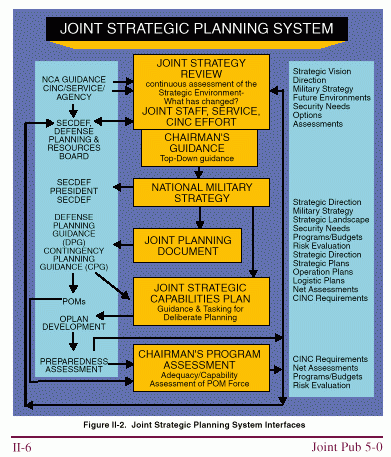
Refer to this diagram to see how the various parts of the JSPS
interrelate
502.4 Comprehend the relationship between national objectives
and means availability within the framework provided by the joint
planning processes [I.4(a)].
502.41 Explain the role of the
NSC System and National Security Strategy in the joint planning
process. (JP 5-0, Sec II)
Four interrelated defense planning systems (NSC System, Planning
Programming and Budgeting System (PPBS), Joint Strategic Planning
System (JSPS), and JOPES) directly impact the joint planning process.
NSC System: Principal forum for deliberation of national security
policy issues requiring Presidential decision. Provides the
framework for establishing national strategy and policy
objectives. NSC prepares national security guidance that,
with Presidential approval, implements national security policy.
These policy decisions provide the basis for military planning
and programming. The CJCS discharges a substantial part of
his statutory responsibilities as the principal military adviser
to the President and Secretary of Defense through the institutional
channels of the NSC.
502.42 Describe the major JSPS
products. (JP5-0, Sec II) (Both SOBs combined into one answer)
502.43 Explain the role of the
National Military Strategy in the joint planning process. (JP
5-0, Sec II) Note: These SOBs are favorite testing areas during
AU's warplanning course (CWPC)
Four Products of the JSPS
502.44 Summarize how the joint assessment tools serve the community as they link national objectives to means availability.
502.5 Comprehend the effect of time, coordination, policy changes, and political development on the planning process [I.4(b)].
Section changed to match toolbook.
502.51 Summarize the effect of
time, coordination, policy changes, and political development
on the various joint assessment tools. Didn't find
this verbatim in the reading, it's my analysis of the readings
plus some "real world" input (i.e. caveat emptor)
Each of the assessment tools is a convoluted process in and of
itself that's designed to assess and redirect a separate convoluted
process. None of these processes occur overnight. One year
to 18 months is probably the average process time. There are political
as well as military inputs to all these processes. Mid stream
policy shifts can cause any of these processes to regress or start
over. Bottom line: The system can get out of synch and you'll
have (for example) items in the PPBS cycle that are no longer
support by the NEW NMS. Obviously there are other examples.
502.52 Describe the phases of
the PPBS and the linkages between each phase.
Note: This is a favorite testing area for AU in their warplanning
course (CWPC)
Planning, Programming, and Budgeting System's ultimate objective is the acquisition and allocation of resources to meet the warfighting needs of the combatant commanders.
502.6 Comprehend how defense planning systems affect joint operational planning [I.4(c)].
Due to the inter-relationship of all these processes it's sometimes
difficult to find a clean cut answer to the following SOBs. With
that in mind, here goes . . .
General Comment: Keep in mind that the JSPS is a flexible and
interactive system intended to provide supporting military advice
to the DOD PPBS and strategic guidance for use in JOPES. The JSPS
provides the means for the CJCS, and combatant commanders, to
review the national security environments and national security
objectives of the US.
SOBs: The JSPS diagram is very useful for this area:
502.61 Explain how JOPES affect the JSPS.
The outcome of the deliberate planning side of the JOPES process
is an OPlan. The OPlan is based on inputs from the JSCP (a JSPS
product) and then the OPlan is analyzed for adequacy and capability
in the Chairman's Program Assessment (another JSPS product).
The results of the CPS are (eventually) incorporated into the
Chairman's guidance which affects the National Military Strategy
(another JSPS product) and the NMS is rolled into the JSCP which
begins the OPlan cycle again. Like I said all these processes
form a circle by design so that lessons learned are included in
the next cycle (at least in theory)
502.62 Explain how the Acquisitions System affects the JSPS. (Next two will be answered together)
502.63 Explain how the PPBS affects the JSPS.
PPBS is Planning, Programming and Budgeting System
Planning phase (as discussed before) develops the Defense Planning Guidance. The DPG (JP5-0, Fig II-3) is one of the cornerstones of the JSCP (JSPS product).
Programming phase (as discussed before) begins with the DPG and focuses on the development of Program Objective Memorandum (POM) to support warfighter requirements. The Chairman's Program Assessment (CPA, a JSPS product) assesses the adequacy and balance of this POM force
Budgeting phase eventually puts MONEY in the hands of the
services to procure forces and capabilities. Remember the JSCP
and the JOPES process is CAPABILITIES based. Therefore, if a capability
is missing the budgeting process (this is the simple version)
obtains the money to go and ACQUIRE this capability which can
then be included in future JSPS/JOPES cycles.
502.64 Explain how the joint assessment tools affect joint
operational planning.
Their intent is to provide objective capabilities-based assessment
of the differing aspects of operational planning. They identify
shortfalls, limiting factors, or changing strategic issues that
may be included in the JSCP, PPBS, etc. as required. The cleanest
connection is with the Contingency Planning Guidance. The CPG
is the source document for the JSCP. The JSCP is the starting
point for all joint operational planning. The JSCP is capabilities
based and apportions resources to combatant commanders.
502.65 Explain how the PPBS affects operational planning.
Reread how PPBS affects the JSPS SOB above. Additionally, the
PPBS is critical to obtaining new capabilities or being able to
sustain existing capabilities. It does no good to have a plan
that requires 40 fighter wing equivalents if the Budget only has
20 fighter wing equivalents. This is also why the planning process
cannot take into account FUTURE PPBS actions. (Have I mentioned
that it's capabilities based??)
502.66 Explain how the Joint Strategy Review affects operational
planning.
The JSR is the central PROCESS of the JSPS. THE JSR
IS NOT A PRODUCT OF THE JSPS. The JSR continually assesses
the strategic environment for issues and factors that affect the
National Military Strategy in either the near term or the long
term. Therefore, the JSR affects the NMS which affects the Joint
Planning Document, the JSCP, and subsequently joint operational
planning.
502.67 Explain how the Chairman's guidance affects operational
planning.
Uh . . . let's see . . . the Chairman GUIDES the JSPS which
drives every aspect of joint operational planning and any support
required for those plans. Chairman's guidance is TOP
DOWN and is driven by the continually ongoing Joint Strategy
Review.
502.68 Explain how the NMS affects operational planning.
The NMS is advice from the CJCS and combatant commanders to
the President, NSC, and SecDef. Designed to assist with preparation
of DPG and JSCP. Refer to the JSPS diagram for the ripple effect
of the NMS.
502.69 Explain how the Joint Planning Document affects operational
planning.
The JPD (in support of the NMS, [see above]) provides concise
programming priorities, requirements, or advice to SecDef for
preparation of the DPG.
502.610 Explain how the JSCP affects operational planning.
Slam dunk, guranteed test question. JSCP provides the strategic direction required to coordinate the planning efforts of the combatant commanders . THE JSCP IS THE LINK BETWEEN JSPS (STRATEGIC PLANNING) AND JOINT OPERATIONAL PLANNING ACCOMPLISHED THROUGH JOPES. The JSCP performs the following:
502.611 Explain how the Chairman's program assessment affects
operational planning.
The POM identifies priorities and presents a balance of forces.
The CPS analyzes the balance of that POM force structure and determines
if it can meet the national objectives. Referring again to the
JSPS diagram you can see that the JSCP initiates the OPlan development
cycle. At the end of the OPlan cycle is the Plans Review phase
performed by the Chairman based upon the criteria of adequacy,
feasibility, acceptability, and compliance with joint doctrine.
This is all rolled into the CPA.
COURSE OBJECTIVES:
Comprehend the concepts and processes involved in developing joint doctrine, creating joint command relationships, and assessing joint readiness.
Comprehend the concepts and processes involved in planning and training for participation in joint activities and the processes used by combatant commanders to assess joint readiness.
Comprehend how campaign concepts are used at the operational level
of warfare.
READINGS:
READING RATIONALE: Changes: Reading rationales tailored to match lesson.
Joint Pub 1, Joint Warfare of the Armed Forces of the United States, outlines and introduces the basic principles of joint doctrine. Study the introduction and chapter I.
Joint Pub 3-0, Doctrine for Joint Operations, is the keystone publication for Joint Operations doctrine and describes the principles needed to understand how the US operates in a joint environment. Study the introduction and chapter III.
Joint Pub 5-0, Doctrine for Planning Joint Operations, sets forth fundamental principles and doctrine that guide planning by the Armed Forces of the US in joint or multinational operations. Study chapter II.
Joint Doctrine Capstone and Keystone Primer, provides a nice summary of the Capstone and Keystone publications. Study the chapter on the "Joint Doctrine Story."
Chairman Joint Chiefs of Staff Manual 3500.03, is the joint training
manual for our armed forces. Study chapter IV on developing the
joint mission essential task list.
LESSON OUTLINE:
Thesis: The Goldwater-Nichols Act of 1986 was the catalyst
for change and improvement in the joint doctrine and policy arena.
With the commitment of General Shalikashvili "...we must
give joint doctrine the attention it deserves and we must get
it right," and hard work by the joint staff and military
services, joint warfighters in 1995 have more readable and consistent
joint doctrine and policy than they have ever had before. Now
our challenge is to understand it, apply it and continue to make
improvements where needed. This lesson provides the students with
an overview of the current joint doctrine hierarchy and development
process, and introduces them to specific doctrine, principles
and policy governing the unified direction of forces.
Main Point I: Current joint doctrine and the joint doctrine publications hierarchy
a. Roles and limitations of current joint doctrine
b. Understanding current joint publications
Main Point II: Factors influencing joint doctrine
a. Players and process for developing joint doctrine
b. Changes to the joint policy development process
Main Point III: The relationship between service doctrine and joint doctrine
a. Authority of joint doctrine versus service doctrine
b. The relationship of service to joint doctrine in multinational/interagency
ops
c. The relationship of service to joint doctrine when preparing
plans for joint activities and performance
Main Point IV: National level planning systems tie national objectives to means
a. The National Security Council System and National Security
Strategy
b. The National Military Strategy
c. The other national joint planning systems (PPBS and Acquisition)
d. JSPS products: National Military Strategy, Joint Planning Document,
Joint Strategic Capabilities Plan, Chairman's Program Assessment
Main Point V: The effect of time, coordination, policy changes, and political development on the planning process
a. How time affects the joint strategic planning process
b. How the JSPS is coordinated
c. How policy changes affect the JSPS
d. How political development affects the JSPS
Main Point VI: The interrelationships of JSPS to the other defense planning systems
a. NSC
b. JOPES
c. PPBS (Joint Pub 5-0, pp II-5)
Main Point VII: Explain how the JSPS affects operational planning
a. Creates the Joint Strategy Review
b. Creates the Chairman's Guidance
c. Creates the NMS
d. Creates the Joint Planning Document
e. Creates the JSCP
f. Creates the Chairman's Program Assessment
Main Point VIII: The joint assessment process
a. The strategic environment, budget, law, emerging military technologies,
requirements and acquisition leading to creation of the joint
assessment process
b. JROC/JWCA: the players, CinCs' roles, JWCA cycle, and what
the JROC decides
c. Other assessment tools: Chairman's Program Assessment, Chairman's
Program Recommendation, Joint Military Net Assessment, EJROC,
FRAC, SROC, and JMRR
Main Point IX: PPBS Overview
a. The players, the databases, program changes (PCRs) and security PPBS and the Defense Planning Guidance (DPG)
b. Planning: National level guidance, Defense Planning Guidance,
JSPS
c. Programming: POM, Chairman's Program Assessment, Program review
issues Budgeting: Budget Estimate Submission, Budget Review, Summary
and President's Budget
d. The big picture: a continuous process, sequence of events,
and cycle overlap
Main Point X: Describe the UJTL and its structure
a. The need for universal training Tasks, universal tasks, and
joint universal tasks (a list of joint capabilities and competencies)
b. National, strategic, operational, and tactical levels of war
(using the UJTL as a framework, commanders train and employ forces
at the operational level of war)
Main Point XI: Describe how the JMETL is derived and how CinCs employ the
a. UJTL and JMETL to establish capabilities required to execute
an assigned mission
b. Missions consist of tasks
c. Mission tasks become essential tasks for commanders (the JMETL)
d. Training is conducted based on the JMETL
e. JMETL is used as an assessment tool
Main Point XII: Use the UJTL/JMETL as a framework for joint and multinational activities at the operational level of war
a. Joint operation planning, the UJTL, and a joint force commander's
JMETL
b. An evolving process
c. Current doctrine and the UJTL/JMETL
LESSON INTEGRATION AND RATIONALE:
This lesson combines and explains the tools used to coordinate and assess Joint Operational Planning and Execution through current doctrine. The student will gain an understanding of the Joint Strategic Planning System (JSPS), the Joint Requirements Oversight Council (JROC), the Joint Warfighting Capabilities Assessment (JWCA), and the Planning, Programming, and Budgeting System (PPBS). Further, this lesson will include the significance of the Universal Joint Task List (UJTL) and the Joint Mission Essential Task List (JMETL).
LESSON OPR: Joint Operations and Campaign Studies Department