JO 501 - DISCUSSION QUESTIONS:
1. Explain the assignment and transfer
of forces to a Joint Force.
- Forces, not command relationships, are
transferred between commands. When forces are transferred, the
command relationship the gaining commander will exercise (and
the losing commander will relinquish) over those forces must be
specified.
- When the transfer of forces to a joint
force will be permanent (or for an unknown but long period of
time) the forces should be reassigned. Combatant commanders will
exercise combatant command (command authority) and subordinate
joint force commanders (JFCs) will exercise operational control
(OPCON) over reassigned forces.
- When transfer of forces to a joint force
will be temporary, the forces will be attached to the gaining
command and JFCs will exercise OPCON or Tactical Control (TACON),
as appropriate, over the attached forces.
- Establishing authorities for subordinate
unified commands and joint task forces direct the assignment or
attachment of their forces to those subordinate commands as appropriate.
2. List and describe the command relationships
used in joint operations.
- Combatant Command (command authority or COCOM).
Nontransferable command authority exercised only by commanders
of unified or specified combatant commands unless otherwise directed
by the President or the Secretary of Defense. COCOM cannot
be delegated and is the authority of a combatant commander
to perform those functions of command over assigned forces involving
organizing and employing commands and forces, assigning tasks,
designating objectives, and giving authoritative direction over
all aspects of military operations, joint training, and logistics
necessary to accomplish the missions assigned to the command.
Operational control (OPCON) inherent in combatant command (command
authority). Also called. (Joint Pub 1-02)
- Operational control (OPCON) Transferable
command authority that may be exercised
by commanders at any echelon at or below the level of combatant
command. Operational control is inherent in combatant command
(COCOM). Operational control may be delegated and is
the authority to perform those functions of command over subordinate
forces involving organizing and employing commands and forces,
assigning tasks, designating objectives, and giving authoritative
direction necessary to accomplish the mission. Operational control
includes authoritative direction over all aspects of military
operations and joint training necessary to accomplish missions
assigned to the command.. Operational control normally provides
full authority to organize commands and forces and to employ those
forces as the commander in operational control considers necessary
to accomplish assigned missions. Operational control does not,
in and of itself, include authoritative direction for logistics
or matters of administration, discipline, internal organization,
or unit training. (Joint Pub 1-02)
- Tactical Control (TACON). Command authority over assigned
or attached forces or commands, or military capability or forces
made available for tasking, that is limited to the detailed and,
usually, local direction and control of movements or maneuvers
necessary to accomplish missions or tasks assigned. Tactical control
is inherent in OPCON. Tactical control may be delegated
to, and exercised at any level at or below the level of combatant
command. (Joint Pub 1-02)
3. List and explain the four categories
of support used in joint operations.
- General Support
The action that is given to the supported force as a whole rather
than to a particular subdivision thereof.
- Mutual Support
The action that units render each other because of their assigned
tasks, their position relative to each other, and their inherent
capabilities.
- Direct Support
A mission requiring a force to support another specific force
and authorizing it to answer directly the supported force's request
for assistance.
- Close Support The
action of the supporting force against targets or objectives that
are sufficiently near the supported force as to require detailed
integration or coordination of the supporting action with fire,
movement, or other actions of the supported force.
4. Explain the link between the National
Command Authority (NCA), the Chairman of the Joint Chiefs of Staff,
and the Combatant Commanders.
- The NCA exercises authority and control
of the Armed Forces through a single chain of command with
two distinct branches. The first runs from the President,
through the Secretary of Defense, to the commanders of combatant
commands for missions and forces assigned to their commands. The
second branch, used for purposes other than operational direction
of forces assigned to the combatant commands, runs from the President
through the Secretary of Defense to the Secretaries of the Military
Departments. The Military Departments, organized separately, each
operate under the authority, direction, and control of the Secretary
of Defense. The Secretaries of the Military Departments exercise
authority, direction, and control, through the individual Chiefs
of the Services, of their forces not specifically assigned to
combatant commanders.
- The commanders of combatant commands
exercise combatant command (command authority) (COCOM) of assigned
forces and are directly responsible to the NCA for
the performance of assigned missions and the preparedness of their
commands..
- The President, through the Secretary
of Defense, with the advice and assistance of the Chairman
of the Joint Chiefs of Staff, establishes combatant (unified
or specified) commands for the performance of military
missions and prescribes the force structure of such commands.
- The Chairman of the Joint Chiefs of
Staff assists the President and Secretary of Defense in performing
their command functions. The Chairman transmits to
the commanders of the combatant commands the orders given
by the NCA and, as directed by the Secretary of Defense, also
oversees the activities of those commands. Orders will
be issued by the President or the Secretary of Defense and
are normally conveyed by the Chairman of the Joint Chiefs of Staff
by authority and direction of the Secretary of Defense..
5. Discuss the impact of the Nichols-Goldwater
Act of 1986 on the military operations of the United States.
The Goldwater-Nichols Department of Defense Reorganization Act
of 1986 makes the following statement of policy:
"In enacting this Act, it is the intent of Congress, consistent
with the congressional declaration of policy in section 2 of the
National Security Act of 1947 (50 U.S.C. 401)--
- to reorganize the Department of Defense and strengthen civilian
authority in the Department;
- to improve the military advice provided to the President,
the National Security Council, and the Secretary of Defense;
- to place clear responsibility on the commanders of the unified
and specified combatant commands for the accomplishment of missions
assigned to those commands;
- to ensure that the authority of the commanders of the unified
and specified combatant commands is fully commensurate with the
responsibility of those commanders for the accomplishment of missions
assigned to their commands;
- to increase attention to the formulation of strategy and to
contingency planning;
- to provide for more efficient use of defense resources;
- to improve joint officer management policies; and
- otherwise to enhance the effectiveness of military operations
and improve the management and administration of the Department
of Defense."
- The key among these changes was vesting overall
responsibility for the development of joint doctrine with
a single individual, the Chairman of the Joint Chiefs of
Staff.
6. List and explain the seven general functions
of a Combatant Commander.
- Giving authoritative direction to subordinate
commands and forces necessary to carry out missions assigned to
the command, including authoritative direction over all aspects
of military operations, joint training, and logistics.
- Prescribing the chain of command to the
commands and forces within the command.
- Organizing commands and forces within
that command as necessary to carry out missions assigned to the
command.
- Employing forces within that command as
necessary to carry out missions assigned to the command.
- Assigning command functions to subordinate
commanders.
- Coordinating and approving those aspects
of administration, support (including control of resources and
equipment, internal organization, and training), and discipline
necessary to carry out missions assigned to the command.
- Exercising the authority with respect
to selecting subordinate commanders, selecting combatant command
staff, suspending subordinates, and convening courts-martial as
delineated in chapter 6, title 10, US Code.
7. Explain the basic organizational structure
of a joint force including, the difference between functional
responsibility and service components.
Organizing Joint Forces. A
JFC has
the authority to organize forces
to best accomplish the assigned
mission based on the concept of operations. The organization should
be sufficiently flexible to meet the planned phases of the contemplated
operations and any development that may necessitate a change in
plan. The JFC will establish
subordinate commands, assign responsibilities,
establish or delegate appropriate
command and support relationships,
and establish coordinating instructions
for the component commanders.
All joint forces include Service component
commands because administrative
and logistic support for joint forces are provided through Service
component commands.
The JFC can establish functional
component commands to conduct operations.
Functional component commands can be appropriate when forces
from two or more Military Departments must operate in the same
dimension or medium or there is a need to accomplish a distinct
aspect of the assigned mission.
Joint force land, air, maritime, and special operations component
commanders are examples of functional components. (NOTE: Functional
component commands are component
commands of a joint force and do
not constitute a "joint force" with
the authorities and responsibilities of a joint force as described
in this document even when composed of forces from two or more
Military Departments.) Most often, joint forces are organized
with a combination of Service
and functional component commands with
operational responsibilities. Joint forces organized with Army,
Navy, Air Force, and Marine Corps components will have special
operations forces (if assigned)
organized as a functional component.
The JFC defines the authority
and responsibilities of the
Service and functional component commanders; however, the Service
responsibilities (i.e., administrative and logistic) of the components
must be given due consideration by the JFC.
8. What is the role of joint doctrine?
Who is responsible for the development of joint doctrine? Explain
the difference between authoritative and directive and which term
applies to joint doctrine.
Joint doctrine offers a common perspective
from which to plan and operate, and fundamentally shapes the way
we think about and train for war. Though neither policy
nor strategy, joint doctrine deals with the fundamental issue
of how best to employ the national military power to achieve strategic
ends. As such, it represents authoritative guidance for
the joint employment of the Armed Forces. A large body of joint
doctrine has been and is being developed by the Armed Forces of
the United States through the combined effort of the Joint Staff,
Services, and combatant commands.
Directive is - A military communication in which policy
is established or a specific action is ordered. 2. A plan issued
with a view to putting it into effect when so directed, or in
the event that a stated contingency arises.
9. Explain the joint doctrine publication
hierarchy, including a discussion of the capstone and keystone
documents, and what staff directorate is responsible for the publication
of joint doctrine.
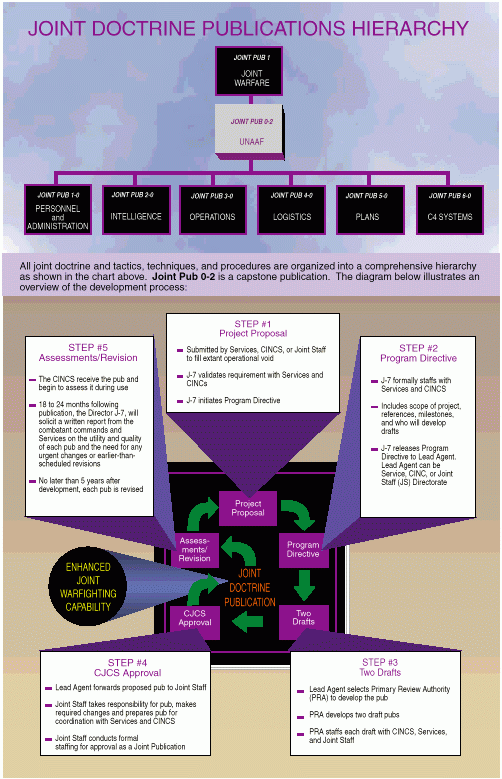
Capstone Documents:
JP 1 - Joint Warfare, JP 0-2 - UNAFF
Keystone: JP 1-0 - Personnel and Administration, JP 2-0
- Intel, JP 3-0 - Operations, JP 4-0 - Logistics, JP 5-0 - Plans,
JP 6-0 - C4 Systems.
10. What is a joint task force (JTF)? Who
has the authority to establish a joint task force and explain
the capabilities and limitations of a JTF?
A joint task force (JTF) is a joint
force that is constituted and so designated by the Secretary
of Defense, a combatant commander, a subordinate unified command
commander, or an existing joint task force commander.
A JTF is dissolved by the proper authority
when the purpose for which it was created has been achieved
or when it is no longer required. b. The authority establishing
a JTF designates the commander and assigns the mission and forces.
The commander of a JTF exercises OPCON
over assigned and normally over attached forces. The commander
is responsible for making recommendations to the superior commander
on the proper employment of assigned and attached forces and
for accomplishing such operational missions as may be assigned
by the establishing commander