MY ADOPTED NAVY POW/MIA

"This page is dedicated to Lt.Dickson's family and friends"
Name: Edward Andrew Dickson
Rank/Branch: 03/US
Navy Reserves
Unit: Attack Squadron 155, USS CORAL
SEA(CVA-43)
Date of Loss: 07 February 1965
Country of
Loss: North Vietnam/Over Water Loss Coordinates:173200N
1063600E (XE707391) Status (in 1973):
Killed/Body Not
Recovered Category: 2 Aircraft/Vehicle/Ground:
A4E
Refno: 0053
Other Personnel in Incident: (none
missing)
Source: Compiled by Homecoming II Project 15 May
1990 with the assistance of Task Force Omega from one or
more of the following: raw data from U.S. Government agency
sources,and interviews. Updated by the P.O.W. NETWORK 1998.
REMARKS: EJECTED-NO PARA-SEAT-J
SYNOPSIS: By early January,1965 following two
significant military defeats at the hands of North
Vietnamese guerrilla forces, the Army of the Republic of
South Vietnam was near collapse; U.S.options were either to
leave the country or increase its military activity.
President Johnson chose to escalate. Plans were authorized
for a "limited war" that included a bombing campaign in
North Vietnam.
The first major air strike over North Vietnam took place
in a reaction to the Viet Cong mortaring of an American
advisor's compound at Pleiku on Friday Feb.07 1965.Eight
Americans died in the attack, more than one hundred were
wounded, and ten aircraft were destroyed. President Johnson
immediately launched FLAMING DART I, a strike against the
Viet Thu Lu staging area, fifteen miles inland and five
miles north of the demilitarized zone
(DMZ).
 Thirty-four aircraft launched from the USS RANGER, but
were
prevented from carrying out that attack by poor weather,
and the RANGER aircraft were not allowed to join the
forty-nine planes from the USS CORAL SEA and the USS
HANCOCK, which struck the North Vietnamese army barracks
and port facilities at Dong Hoi.
Thirty-four aircraft launched from the USS RANGER, but
were
prevented from carrying out that attack by poor weather,
and the RANGER aircraft were not allowed to join the
forty-nine planes from the USS CORAL SEA and the USS
HANCOCK, which struck the North Vietnamese army barracks
and port facilities at Dong Hoi.
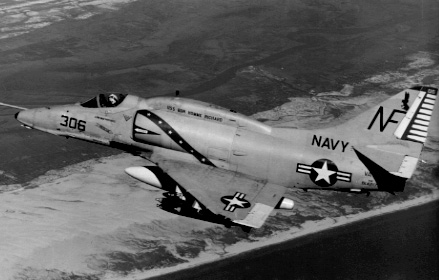
Lt. Edward A. Dickson was an A4E Skyhawk pilot assigned
to attack squadron 155 onbroard the CORAL SEA. Dickson was
a
section leader in a four-plane flight on the strike a Dong
Hoi. About 5 miles south of the target area, Lt.Dickson
reported that his aircraft had been hit by ground fire. His
wingman was instructed to look his aircraft over for damage
as they continued to approach the final run-in to the
target.
Just prior to reaching the bomb release point, Lt.
Dickson's left wing burst into flames and the wingman
notified that fact. At this time the flight leader gave the
signal to drop the bombs. Dickson continued in his bomb
run, turning out to sea only after his last bomb had left
the aircraft. Upon completing the bombing run, the flight
made an immediate turn to head for the sea, and for easier
rescue. As the flight continued to the coastline it was
noted that the left wing of Dickson's aircraft was
completely engulfed in flames. He was instructed to eject,
the canopy and ejection seat were observed to leave the
plane.
 Partly because the aircraft were traveling at a high
rate of speed, no one was sure Dickson himself left the
aircraft, nor was a parachute seen deployed. The crippled
A4 crashed into the Gulf of Tonkin approximately one-half
mile off shore. Search and rescue facilites were alerted
and accompanying aircraft circled in the vicinity of the
crash for roughly 15 minutes without being able to locate
their downed comrade. Weather conditions in the target area
were overcast with multiple stratus cloud layers. The
search was terminated two days later with no
results.
Partly because the aircraft were traveling at a high
rate of speed, no one was sure Dickson himself left the
aircraft, nor was a parachute seen deployed. The crippled
A4 crashed into the Gulf of Tonkin approximately one-half
mile off shore. Search and rescue facilites were alerted
and accompanying aircraft circled in the vicinity of the
crash for roughly 15 minutes without being able to locate
their downed comrade. Weather conditions in the target area
were overcast with multiple stratus cloud layers. The
search was terminated two days later with no
results.
Lt.Dickson, because he was lost over water, was
classified
Killed in Action/Body Not Recovered. His name is listed
among the missing because no remains were ever recovered to
return home.
The strike was judged at best an inadequate reprisal. It
accounted for sixteen destroyed buildings.
THE COST? The loss of one A4E Skyhawk pilot from
the USS CORAL SEA and eight damaged
aircraft.
Lt.Dickson's loss was indeed ironic, or possibly just
symbolic of the deadly business of naval aviation. One year
earlier, Dickson had narrowly evaded death after ejecting
from a A4 during a training exercise over the Sierra Nevada
range in California. His parachute failed to open, but
Dickson landed in a thirty-foot snowdrift and
survived.
Edward A. Dickson is one of nearly 2500 Americans still
missing from the Vietnam war. Some certainly died. However
it is not totally clear that Lt. Dickson actually died when
his aircraft went down, or in a faulty ejection, or if he
survived to make it to shore or to be picked up by boats in
the area. Like many cases of those missing, Lt.Dickson's
case is unclear.
Speculation continues that Americans are still alive in
Southeast Asia, waiting for their country to free them. It
is not beyond comprehension that Lt. Edward A. Dickson
could be one of them.
"If so, what must he think of
us?"





 Want to join the"International Hall of Honor
Web Ring"
Want to join the"International Hall of Honor
Web Ring"