Advantages
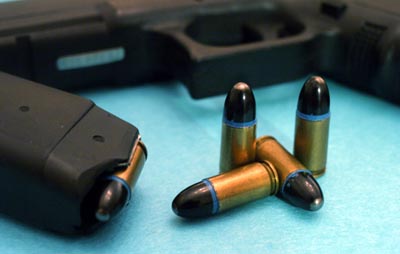
There are several forms of plastic ammunition available that are intended for training purposes. Perhaps the most common variety is a lightweight plastic round-nose bullet in a plastic cartridge case or a standard metal case as pictured above. This type of ammunition is not commonly made in the U.S., but it's available as military surplus from a variety of countries in a variety of calibers. The most commonly available calibers seem to be 9mm Parabellum (the Swedish-made sample in the photo), and 7.62x39 Russian, though German-made 7.65mm (.32 ACP) was commonly available at one time.
Plastic ammunition is patterned after standard cartridges, so it will feed and fire in any firearm designed for that cartridge. It allows the use of one's actual weapon (assuming there's ammo available in that caliber) for better, more integrated training. Plastic ammunition can be used with minimal backstops since the bullets don't carry much energy and thus don't pose much of an overpenetration risk. That means that plastic ammunition can often be used indoors for marksmanship training with simple bullet traps (hanging carpet boxes or styrofoam blocks). Plastic ammunition has low recoil and typically a low report signature, making it good for firearms familiarization training. Also, plastic ammunition is generally very affordable if purchased as military surplus; at the time of this writing, Swedish 9mm plastic rounds were $30 for a case of 864 rounds. Comparable "live" ball ammo would run around three times as much.
Disadvantages
There are several disadvantages to plastic training ammo. The first is that since the bullet is so light (and, generally, so are the powder loads), there isn't enough energy to cycle the action on a semi- or full-auto firearm. Each round has to be cycled manually. The second disadvantage is the unpredictable accuracy. The Swedish ammo seems to depend highly on the type of rifling in a firearm's barrel. Most standard rifling seems to give acceptable results to ten or fifteen yards, but the polygon rifling on Glocks and some H&Ks yields poor accuracy with the plastic ammo. Poor as in not being able to hit a human-sized silhouette target at ten yards.
There are rarer systems for plastic ammuntion; Glock makes dedicated training firearms that fire only plastic bullets, and H&K makes dedicated P7 and MP5 variants for training and, reportedly, tactical operations aboard aircraft.
Overall, plastic training ammo is a below-average training tool. It's affordable and you can use your duty weapon (if there's plastic ammo available for it), but the accuracy is unpredictable and the weapons's action needs to be cycled by hand betwen shots.