"If we open a quarrel between the past and the present,
we shall find that we have lost the future."
Winston Churchill (1874 - 1955)

As told by General Frederick C. Weyand, U.S. Army (ret.)
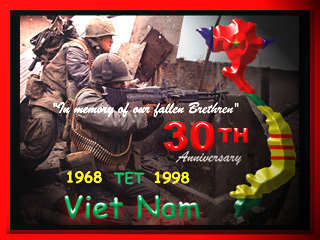
During the Viet Cong's 1968 Tet Offensive, General Weyand's timely and effective maneuver of II Field Force's combat elements--including the U.S. 1st Infantry Division, 9th Infantry Division, 25th Infantry Division, 101st Airborne Division, 199th Light Infantry Brigade, 11th Armored Cavalry Regiment and the Australian Task Force--was instrumental in saving Saigon from capture and in the subsequent rout of the VC attackers.
In the early morning hours of January 31st, the first day of the Vietnamese New Year, NLF/NVA troops and commandos attacked virtually every major town and city in South Vietnam as well as most of the important American bases and airfields. There were some earlier attacks around Pleiku, Quang Nam, and Darlac but these were largely misinterpreted as the enemy's main thrust by those who were expecting some activity during Tet Almost everywhere the attacks came as a total surprise. Vast areas of Saigon and Hue suddenly found themselves "liberated" and parades of gun-waving NVA/VC marched through the streets proclaiming the revolution while their grimmer-minded comrades rounded up prepared lists of collaborators and government sympathizers for show trials and quick executions.
In Saigon, nineteen VC commandos blew their way through the outer walls of the US Embassy and overran the five MP's on duty in the early hours of that morning. Two MP's were killed immediately as the action-team tried to blast their way through the main Embassy doors with anti-tank rockets. They failed and found themselves pinned-down by the Marine guards who kept the VC in an intense firefight until a relief force of US lO1st Airborne landed by helicopter. By mid-morning, the battle had turned. All nineteen VC were killed, their bodies scattered around the Embassy courtyard. Five Americans and two Vietnamese civilians were among the other dead. The commandos had been dressed in civilian clothing and had rolled-up to the Embassy in an ancient truck. The security of the Embassy was not in serious danger after the first few minutes and the damage was slight but this attack on 'American soil" captured the imagination of the media and the battle became symbolic of the Tet Offensive throughout the world. Other NVA/VC squads attacked Saigon's Presidential Palace, the radio station, the headquarters of the ARVN Chiefs of Staff, and Westmoreland's own MACV compound as part of a 7O0 man raid on the Tan Son Nhut air-base. During the heavy fighting that followed, things became sufficiently worrying for Westmoreland to order his staff to find weapons and join in the defense of the compound. When the fighting at Tan Son Nhut was over, twenty-three Americans were dead, eighty-five were wounded and up to fifteen aircraft had suffered serious damage. Two NVA/VC battalions attacked the US air-base at Bien Hoa and crippled over twenty aircraft at a cost of nearly 170 casualties. Further fighting at Bien Hoa during the Tet offensive would take the NVA/VC death total in Saigon to nearly 1200. Other VC units made stands in the French cemetery and the Pho Tho race track. The mainly Chinese suburb of Cholon became virtually a NVA/VC operations base and, as it later turned out, had been the main staging area for the attacks in Saigon and its immediate area. President Thieu declared Marshal law on January 31st but it would take over a week of intense fighting to clear-up the various pockets of resistance scattered around Saigon. Sections of the city were reduced to rubble in heavy street by street fighting. Tanks, helicopter gunships, and strike aircraft blasted parts of the city as entrenched guerrillas fought and then slipped off to fight somewhere else. The radio station, various industrial buildings, and a large block of lowcost public housing were leveled along with the homes of countless civilians who were forced to flee. The city dissolved into a chaos which took weeks to begin to put right.
The fighting within Saigon itself was pretty much over by February 5th but it carried on in Cholon until the last week of the month. Cholon was strafed, bombed, and shelled but the NVA/VC held on and even mounted sporadic counter-offensives against US/ARVN positions within the city and against Tan Son Nhut airport. B-52 strikes against communist positions outside Saigon came within a few miles of the city When the NVA/VC were finally driven out of Saigon's suburbs, they retreated into the surrounding government villages and fought there. US and ARVN artillery and strike-aircraft bombed and shelled these supposedly pacified villages before troops moved in to reoccupy them. The NVA/VC repeated this tactic again and again in a clear effort to make the Saigon Government destroy their own fortified villages and, by doing so, further alienate the rural population. A month after the offensive began, US estimates put the number of civilian dead at some 15,000 and the number of new refugees at anything up to two million and still the battles went on.
More Tet 1968
Tet Offensive marked turn in war
by John Omicinski
Gannett News ServiceWASHINGTON - Thirty years ago this week, events in Southeast Asia changed the U.S. presidency, the press, the public and the Pentagon in ways still reverberating.
On Jan. 30-31, 1968, North Vietnamese troops and their Viet Cong guerrilla allies in South Vietnam mounted a coordinated series of shock attacks on more than 30 supposedly safe cities - including the South's capital, Saigon.
The Tet Offensive became a watershed news story, changing not only military realities but American politics, journalism and culture. It also came at the beginning of 1968 which, as it turned out, would be overloaded with tragic events.
"There's no doubt Tet was one of the biggest events in contemporary American history," said Don Oberdorfer, a former Washington Post reporter whose 1971 book "Tet!" remains a central study of those era-changing weeks. "Within two months, the American body politic turned around on the war. And they were significantly influenced by events they saw on television."
North Vietnamese leader Ho Chi Minh's attackers timed the wave of assaults to catch U.S. and South Vietnamese troops off guard during the big Asian holiday, called Tet. Nonetheless, they suffered more than 58,000 deaths and suffered serious military setbacks in succeeding weeks.
U.S. troops lost 3,895 in the next 12 weeks, but the American press portrayed Tet as a severe loss for American and South Vietnamese troops. That happened partly because Gen. William Westmoreland and U.S. officials said, before Tet, that U.S. efforts had "turned a corner" in Vietnam.
Tet produced a famous quote from a still-unnamed (and perhaps non-existent) U.S. officer: "We had to destroy the village in order to save it." And it produced the My Lai massacre, when some U.S. troops went haywire and executed unarmed Vietnamese villagers.
Perhaps most famously, it produced Associated Press photographer Eddie Adams's Pulitzer Prize-winning photo of South Vietnam's national police chief, Brig. Gen. Nguyen Ngoc Loan, executing a Viet Cong officer on the streets of Saigon with a pistol shot to his head.
In graphic television footage and newspaper photos, Americans saw images of Viet Cong guerrillas breaching the U.S. Embassy compound in Saigon and two Marines dragging a wounded and bloodied buddy from fighting in Hue.
News film from the battlefields was by 1968 transmitted from Tokyo via satellite. Often, the unedited film went straight onto the airwaves for the evening news in jumbled, unexplained minutes that gave the war an even more chaotic look. Within days of the Tet attacks, American campuses were in an uproar. Within weeks, many average Americans suddenly turned against the war.
And within two months, after dove Eugene McCarthy made a strong showing in the March 12 New Hampshire Democratic presidential primary, President Johnson shocked the nation by taking himself out of the 1968 race.
Johnson's withdrawal came as a complete surprise and shock to a nation still reeling from the unexpected events in Vietnam.
Regarded as a watershed, too, was press icon Walter Cronkite's Feb. 27, 1968, broadcast saying the war was "mired in stalemate" and the "only rational way out then will be to negotiate, not as victors, but as honorable people . . . "
Cronkite's shift into the opposition camp - followed in short order by the editors and opinion-makers at Time and Life magazines - made it acceptable and almost fashionable for journalists to oppose the war.
"For the first time in modern history," wrote Robert Elegant of the Los Angeles Times, "the outcome of a war was determined not on the battlefield but on the printed page and, above all, on the television screen."
Back to Main Page