
RAH-66 Comanche
The RAH-66 Comanche is the helicopter of tomorrow. It is being tested in the field at different locations at this posting
The Comanche RAH-66 is the US Army's new Reconnaissance and Attack Helicopter being developed by Boeing Sikorsky. The first flight of the Comanche took place on 4th January 1996. Production is scheduled to start in the year 2004 but the US Department of Defence has approved an operational capability program which requires six additional Comanche helicopters to be manufactured in the year 2001 for operational testing by the US Army.
MISSIONS
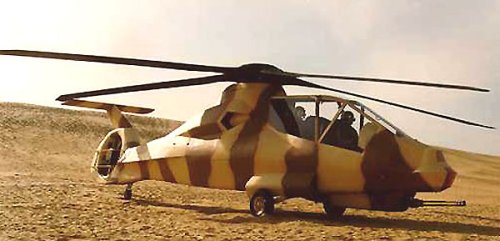
In an armed reconnaissance mission, Comanche can locate and classify threats, recognise and identify targets and digitally transmit the information to the battlefield commander in near real-time, select the optimum force deployment and co-ordinate the attack.
RECONNAISSANCE
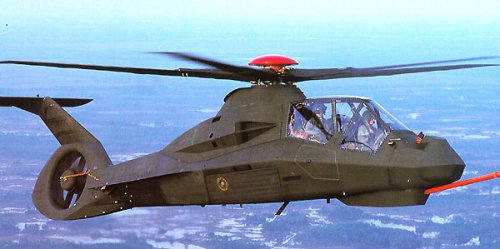
The Comanche is equipped with a suite of passive sensors which provide a target identification range 2 times greater than provided on current generation helicopters. To enhance the survivability, a computer aided mission planning system is provided.
The on board computer systems carry out sensor data fusion, high speed analysis and correlation of the sensor data. The analysed target and battlefield situation data is presented to the crew in the cockpit displays or transmitted to other elements of the force, providing direct relay of near real time intelligence.
GUN
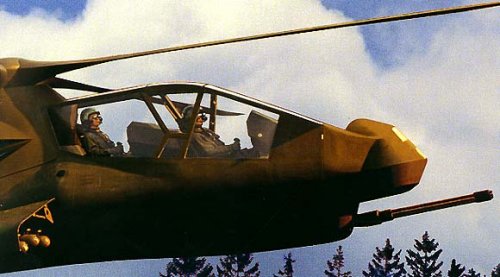
The Comanche is equipped with a stowable three-barrel 20 millimetre Gatling gun from General Electric. The gun, with up to 500 rounds of ammunition, is mounted on a Giat turret under the nose of the helicopter. The Gatling gun is capable of firing 750 or 1,500 rounds per minute
MISSILES
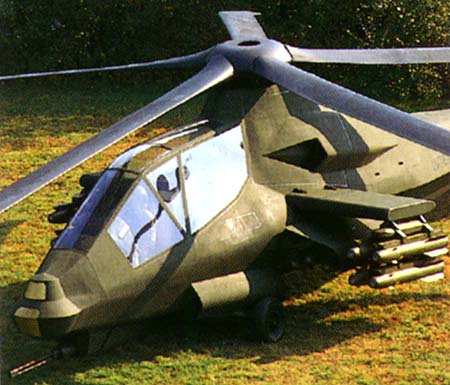
The Comanche carries its weapons internally and has a weapons bay on each side of the fuselage. The missiles are mounted on the weapon bay doors which open sideways. The missiles fire within three seconds of the bay doors opening. Missiles which fit the internal weapon bay include the Sura D 81 mm rocket, Euromissile Hot II, AIM-92 Stinger, Oerlikon Snora 81 mm Rocket, Starstreak, TOW II, Hydra 70 rocket, Matra Mistral, the Army Counter Air Weapon System,and the Longbow Hellfire missile.
The number of missiles on each door mounting varies according to the size of the missile system, for example each door will hold three Hellfire or six Stinger missiles. The helicopter can be reconfigured with optional stub wings fitted with multiple weapon pylons which carry an additional four Hellfire or eight Stinger missiles.
SENSORS
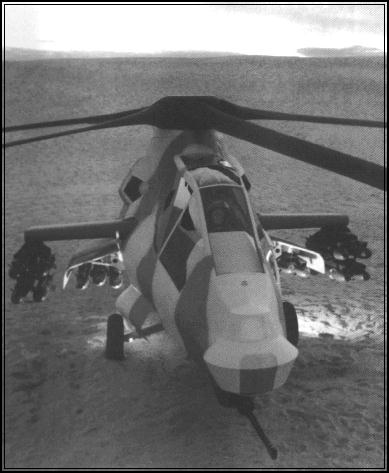
The nose of the helicopter houses an infra-red piloting sensor incorporating a low visibility image intensifier. The long range second generation forward looking infra-red (FLIR) system and television targeting sensor is also located in the nose. The Comanche can be fitted with the Longbow fire control radar from Westinghouse and about one third of the fleet are being equipped with the Longbow radar
COUNTERMEASURES
The helicopter is equipped with a laser warner, radar warner and radar and infrared jammers.
COCKPIT
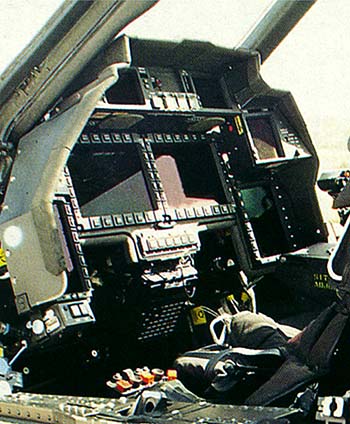
The Comanche has two identical cockpits in a stepped configuration for the pilot and the co-pilot. The cockpits are sealed and have a positive pressure air system for protection against chemical and biological warfare. The crash resistant crew seats are rated to resist a 40 feet per second vertical landing.
The cockpit is fitted with a night vision pilotage system from Lockheed Martin and the pilots have a wide field of view, 35 degree x 52 degree, Kaiser and Hamilton Standard helmet mounted display for head-up flying. The targets are designated and the weapons fired from collective and sidestick control push buttons.
Each integrated cockpit has flat screen liquid crystal displays, a colour display for a moving map, tactical situation and night operation display. The digital map system is an upgraded version of the system installed on the F-117. The avionics is based on three redundant databuses, a current generation Military Standard 1553B bus, a high speed and a very high speed fibre optic bus for signal data.
COMMUNICATIONS
The helicopter is equipped with an identification friend or foe (IFF) interrogator and a dual jam resistant VHF-FM / UHF-AM Have Quick tactical communications system.
NAVIGATION
The helicopter has a global positioning system, a radar altimeter and an attitude heading reference system, AHRS, from Litton.
ENGINES
The Comanche ie equipped with two T-800-LHT-801 turboshaft engines from LHTec with a maximum rated power of 1,563 shaft horsepower each. The internal fuel capacity of the helicopter is 1,142 litres. In field conditions three soldiers can refuel and rearm the Comanche in less than 15 minutes.
SURVIVABILITY
The small cross-section and the all-composite airframe construction of the Comanche provides very low detectability. The airframe is crashworthy and ballistically tolerant to 23 mm gunfire. In the event of impact the Comanche's separate redundant systems help assure safe return. The helicopter systems are hardened against electromagnetic interference.
The radar cross section has been minimised, primarily by the precisely shaped fuselage and internal weapons configuration. A low acoustic signature is achieved by an advanced rotor design.
The helicopter has a five-bladed bearingless main rotor and a fantail anti-torque system. The rear rotor is able to withstand impact by 12.7 mm rounds and operates for 30 minutes with one blade missing. The rear rotor provides a 180 degree turn in 4.7 seconds in hover mode and an 80 knot snap-turn-to-target in 4.5 seconds. Cooled engine exhaust and cool aircraft skin provide low detectability by hostile infra-red sensors.
TRANSPORTABILITY
The ferry range of 1,400 miles allows the Comanche to be self-deployable worldwide. The helicopter can be loaded on or off a C-130 transport aircraft in 22 minutes. The C-5 transport aircraft has the capacity to carry eight Comanches, the C-17 four , the C-141 three and the C-130 one Comanche.
RAH 66 COMANCHE - SPECIFICATION |
|||||||||||||||||||||||||||||||||||||||||||||||||||||
|
|||||||||||||||||||||||||||||||||||||||||||||||||||||