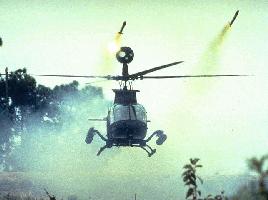
OH-58D
Kiowa Warrior
OH-58D Kiowa Warrior
The OH-58D Kiowa Warrior is a two-place single engine armed reconnaissance helicopter. The OH-58D's highly accurate navigation system permits precise target location that can be handed-off to other engagement systems. The OH-58D has an infrared thermal maging capability and can display night vision goggle flight reference symbology. It's laser designator/laser rangefinder can provide autonomous designation for laser-guided precision weapons. Air-to-Air Stinger (ATAS) issiles provide the Kiowa Warrior with protection against threat aircraft.
The primary mission of the Kiowa Warrior is armed reconnaissance in air cavalry troops and light attack companies. In addition, the Kiowa Warrior may be called upon to participate in the following missions or tasks: Joint Air Attack (JAAT) operations Air combat mited attack operations Artillery target designation.
The Kiowa Warrior is an armed version of the earlier OH-58D Kiowa Advanced Helicopter Improvement Program (AHIP) aircraft, which itself was a highly modified version of the OH-58A/C Kiowa. A hostile gunboat presence at night in the Persian Gulf in 1987 created the need for a small armed scout helicopter for interdiction. Close team work between the U.S. Armed Forces and Bell Helicopter Textron, Inc. developed the OH-58D Kiowa Warrior in less than 100 days, to counter this threat.
The principal difference between the Kiowa Warrior and its immediate OH-58D predecessor is a universal weapons pylon on both sides of the aircraft capable of accepting combinations of the semi-active laser Hellfire missile, the Air-to-Air Stinger (ATAS) missile, 2.75" Folding Fin Aerial Rocket (FFAR) pods, and a 0.50 caliber machine gun. In addition to these weapons, the Kiowa Warrior upgrade includes changes designed to provide improvements in air-to-air and air-to-ground communications, mission planning and management, available power, survivability, night flying, and reductions in crew workload through the use of on-board automation and cockpit integration.
The Kiowa Warrior is a Category I acquisition program. The Army plans to acquire approximately 400 Kiowa Warriors through either modification or retrofit of existing OH-58 Kiowas. The Kiowa Warrior replaces AH-1 attack helicopters currently found in air cavalry troops and light attack companies, and OH-58 Kiowas in air cavalry troops.
Beginning in March 1997, a number of improvements were introduced into new production OH-58Ds resulting from Task Force XXI exercises that took place at Fort Irwin, CA in March 1997, to demonstrate the Army's concept of the "digital battlefield". These improvements include an improved Allison 250-C30R/3 650 shp engine equipped with an upgraded hot section to improve high-altitude/hot-day performance. The C30R/3 will be fitted with a full authority digital electronic control system that will replace the hydromechanical fuel control unit. The improved production Kiowa Warrior will have an integrated cockpit control and display system, master control processor with digital map and video crosslink, along with an improved data modem, secure radio communications, and a GPS embedded in the inertial navigation system. Additional improvements include an infrared jammer, infrared suppressor, radar warning receivers, and a laser warning detector to improve aircraft survivability. Improved Mast Mounted Sight System Processor (IMSP). The product improved aircraft will include a new high-speed digital signal processor that will provide improved tracking capabilities by split-screen in both TV and Thermal Imaging Sight (TIS) modes, low contrast target tracking, simultaneous multi-target tracking of up to six targets, moving target indicator, aided target recognition, and automatic reaquiring of targets lost due to obstruction. The operator video display will reflect real time TV zoom and still frame capabilities. The IMSP will replace the current configuration MMS System Processor (MSP).
The addition of weapons, improved cockpit integration, and better navigational capability have resulted in an aircraft that is much more capable than its predecessor. Furthermore, the potential enhancements to mission planning and management provided by the aviation mission planning system (AMPS) and data transfer system (DTS) were very apparent during the DSUFTP. All of these improvements were achieved without any noticeable impact on readiness, as indicated by the aircraft's operational availability.
General description.
Crew--2 pilots.
Height--12 feet 10.6 inches.
Length--41 feet 2.4 inches.
Rotor diameter--35 feet.
Maximum gross weight--4,500 pounds (unarmed); 5,500 pounds
(armed).
Maximum airspeed--125 KIAS.
Cruise airspeed--80 KIAS.
Endurance--2 hours.
Cargo hook capacity--2,000 pounds.
Litter capacity--4 (externally).
Troop-carrying capacity--6 (externally).
Data transfer system--ground station, data transfer module, data
transfer receptacle in the aircraft.
Video tape recorder--records up to 2 hours of copilot's MFD.
ANVIS display symbology system--provides basic flight
information.
Mast-mounted sight.
Thermal imaging sensor.
Television sensor.
Laser range finder/designator.
Optical boresight system.
Weapons.
.50-caliber heavy machine gun.
70-millimeter folding fin aerial rocket.
Air-to-air Stinger missile.
Hellfire modular missile system.
Communication equipment.
Two VHF-FM AN/ARC-186 or AN/ARC-201 SINCGARS.
One UHF AN/ARC-164 Have Quick.
One VHF-AM AN/ARC-186.
Two TSEC/KY-58.
HF capable (radio not installed).
TSEC/KY-75 (device not installed).
Retransmission capabilities.
FM homing (AN/ARC-186 only).
Airborne target handover system (digital communications).
Navigation equipment.
Attitude and heading reference system (Litton LR-80 Inertial).
AN/ASN-137 doppler.
AN/ASN-43 directional gyro.
Aircraft survivability equipment.
AN/APX-100 IFF.
AN/ALQ-144 IR jammer.
AN/APR-39A radar warning receiver.
AN/APR-44(V)3 radar warning receiver.
AN/AVR-2 laser detecting set.