CH-47
Chinook
CH-47 Chinook
The CH-47 is a twin-engine, tandem rotor helicopter designed for transportation of cargo, troops, and weapons during day, night, visual, and instrument conditions. The aircraft fuselage is approximately 50 feet long. With a 60-foot rotor span, on each rotor system, the effective length of a CH-47 (with blades turning) is approximately 100 feet from the most forward point of the forward rotor to the most rearward point on the aft rotor.
Maximum airspeed is 170 knots with a normal cruise speed of 130 knots. However, speed for any mission will vary greatly depending on load configuration (internal or external), time of day, or weather conditions. The minimum crew for tactical operations is four, two pilots, one flight engineer, and one crew chief. For more complex missions, such as NVG operations and air assaults, commanders may consider using five crew members and add one additional crew chief.
Development of the medium lift Boeing Vertol (models 114 and 414) CH-47 Series Chinook began in 1956. Since then the effectiveness of the Chinook has been continually upgraded by successive product improvements, the CH-47A, CH-47B, CH-47C, and CH-47D. The amount of load a cargo helicopter can carry depends on the model, the fuel on board, the distance to be flown, and atmospheric conditions.
The CH-47A, first delivered for use in Vietnam in 1962, is a tandem-rotor medium transport helicopter. The Chinook's primary mission is moving artillery, ammunition, personnel, amd supplies on the battlefield. It also performs rescue, aeromedical, parachuting, aircraft recovery and special operations missions.
The CH-47C Chinook model has a maximum cargo hook capacity of 20,000 pounds. The CH-47C has only a single cargo hook below the center of the aircraft. When hooking a single load, soldiers use the main hook. They must coordinate closely with the aircrew as to which hooks to use when carrying multiple loads. The planning figure for the fore and aft hooks is 10,000 pounds each.
The CH-47D was the result of June 1976 contract
for a modernized Chinook. Three airframes, CH-47A, CH-47B, and a
CH-47C, were stripped down to their basic airframes and then
rebuilt with improved systems to provide three CH-47D prototypes.
Improvements included upgraded power plants, rotor transmissions,
integral lubrication and cooling for the transmission systems,
and fiberglass rotor blades. Other improvements included a
redesigned cockpit to reduce pilot workload, redundant and
improved electrical systems, modularized hydraulic systems, an
advanced flight control system, and improved avionics. The
Chinook has two tandem three-bladed counter-rotating fiberglass
rotors. The CH-47D is powered by two Allied Signal Engines
T55-L-712 3750 shp turboshaft engines and has a maximun speed of
163 mph (142 knots). The CH-47D was rolled-out in March 1979. The
CH-47D carrys twice the load of a CH-47A and has improved
performance. The CH-47D can operate at night and in nearly all
weather conditions. The CH-47D is equipped with an air-to-air
refueling probe. The Chinook can accommodate a wide variety of
internal payloads, including vehicles, artillery pieces, 33 to 44
troops, or 24 litters plus two medical attendants. The Chinook
can be equipped with two door mounting
M60D 7.62mm machine guns on the M24 armament subsystem and a ramp
mounting M60D using the M41 armament subsystem. The "D"
model can carry up to 26,000 pounds externally. The CH-47D has
three cargo hooks: a center (main) hook and two additional hooks
fore and aft of the main hook.
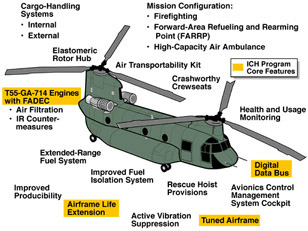
The The Improved Cargo Helicopter (ICH) is a remanufactured version of the CH-47D Chinook cargo helicopter with the new T55-GA-714A engines. The CH-47D is a twin-turbine tandem rotor helicopter that was designed for combat and combat support heavy-lift cargo missions. The ICH program is intended to restore CH-47D airframes to their original condition and extend the aircraft's life expectancy another 20 years. In addition, the following improvements will be incorporated into the aircraft:
Fuselage stiffening and possible active systems for vibration reduction (this is expected to lead to improved reliability and therefore reduced operating and support costs) Integrated cockpit Digital architecture for Force XXI compatibility
Additional improvements may be incorporated into the aircraft if funding permits. The ICH will transport weapons, ammunition, equipment, troops, and other cargo in general support of combat units and operations other than war. The ICH is a dominant maneuver platform that provides focused logistics to the force.
The MH-47E Special Operations Aircraft (SOA) is a derivative of the Boeing CH-47 Chinook. Included with other modifications is a significantly increased fuel capacity with modified main and auxiliary fuel tanks. The aircraft has modified integrated avionics suites and multi-mode radars and is intended to provide adverse-weather infiltration/exfiltration and support to US Military Forces, country teams, other agencies and special activities. The CH-47D Chinook has been specially modified to perform the special operations mission and has been tested in combat. The three versions of the CH-47 in the Army inventory are the CH-47D, the MH-47D, and the MH-47E. The MH-47D and the MH-47E are air refuelable. It provides long-range penetration, medium assault helicopter support to special operations forces. Depending on the version, it can be ferried 1,100 to 2,000 nautical miles unrefueled. During Operation Just Cause, CH-47s conducted H-hour assaults to support other elements who were air-landing SOF to disrupt enemy responses and seize key facilities. During Operation Desert Storm, the CH-47 conducted infiltration and exfiltration of SOF and CSAR of downed pilots. MH-47E testing was limited to the major change to the aircraft which affects vulnerability. In the case of the MH-47E, this was the addition of an 800 gallon Robertson Auxiliary Fuel Tank in the cabin and Boeing designed sponson tanks with expanded capacity and honeycomb shell construction. Analyses conducted during the test planning phase revealed that the largest potential vulnerability was associated with projectiles entering the fuel tanks in the volume above the liquid fuel. Such impacts could ignite the fuel vapors and cause explosions and/or fires with serious consequences. During test planning, USSOCOM decided to add an inerting system to the fuel tanks to avoid such fires/explosions. This will be a lead-the-fleet system that will be available for similar helicopter variants in other fleets as well.