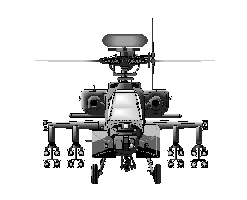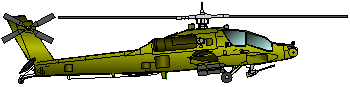
AH-64
Apache
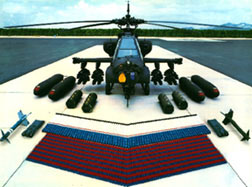
AH-64 Apache
The Boeing (McDonnell Douglas) (formerly Hughes) AH-64A Apache is the Army's primary attack helicopter. The AH-64 Apache is a twin-engine, four bladed, multi-mission attack helicopter designed as a highly stable aerial weapons-delivery platform. It is designed to fight and survive during the day, night, and in adverse weather throughout the world. With a tandem-seated crew consisting of the pilot, located in the rear cockpit position and the co-pilot gunner (CPG), located in the front position, the Apache is self-deployable, highly survivable and delivers a lethal array of battlefield armaments. The Apache features a Target Acquisition Designation Sight (TADS) and a Pilot Night Vision Sensor (PNVS) which enables the crew to navigate and conduct precision attacks in day, night and adverse weather conditions.
The Apache can carry up to 16 Hellfire laser designated missiles. With a range of over 8000 meters, the Hellfire is used primarily for the destruction of tanks, armored vehicles and other hard material targets. The Apache can also deliver 76, 2.75" folding fin aerial rockets for use against enemy personnel, light armor vehicles and other soft-skinned targets. Rounding out the Apache’s deadly punch are 1,200 rounds of ammunition for its Area Weapons System (AWS), 30MM Automatic Gun.
Powered by two General Electric gas turbine engines rated at 1890 shaft horsepower each, the Apache’s maximum gross weight is 17,650 pounds which allows for a cruise airspeed of 145 miles per hour and a flight endurance of over three hours.
AH-64A
The AH-64 fleet consists of two aircraft models, the AH-64A and the newer Longbow Apache (LBA), AH-64D. AH-64A model full-scale production began in 1983 and now over 800 aircraft have been delivered to the U.S. Army and other NATO Allies. The U.S. Army plans to remanufacture its entire AH-64A Apache fleet to the AH-64D configuration over the next decade.
The AH-64A proved its capabilities in action during both Operation Restore Hope and Operation Desert Storm. Apache helicopters played a key role in the 1989 action in Panama, where much of its activity was at night, when the AH-64's advanced sensors and sighting systems were effective against Panamanian government forces.
Apache helicopters also played a major role in the liberation of Kuwait. During Operation Desert Storm, AH-64s were credited with destroying more than 500 tanks plus hundreds of additional armored personnel carriers, trucks and other vehicles. They also were used to destroy vital early warning radar sites, an action that opened the U.N. coalition's battle plan. Apaches also demonstrated the ability to perform when called upon, logging thousands of combat hours at readiness rates in excess of 85 percent during the Gulf War.
And the AH-64A Apache helped to keep the peace in Bosnia. The AH-64A’s advanced sensors and sighting systems proved effective in removing the cover of darkness from anti-government forces.
Army National Guard units in North and South Carolina, Florida, Texas, Arizona, Utah and Idaho also fly Apache helicopters. The Army has fielded combat-ready AH-64A units in the United States, West Germany and in Korea, where they play a major role in achieving the U.S. Army's security missions.
By late 1996, McDonnell Douglas Helicopters delivered 937 AH-64A Apaches -- 821 to the U.S. Army and 116 to international customers, including Egypt, Greece, Israel, Saudi Arabia and the United Arab Emirates.
AH-64A Apache Multi-Mission Configurations
Primary Mission
Starboard Wing
M230 Gun
Port Wing
Rate of Climb
Duration
Combat
(Anti-armor)
4 Hellfire
320 rds 30mm
4 Hellfire
1450 fpm
1.8 hours
Multi-role
(Covering force)
4 Hellfire
19 FFAR *
1200 rds 30mm
4 Hellfire
19 FFAR *
860 fpm
2.5 hours
Close-support
(Anti-armor)
8 Hellfire
1200 rds 30mm
8 Hellfire
990 fpm
2.5 hours
Ground-support
(Airmobile escort)
38 FFAR *
1200 rds 30mm
38 FFAR *
780 fpm
2.5 hours
* FFAR = 70mm (2.75 inch) Folding-Fin Aerial Rockets
AH-64D Longbow
The AH-64D Longbow Apache is a remanufactured and upgraded
version of the AH-64A Apache attack helicopter. The primary
modifications to the Apache are the addition of a millimeter-wave
Fire Control Radar (FCR) target acquisition system, the
fire-and-forget Longbow Hellfire air-to-ground missile, updated
T700-GE-701C engines, and a fully-integrated cockpit. In
addition, the aircraft receives improved survivability,
communications, and navigation capabilities. Most existing
capabilities of the AH-64A Apache are retained.
The AH-64D is being fielded in two configurations. The full-up AH-64D includes all of the improvements listed above. In addition, a version of the AH-64D without the FCR will be fielded. This version will not receive the new Radar Frequency Interferometer (RFI) or the improved engines, but will retain the other Longbow modifications. The AH-64D without FCR is capable of launching the Longbow Hellfire missile.
All AH-64A Apaches in the fleet are to be upgraded to the AH-64D configuration: 227 will be equipped with the FCR, and the remaining 531 will not. Each attack helicopter company will receive three aircraft with FCRs and five without.
McDonnell Douglas Helicopter Systems is under contract for the first 18 Longbow Apaches and delivered the first remanufactured Longbow Apache in March 1997. The Army and McDonnell Douglas agreed to a five-year, multi-year agreement that will give the Army 232 Longbow Apaches in the first five years of production. The multi-year purchase increases the Longbow Apache production rate in the first year to 24 aircraft and 232 for the five-year period. Under the multi-year contract, the Army will field two additional combat-ready Longbow Apache battalions. The contract also includes funding for McDonnell Douglas to train pilots and maintenance personnel for the first two equipped units, development of interactive electronic technical manuals, development of training devices, first article testing of the production aircraft, initial spares, and a variety of program support tasks for the first production lot. The U.S. Army plans to remanufacture its entire AH-64A Apache fleet of more than 750 aircraft over the next decade.
During Army operational testing in 1995, all six Longbow Apache prototypes competed against standard AH-64A Apaches. The threat array developed to test the combat capabilities of the two Apache designs was a postulated 2004 lethal and digitized force consisting of heavy armor, air defense and countermeasures. The tests clearly demonstrated that Longbow Apaches:
Are 400 percent more lethal (hitting more targets) than the AH-64A, already the most capable and advanced armed helicopter in the world to enter service.
Are 720 percent more survivable than the AH-64A.
Meet or exceed Army requirements for both target engagement range and for probability of acquiring a seleted target. The specific requirements and results are classified.
Easily can hit moving and stationary tanks on an obscured, dirty battlefield from a range of more than 7 kilometers, when optical systems are rendered ineffective.
Can use either its Target Acquisition Designation Sight or fire control radar as a targeting sight, offering increased battlefield flexibility.
Have the ability to initiate the radar scan, detect and classify more than 128 targets, prioritize the 16 most dangerous targets, transmit the information to other aircraft, and initiate a precision attack -- all in 30 seconds or less.
Require one third less maintenance man hours (3.4) per flight hour than the requirement.
Are able to fly 91 percent of the time -- 11 percent more than the requirement.
One issue uncovered during the Initial
Operational Test that requires follow-on testing involves the
method of employment of the Longbow Hellfire missile. During the
force-on-force phase, Longbow flight crews frequently elected to
override the system's automatic mode selection logic and fire
missiles from a masked position. This powerful technique can
significantly increase the helicopter's survivability, but has
not been validated with live missile firings during developmental
or operational testing. DOT&E is currently working with the
Army to develop a test plan that will confirm system performance
using this firing technique. This test program will
include computer simulation of the missile's target acquisition
and fly-out as well as live missile firings at moving armored
vehicles.
With the addition of a new and highly sophisticated fire control radar (FCR), more commonly called the Longbow Fire Control Radar, the AH-64D has become the most advanced aerial fighting vehicle in the world. The FCR provides the Apache with the ability to detect, classify and prioritize stationary and moving targets both on the ground and in the air. With state of the art fire control, digital communications, automatic target classification and many other up to date features, the AH-64D Longbow Apache will dominate the battlefield for years to come.
The AH-64D Apache Longbow increases combat effectiveness over the AH-64A by providing a more flexible digital electronics architecture and integrating computer-based on-board Built-In Test Equipment (BITE), Automatic Test Equipment (ATE), and hard copy operator or Interactive Electronic Technical Manual (IETM) troubleshooting/maintenance manuals that will easily accommodate changes resulting from system growth. In addition, upgrades to electrical power and cooling systems and the expansion of the forward avionics bays to accommodate the installation of the FCR, and provide for future growth. Navigation system accuracy is improved through integration of a miniaturized integrated Embedded Global Positioning System (GPS)/Inertial Navigation Unit (INU) (EGI), and an improved DOPPLER Velocity Rate Sensor (DVRS).
The fully integrated AH-64D without Longbow Mission Kit incorporates greater ordnance capability and flexibility than the AH-64A by utilizing the family of Semi-Active Laser (SAL) missiles (including the HELLFIRE II) and Longbow HELLFIRE RF Missile. The AH-64D without Longbow Mission Kit can operate in harmony with the FCR-equipped AH-64D and can accept a target hand over and fire the Longbow missile with minimum exposure to hostile forces.
The AN/APG-78 FCR is a multi-mode Millimeter Wave (MMW) sensor integrated on the Apache Longbow with the antenna and transmitter located above the aircraft main rotor head. It enhances Longbow system capabilities by providing rapid automatic detection, classification, and prioritization of multiple ground and air targets. The radar provides this capability in adverse weather and under battlefield obscurants. The FCR has four modes: (1) the Air Targeting Mode (ATM) which detects, classifies, and prioritizes fixed and rotary wing threats; (2) the Ground Targeting Mode (GTM) which detects, classifies, and prioritizes ground and air targets; (3) the Terrain Profiling Mode (TPM) which provides obstacle detection and adverse weather pilotage aids to the Longbow crew; (4) and the Built in Test (BIT) Mode which monitors radar performance in flight and isolates electronic failures before and during maintenance.
The Longbow RF missile and the Longbow HELLFIRE Launcher (LBHL) are referred to as the LBHMMS. The system incorporates a fire-and-forget missile that accepts primary and/or secondary targeting information from the FCR and single targeting information from TADS or another aircraft to acquire and engage targets. Similar to the FCR, the RF missile provides the capability to engage threats in adverse weather and through battlefield obscurants. Two acquisition modes, lock-on-before-launch (LOBL) and lock-on-after-launch (LOAL), allow engagement of ground and rotary wing threats at extended ranges. In the LOBL mode, the missile will acquire and track moving or short range stationary targets prior to leaving the launch platform. In the LOAL mode, the missile will acquire long range stationary targets shortly after leaving the launch platform.
The combination of the integrated FCR, LBHMMS and the Apache aircraft enhances battlefield awareness by providing coverage of the battle area at extended ranges, by reducing operational dependence on weather and battlefield conditions, and by rapid display of detected targets. It further improves the Longbow system's war fighting capability and survivability by providing rapid multi-target detection and engagement ability, navigational aids, and a fire-and-forget weapon delivery system.
The addition of the Longbow FCR provides a second
and completely independent target acquisition sensor which may be
operated by either crew member or combined to provide a degree of
multi-sensor synergy. When operated independently, the pilot
could use the
FCR to search for air targets in the ATM mode while the
copilot/gunner (CPG) searches for ground targets using the Target
Acquisition Designation Sight (TADS).
Using both TADS and the FCR together combines the unique advantage of each sight. The rapid search, detection, classification, and prioritization of targets by the Longbow FCR can then be quickly and positively identified by using the electro-optics of TADS. The center of view can be focused on the location of the highest priority target and the CPG, at the touch of a switch, can view either display. Alternately, the FCR centerline can be cued to the TADS so that a rapid and narrow search could be made of a suspected target area.
The RFI is an integral part of the Longbow FCR. It has sensitivity over an RF spectrum to detect threat emitters when a threat radar is in a search and acquisition mode and also when the threat emitter is "looking" directly at and tracking the Longbow system. The RF band has been extended over that which was developed for the OH-58D Kiowa Warrior at the low end of the RF spectrum to detect newly identified air defense threats. The RFI has a programmable threat emitter library to allow additional threat signatures to be stored and/or updated.
Physical Description
Size. Length (rotor turning) 58.17 feet
Width (rotor turning) 19 feet
Height (overall) 16.25 feet
Weight. Empty 11,800 pounds
Armament. Air-to-Air and Hellfire missiles;
30mm and 70 mm multi-purpose submunitions
Mission Equipment.
Target Acquisition and Designation System/Pilot Night Vision
System
Propulsion. Two T700-GE-701Cs
Crew. Two
Manufacturer. McDonnell Douglas Helicopter Systems