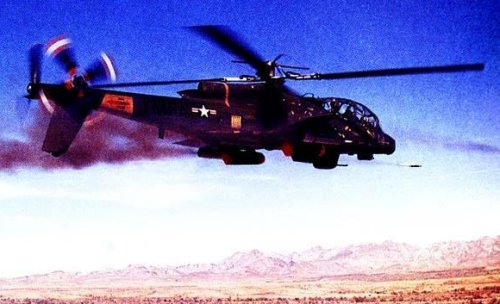
AH-56
Cheyenne
Lockheed AH-56A Cheyenne
attack helicopter (Prototype) (1967). The Lockheed AH-56A was
designed to meet the U.S. Army's requirement for the Advance
Aerial Fire Support System (AAFSS). Lockheed rolled-out the first
prototype on May 3, 1967. The rigid-rotor Cheyenne, with a crew
of two, featured a XM112 swiveling gunner's station linked to
rotating belly and nose turrets, and a laser range-finder tied to
a fire control computer. It was armed with an XM52 30mm automatic
gun in the belly turret and a XM51 40mm grenade launcher or a
XM53 7.62mm Gatling machine gun in the chin-turret, TOWs, and
XM200 rocket launchers. Ten prototypes were completed before the
program was terminated August 9, 1972 due to delayed development,
rising costs, and the appearance of two competitive
company-funded initiatives by Sikorsky and Bell. The Army wanted
a smaller, more agile Advanced Attack Helicopter (AAH) with a
less complicated fire control and navigation system. The
helicopter's mission would eventually be assumed by the Boeing
(formerly McDonnell Douglas) AH-64 Series Apache attack
helicopter. The Cheyenne had a single rigid four-bladed main
rotor and anti-torque tail rotor, and a three-bladed pusher. The
Cheyenne was powered by one General Electric T64-GE-16 3435 shp
turbine engine. The AH-56A had a speed of 246 mph (214 knots).

