The 20th SOS Pony
Express was one of the most extraordinary
and outstanding combat units in Southeast
Asia. The Pony Express
was located at Udorn RTAFB, Thailand during
the Vietnam war.
Morale of the Pony helicopter pilots and crew
members, from the
highest ranking officer to its lowest ranking
enlisted man was
extremely high. There was a wonderful
togetherness in the unit
which incited every member to want to be part
of the team and to
do his best in every endeavor. Every
person took care of his
fellowman, accepting his faults and using
his strengths to the
maximum benefit of the squadron. The
esprit de corps radiating
from the members of the Pony Express was constantly
felt by
everyone that knew the Ponies or had come
in contact with the
Pony mission in this supposedly secret war
in SEA. BUT, THE PONY
EXPRESS WAS TRULY A GREAT SQUADRON WHICH WAS
FORCED TO DIE!!!
Everything that lives
must die eventually. Sometimes things
die of old age, yet, other things die because
they are no longer
useful. Some things are killed with
honor on the battlefield and
some things are uselessly killed without honor!
Because of the
way the Pony Express was killed without honor,
the Pony Express
can never be buried. Had it died with
honor, it could be buried
with the military dignity it deserved, and
only the memory of a
great outfit would live on. It would
be listed in the Hall of
Fame and the real Pony spirit would exist
only in men's minds.
Because it did not die with honor, though,
the spirit still lives
in everyone's heart and everyone that had
a close connection with
the Ponies is still disgusted about its death.
These people
force the memories to live on!!
What really happened
to the Pony Express? Who killed it?
To find an answer, let's go back to l969 to
Udorn and discuss
what happened. The Pony Express always
had two large and
important missions, Tacan support and DOSA
(Director of
Operations for Special Activities) missions
fragged by the 7/l3th
AF in support of the secret war in Laos.
Most of these DOSA
missions were lead by Air America or CAS and
were flown all over
Laos. The Ponies, though, did not have
sufficient helicopters
and pilots to accomplish every mission adequately.
Because some
of its missions were too massive and required
many helicopters
and more capability than the Ponies had, they
were forced to call
on other helicopter outfits to help them on
some of their largest
missions. Some of their large missions
required the use of up to
twenty CH-3E helicopters, and with only nine
aircraft assigned,
it was almost impossible to complete these
large missions. On
many occasions the Pony Express desperately
called upon the 21st
SOS at NKP to help with the largest missions.
The 21st SOS had
the same type of helicopters and needed something
to do, as only
25% of their flying time was devoted to flying
combat missions.
On most of these occasions,
the 21st SOS volunteered to
help, however, their headquarters, the 56th
SOW, usually refused
to permit them to help us. On one large mission,
the mass
infiltration of Hmong tribesmen on 25 March
l969, the two
squadrons flew together. The mission
turned out to be less than
a total success and six aircraft were damaged
by hostile fire and
one pilot, the Pony Operations Officer, was
seriously wounded in
the thigh. On another large infiltration
of General Vang Pao's
Lao troops, the 20th SOS could not get the
help of the 21st SOS,
so they had to make a mass infiltration with
only seven
helicopters forcing the Ponies to make three
dangerous shuttles
into the besieged landing area. Had
the 21st SOS been permitted
to help on this mission, the job could have
been accomplished in
one shuttle, exposing the aircraft and crews
to hostile fire for
a much smaller amount of time.
Another important
mission in June 69, the evacuation of a
Thai Artillery team from Moung Soui required
more helicopters
that the Ponies could scrape together. Two
days before this
mission the Ponies were called to Lima Site
20A (Long Tieng) to
accomplish the mission. After we landed
we reported to the Raven
shack for a briefing by Ambassador Sullivan
and General Vang Pao.
We were told to stand by and be ready to go
to Moung Soui to
evacuate the Thai artillery team. The
weather was good and the
North Vietnamese were still quite a ways from
Moung Soui. I'm
sure they thought the Viets would not keep
coming so they delayed
and delayed our takeoffs. Finally, as
it was getting dark, they
set up bunks in the Raven shack and fed us
and let us go to bed
as we would try again the next day.
When we got up Sullivan and
Vang Pao kept talking to the people
at Moung Soui while we sat
and waited. As it was getting late and
the Viets had obviously
stopped their convoy, they told us it was
too late to evacuate
the Thais and they sent us back to Udorn.
During the night we
were told to take off at first light and rush
back to 20A.
This we did
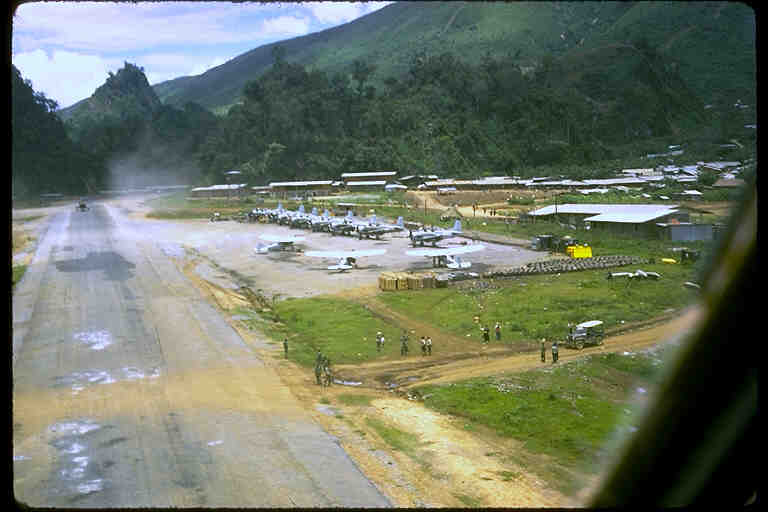
and we were joined by the 21st SOS and a HH-53
rescue
helicopter.
Because of the sensitive
nature of the mission, higher
headquarters, the 7/l3th AF, allowed the 21st
SOS to supply three
CH-3Es to support the mission. The weather
was extremely bad and
the mission was extremely dangerous as mortars
were being fired
and snipers were hiding in the hills surrounding
the landing
zone. The mission required the utmost
in pilot technique. All
pilots needed to make heavy gross weight takeoff
and take off
down wind. The first 21st SOS helicopter
took on too many Thais
and during the attempted take off fell to
the ground landing in a
rice paddy (actual photograph below)
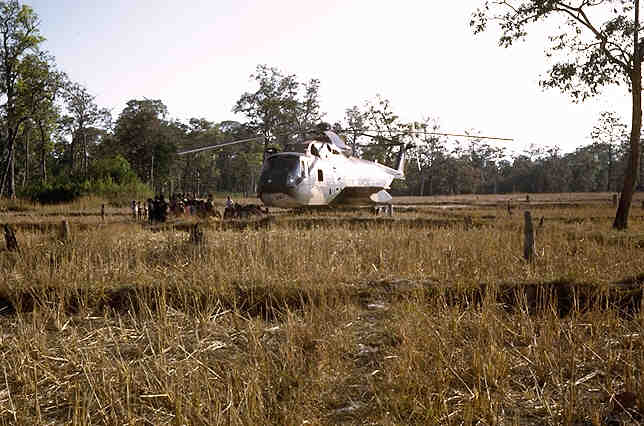
a few yards from the takeoff pad. After off
loading a
few Thais the aircraft was able to take off
and continue its trek
back to 20A. The next 21st SOS helicopter
onloaded too many
people also. The aircraft drooped and crashed,
but the crew and
Thais were picked up by the rescue helicopter.
Possibly an engine quit or the helicopter was shot down by small arms fire,
but the fact remains the aircraft was lost on the mission and had to be
destroyed by the fighters that were protecting us. All Pony aircraft
completed their portion of the mission without incident although most of
us had a high "pucker-factor" because the place was extremely hot and mortars
were landing all over the place. Fighters were firing rockets at
the oncoming Viets, at mortar sights and at any thing that moved.
The whole mission seemed to indicate that the Ponies were
better qualified for this type of DOSA mission
as we had been
trained by our group to do this. The 21st
SOS pilots were not
used to flying at maximum gross weights with
limited power. On
their missions, they normally carried only
six or seven persons
and most often had out of ground effect hover
capability. The
21st SOS crews did help us greatly on this
important and
sensitive DOSA mission, however, and because
of the increased
number of aircraft on the mission, we were
exposed to hostile
action to a lesser degree and did not have
to make shuttle runs
to evacuate the 350 member Thai artillery
team from Moung Soui.
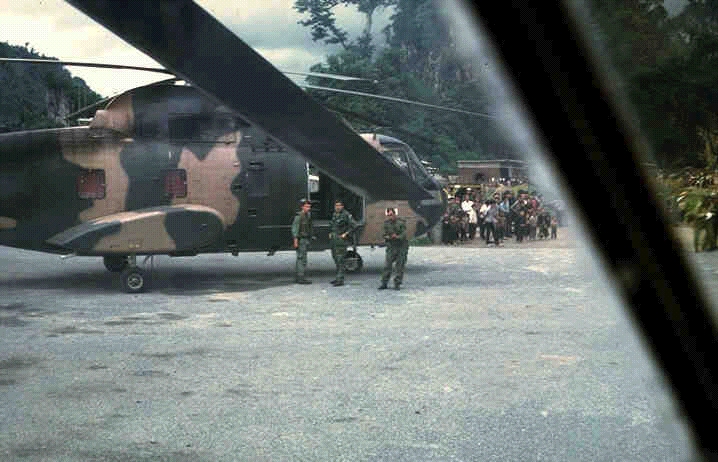
Pictured above: My helicopter &
crew as well as myself (middle) after landing at Lima Site 20A after the
mission.
Because the Ponies needed help on these sometimes
massive
DOSA missions which was often provided by
the 21st SOS, no one
really thought too much about the coming of
a possible merger of
the two squadrons. All persons seemed to feel
that it would be a
good idea, as it would combine all the helicopter
resources in
Thailand and allow each squadron to better
accomplish its
mission. After all, the Ponies were flying
75% of their flying
time as combat time and spending over 75%
of their time flying
their primary DOSA missions. The 21st
SOS, on the other hand,
was flying only 25% of their flying time on
combat missions.
Since this 25% included some combat time not
in direct support of
their primary mission, it is safe to say that
less than 25% of
their combat time was flown in direct support
of their primary
mission.
Ideally then, the
merger of the two squadrons should give
the 21st SOS more combat missions and allow
them to share the
bigger DOSA missions of the Pony Express.
The merger turned out
to be a bitter battle, though, as no one could
agree on the
issues. Most everyone saw the merger
as not really changing
anything except the efficiency of the two
squadrons. There would
still be a Pony Express at Udorn as the FOL
(Forward Operating
Location) would still have the same people,
the same aircraft and
the same mission. The 21st SOS would still
have the same mission
at NKP, but they would assume part of the
Ponies' mission and get
better utilization out of their aircraft.
Most everyone was
actually looking forward to the merger, however,
just before the
merger took place, the 56th SOW entered the
picture and asked
that all aircraft and all personnel assigned
to the Pony Express
be transferred to NKP. This was quite a shock
to the Pony
personnel as no one wanted to leave the FOL
at Udorn for an
isolated outpost like NKP. Also, everyone
knew that the wing at
NKP did not have adequate housing facilities
to accommodate the
transfer of the entire Pony outfit. The Ponies
were told that
room would be made for them. After all, they
said there was a war
on and no one should mind doubling up for
the old war effort.
The Deputy Wing Commander of NKP visited the
Ponies and told us
how great NKP was and how he felt it was the
best base in
Southeast Asia. He convinced no one!
In fact, he possibly woke up
the sleepers in 7/l3th AF who had not done
their utmost to assure
that the transfer worked smoothly. Too
much had been taken for granted by everyone! No one expected too much to
change!
All the preliminary
planning on the merger was left to too
few people. Only now did the concerned people
began to stir. The
original intent of the merger was to transfer
all Pony assets to
the 56th SOW, but fragging authority for the
combined squadrons
was to stay with the 7/l3th AF. The
Pony Express was supposed to
remain in tact and in place at the FOL at
Udorn. Hangers were
already programmed, and H-53 helicopters were
scheduled to
replace the Ponies' aircraft. But, nevertheless,
the wing
commander insisted that everything be physically
transferred to
NKP. After many, sometimes bitter exchanges
of views, messages,
and phone calls, the merger took place.
Three of the Pony
aircraft and several pilot spaces were transferred
to NKP.
Eighteen pilots and six aircraft were left
at Udorn and the new
21st SOS was formed with one commander stationed
at NKP to run
the squadron, and an operations officer at
Udorn reporting
directly to the commander. What happened
then, as this seemed to be a workable solution. The Pony Express FOL was
smaller now, but the 21st SOS at NKP was going to assume part of its old
mission, or at least the missions would be accomplished together; everything
could work out.
The new 21st SOS commander,
bless his soul, wanted to keep
some things as they were in the past, but
at the same time, he
had a new squadron and wanted to bring the
two separate squadrons together. He wanted to retain the high spirit of
the Pony Express and some of their glorious history. He wanted to
keep the good reputation and accomplishments of the Dust Devils. He wanted
one unit with the best of both squadrons to stay in his new unit. He
wanted to capitalize on the greatness of the
Ponies and the
greatness of the Dust Devils and have a great
squadron.
The new squadron needed
a name. The Ponies had been around a lot longer and had a more glorious
history. He had two old units
combined with the less glorious of the two
absorbing the more
glorious. To do something about this problem,
he appointed a
committee from both squadrons to recommend
to him a new name, a new patch, a new party suit and anything else that
would benefit
the new squadron.
This committee met
and patches were introduced, names were
suggested. The Ghost Riders, The Devil Riders,
Gommers, Buffalo
Fluckers, Dusty Horses, Dusty Ponies, Turtles,
Dust Devils, and
Pony Express---all these names were suggested.
After the meetings
and coordination with the two squadrons, the
committee agreed
that the "PONY EXPRESS" name should be retained
for the new
squadron. The new squadron would just be an
extension of the fame
of the Pony Express. After all, The
Dusties were originally
formed from the Pony Express. They were already
part of its
history. The fragment was just going
back to the mother
squadron. Naturally, many people at NKP complained,
but the
majority of the pilots in both outfits felt
this was a wise choice.
The words Pony Express had a good ring to
them. The Knife
call sign had no special meaning to anyone.
The Pony Express call sign fit the mission--hauling gommers, mail, goats,
buffaloes through
hostile territory like the old Pony express riders did.
Everything seemed set and nearly everyone
in the squadrons
agreed. Morale started to increase.
WHAT HAPPENED THEN???
Some say the commander
dropped the idea because he knew that the wing commander was bitter about
not getting all the Ponies
and aircraft assigned to NKP. Some say the
wing commander blamed the Ponies for all his troubles with the merger and
with 7/l3th AF. Some say that since he did not have full command and control
of the new squadron, he was determined to eradicate the Pony Express and
everything that reminded him of it. Most people
think that he refused to let the new squadron
adopt a new name
and dictated that it would retain the present
call sign and the
present name. What ever the reasons, the whole
thing was dropped
and the new squadron retained the name and
history of the 21st
SOS. The PONY EXPRESS WAS SUPPOSED TO
DIE!!
To appease the FOL
and to try to accept the wing commander's
decision, the Dusty commander allowed the
FOL to call itself the
Pony Express on the ground and wear the Pony
Patch on the Dusty
Hat which he asked everyone to buy. Every
one started buying the
new hats and morale started to pick up. Things
seemed to working
out pretty well. But, the 56th SOW sent
its inspectors to the
FOL to help them proceed to changing every
thing over to the
operating standards of the wing. Everyone
of the inspectors
seemed to stress that the FOL was a completely
sub par
organization. Everyone insinuated the FOL
surely could not have
ever done any thing right. The FOL was constantly
told how
terrible they were, and no one could understand
how the FOL could
ever have gotten an aircraft in the air, little
on fly a combat
mission. The inspection of the FOL did
a lot of damage to the
morale of everyone connected to the Ponies.
However, as the new
FOL was sub par and full of incompetents and
Pony diehards, the
answer was simple. The Wing sent a new
operations officer to the
FOL. They sent an officer who understood the
56th SOW, one who
would shape up the FOL, or beat it into line.
The new operations
officer arrived in Aug. 69. He had been
the old 21st SOS
commander.
Even though skeptical,
everyone accepted the new Commander.
At first he joined in the Pony spirit, called
himself a Pony,
bought himself a new Dusty hat with the Pony
patch and worked
extremely hard to gain the confidence of all
personnel in the
Pony Express. The Ponies needed leadership
and he seemed to be a good answer to our problems. The new commander would
be believed at NKP, his decisions would be approved and some of the confusion
that was already developing in the new squadron would be cleared up. The
commander worked hard, was very productive, and the squadron began to take
shape again. Facilities were renovated, better procedures, systems and
policies were established. MORALE WAS ON THE UPSWING!
However, unfortunately,
this boost in morale did not last
very long. First the Pony Express trucks were
repainted, the
Gommers, and the words Pony Express were removed
from the sides. Dust Devil sign appeared. The Pony patch and the
old 20th SOS hats were forbidden, and the new Dusty hat with the Pony Patch
was outlawed on the base as not being a proper hat to wear. This
quick change was accomplished without any explanation. The new leader had
not kept his troops informed. When several of the
officers in the squadron questioned him, they
were told that the
wing commander at NKP had ordered him to take
all the Pony
Express signs down
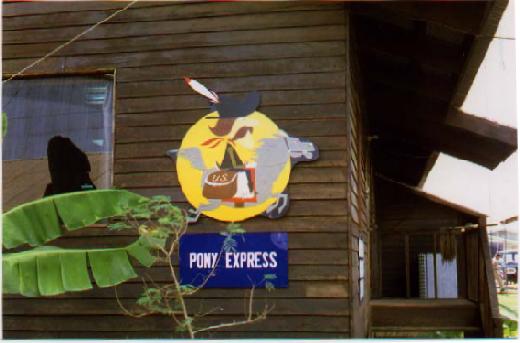
and put up the Dusty signs. The word
was out
that the Wing Commander 56th SOW at NKP said
that he never wanted to hear the words PONY EXPRESS again!!!
Morale dipped to an all
time low and the new commander of
the FOL had lost the devotion and respect
of his troops. As a
visible revolt all the officers and enlisted
men started growing
mustaches, comical at times as one young captain
bragged about
the two hairs that sprouted on his upper lip
area. He was trying
to fit in though. My mustache was more gray
that black but it
looked like the one Stalin used to wear. The
Dust Devil signs
stayed up but were sprayed with black paint
a few times. All
personnel reverted to wearing their regulation
military hat with
rank pinned on and hid their pony patches.
The High Frequency
call sign was changed by the wing from "WELLS
FARGO" to "LOLLY
POP FOXTROT" Most of us refused to become
part of this new
21st SOS even though we always did our jobs
to the best of our
ability.
Many unfortunate things
happened since the merger. The FOL
lost many of its maintenance people and much
of its capability to
perform maintenance. The FOL pilots were forbidden
to talk
directly to the 7/l3 AF DOSA shop. Flying
schedules, which used
to be published before noon, never seemed
to get published until
late at night. Crew planning for combat missions
became almost
non existent. The High Bird or rescue aircraft
which the Ponies
always had on a combat mission, was tampered
with. Crew rest was
extended many times. Some tactics were changed
just for the sake
of change and because they were known to be
Pony tactics. Command and control by the 56SOW caused confusion and the
FOL continually had to wait to be told what to do. No decision could be
made at the FOL as every decision had to be phoned from NKP.
What was really accomplished by this merger? First of all, it is necessary to look back at the reasons for the merger in the first place. Simply stated, the Pony Express had too big of a mission and the Dusties' mission was not big enough. Since the Pony Express flew 75% of their flying time as combat time supporting DOSA and the clandestine war in Laos versus only 25% for the Dust Devils at NKP, the merger should prove beneficial to both squadrons. Ideally, the 21st SOS should be flying more combat missions and the Ponies should be flying less. Together they should be better able to accomplish their primary missions. To find out if this is true, lets look at three months of combined operations -- Oct, Nov, and Dec l969.
The 21st SOS history
is on file and l969 is a closed issue,
however, let's take a look at these last three
months of l969.
During this period the Pony Express FOL had
four helicopters and eighteen pilots as one
aircraft was lost and one was in IRAN.
During this period, the FOL flew 915.3 hours;
NKP flew 1224.5
hours. The Ponies flew 595.4 hours of combat
time and NKP flew
541.3 combat hours. In other words, the Ponies
flew 309.2 hours
less than the Dusties, but flew 54.1 hours
of combat time more
than the 21st SOS. NKP flew 44.2% of their
total flying time
during Oct-Dec 69 in the combat zone while
the Ponies flew 65% of
their time in combat. (Note: In Oct,
NKP 30.1%; FOL 64.5%; in
Nov, NKP, 48%; FOL 57%; In Dec, NKP flew 34%,
the FOL flew 73.5%
of their flying time in the combat zone of
Laos.)
These figures bear
out the fact that NKP has assumed a small
percentage of the combat load from the FOL,
however, the Ponies
with only l8 pilots and four CH-3Es are doing
almost the same as
before and still flying more combat time than
the Knives. In
essence, then, what has happened is that NKPs
21st SOS are doing
about the same combat flying that they were
doing before the
merger, but now have more aircraft and personnel
to do it with.
The transfer of pilots and helicopters from
the FOL to NKP just
gave them a better capability to do their
primary mission. The
Ponies on the other hand are doing about the
same amount of
combat flying as they have always been doing
but have fewer
aircraft and pilots to do it with.
To further show this, during
the same period of time, there
were 6l6.4 hours devoted to DOSA missions
of which NKP flew 228.5
hours or 27% of the DOSA hours. The FOL Ponies
flew 387.9 DOSA
hours. There were 222.3 hours flown for TACAN
out of country
support. NKP flew 64.4 hours or 28%
of the TACAN support hours.
The Ponies flew l57.9 TACAN out of country
hours. It should be
obvious that the FOL gave up 1/3 of its capability
to have NKP
support 27% of its DOSA and 28% of its TACAN
mission. Had the FOL
at Udorn retained its full capability, it
could have easily done
this small amount of hours with out the 21st
SOS.
Any sane person
has to ask himself, just what has been
accomplished by the merger? How has the merger
helped the 20th
SOS "Pony Express" better fulfill its primary
mission of DOSA and
TACAN support???
What is NKP
doing if they are only flying 27-28% of the Ponies primary missions?? During
Oct-Dec 69, NKP flew 258.9 hours of Prairie Fire on 29 different missions.
NKP tied up three helicopters daily on Prairie Fire alert, yet in these
92 days of Oct through Dec 69, the 21st SOS flew only 258.9 hours. This
means that of their total flying time during this period (1224.5 hours),
21% of it was devoted to their primary mission of Prairie Fire. Also, 228.5
hours were devoted to DOSA or l8% of their flying time. 5.2% of their
flying time was devoted to out of country TACAN support. Thus 44.2% of
their flying time was devoted to their primary mission of Prairie Fire,
DOSA, and TACAN out of country missions. NKPs TACAN in country support
only amounted to 25.3 hours or about 2% of their total time. Giving them
this credit raises the percentage to 46.2%, but this still
means that 53.8% of their flying time is devoted
to other than their primary mission.
The FOL at Udorn,
on the other hand, devoted 74% of their
flying time in support of their primary missions
of DOSA and
TACAN support, and only 26% of their time
flying other than their
primary mission.
What can be concluded from all these statistics?
l. The FOL at Udorn, the Pony Express, still
flew the major
share of combat time of the combined squadrons.
65% of the FOLs
time was combat time; 44.2% of NKPs time was
combat time. From
Oct to Dec 69 the FOL flew 309.2 hours less
that NKP but 54.l
hours of combat time more!
2. NKP picked up only 27% of the DOSA missions
supporting the
secret war in Laos and 28% of the TACAN hours
even though they
were given three additional helicopters and
all but eighteen of
the FOL pilots.
3. Before the merger, NKP flew 25% of their
time as combat
time primarily on Prairie Fire missions and
they still fly 21% of
their flying time doing this mission. They
used to fly 75% of
their total time in support of missions other
than their primary
mission. Now they spend only 53.8% of their
time supporting these
other missions. This decrease is because they
now fly l8% of DOSA
and 7.2% on TACAN support. By adding l8%,
7.2%, and 21% on
Prairie Fire, one can see that they now fly
46.2% of their flying
time on the primary missions of Prairie Fire,
DOSA and TACAN
support!
4. The FOL at Udorn lost three helicopters
to NKP and many
pilot spaces which amounted to one third of
its capability, yet
the FOL still flew 63% of the DOSA missions
and 60% of the TACAN
and an amazing 53.8% of the overall mission
of the entire newly
formed 21st SOS headquarters at NKP with the
FOL stationed
at Udorn RTAFB, Thailand.
In summary, the merger
of the two squadrons did not really
work as the planners felt it would.
The old Pony Express outfit
even though it was much smaller in size, had
fewer helicopters
(only four helicopters and eighteen pilots
during Oct-Dec 69) flew more than half of the Squadron's primary mission.
Every pilot at the FOL still flew more combat time than the pilots at NKP
even though the pilots at NKP supposedly flew more time.
WHAT DID THIS MERGER PROVE?
DID THE PONY EXPRESS DIE NEEDLESSLY?????
NOTE:
This story was written
in Jan l970 by Major Matthew D.
Kirkpatrick USAF while
stationed at Udorn RTAFB, Thailand,
assigned to the 20th
Special Operations Squadron (Pony Express)
flying the CH-3E Helicopter
as a Flight Commander and Aircraft
Commander. While there
the 20th SOS was absorbed by the 21st SOS at NKP. When I wrote this article
I had all the figures, hours,
percentages before me
so they are accurate to this date. 30 years ago, this sad story was
written by a 39 year old Major and now it is being typed and published
by a 70 year old retired LtCol from the U.S. Air Force. Although
I had the utmost respect for the 21st SOS pilots and aircrews, their
leaders in the squadron and Wing were some of the worse that I experienced
in my Air Force career. Because of the outrageous way the merger of the
two squadrons was accomplished, and the despicable actions of their leaders,
I swore to all that were present at my going home party at Udorn that I
would always be proud to call myself a PONY, but I would never openly admit
that I was also a Knife during the last few months of my combat tour in
South East Asia! AMEN!!