NATO forces push into Kosovo
June 12, 1999
Confusion surrounds early entry of Russian troops
PRISTINA, Yugoslavia June 12 — By land and air,
NATO troops, including those from the U.S.,
began pouring into Kosovo at daybreak
 Saturday,
in a two-pronged advance cheered by
Saturday,
in a two-pronged advance cheered by
refugees and slowed by minefields and
booby-traps. But in a move that surprised Washington, a Russian
armored column beat the alliance into the province, taking
positions shortly after midnight Saturday at the airport in
Pristina and staking a claim on a leadership role in the key
provincial capital.
The NATO march through the rugged mountain passes
from the Macedonian border toward Pristina was
proceeding slowly. After four hours, the foward elements of
the British and French convoys had advanced only about 15
miles.
The first contingent of U.S. troops moved into Kosovo
hours later, NBC News reported..
Nine armoured Humvee vehicles from the U.S. 82nd
Airborne Division crossed the border from Macedonia
some 10 hours after British troops spearheaded a NATO
thrust into the Yugoslav province.
U.S. Apache attack helicopters flew cover as
helicopters
moved in an advance team of British paratroopers.
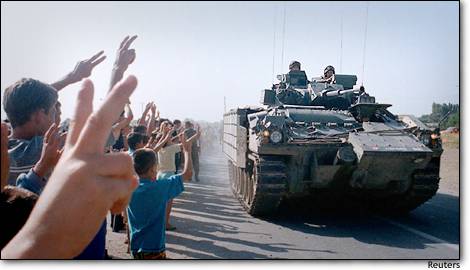
Kosovo Albanian refugees in Macedonia cheered — shouting “NATO! NATO!”
—as the first British troops passed their camp headed through the Blace
border crossing into Kosovo at dawn Saturday.
The first refugees — about 70 — have voluntarily returned to Kosovo in
the past 24 hours, the Macedonian Interior Ministry said Saturday.French
tanks were delayed along the Yugoslav-Macedonian border by a
minefield, which French officers said the Serbs failed
to report. A French mine-clearing team was dispatched to the area, while
1,200 French infantry were preparing to leap-frog over the obstacle to
fan out into the province. By this afternoon, the British convoy had reached
the outskirts of Urosevac, a key town
about midway between the Kosovo border and Pristina.
About 100 ethnic Albanian villagers, waving and chanting
“NATO! NATO!” briefly blocked the road before troops gently
asked them to move aside.
One elderly woman, Zolfia Selime, said she and other villagers had been
hiding in the mountains while Serb
soldiers were in the area. “We’re very happy,” she said.“God
helped us to survive until this day that NATO came.” Serb troops could
be seen retreating, some in civilian trucks, as the convoy advanced northward.
50,000 TROOPS
In one of the biggest military undertakings in Europe since World War II,
the NATO-led peacekeeping force,authorized by the United Nations, is due
to reach 50,000 troops.
They will back up a U.N. administration of the province and protect the
return of hundreds of thousands of Kosovo Albanian refugees to their homes.
Operation Joint Guardian began when Chinook and Puma helicopters
flew across the border, carrying members of Britain’s Gurkha rifle regiment
and paratroopers to secure mountain positions along the route.
The Gurkha’s are elite Nepalese infantrymen. As the British convoy
rumbled through southern Kosovo, troops could see evidence of the turmoil
that has swept the province. The town of Kacanik — which had a pre-war
population of 15,000 — was virtually deserted.
ROLE OF PEACEKEEPERS
NATO troops are supposed to deploy by moving into designated areas — five
international sectors — as soon asthe 40,000 Serb forces pull out.
NATO said that as of late Friday, 10,000 Serb personnel had left
Kosovo, along with 11 Mig-29s from the
Pristina airport. The Serbs were given 11 days to complete
the evacuation.
NATO has massed 19,300 troops from Britain, France, Germany, Italy and
the United States on the borders of Kosovo. Up to 7,000 U.S.
troops will take part in the international peacekeeping force.
Germany’s parliament approved sending 8,500 peacekeepers its biggest
military deployment since World War II.
NATO and Yugoslav liaison officers were trying to coordinate movements
in a complicated plan that calls for peacekeepers to move into designated
areas — five international sectors —as soon as the 40,000 Serb forces pull
out.
SERB RETREAT
As the Yugoslav withdrawal continued Friday, Yugoslav soldiers cheered,
waved and honked their horns. One vehicle had “Serbia all the way to Tokyo”
painted on it. In Prokuplje, cheering residents threw flowers onto several
dozen Yugoslav army vehicles heading northward.
NBC’s Kerry Sanders, who traveled with a fast-moving Yugoslav army convoy
headed north to Serbia on Friday afternoon, said that the convoy also included
civilian vehicles carrying fleeing Serbs.
One man told Sanders he feared he would never return to his home
in Kosovo. Some Serbs are afraid of the impending NATO occupation or of
retribution when ethnic Albanian refugees come home, Sanders reported.
All of the estimated Yugoslav soldiers and Serb special police are supposed
to be out of the southern Serb province within 11 days.
In Brussels, NATO said 4,000 Serb military personnel had left Kosovo by
Friday.
The Kosovo crisis began in February 1998 when Milosevic cracked down on
ethnic Albanian rebels seeking independence for the province. NATO
began bombing Yugoslavia after Milosevic refused to sign a peace agreement.