Marines Under Fire
June 25, 1999
U.S. Forces Attacked as NATO Struggles to Control
Kosovo
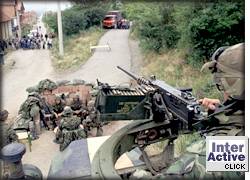 A
U.S. Marine sits on top of an armored personnel carrier as his unit guards
a road to the village of Zegra village in southeast Kosovo. Marines killed
one attacker and wounded two others Wednesday during a sniper attack in
the village. (Viktor Korotayev/Reuters
A
U.S. Marine sits on top of an armored personnel carrier as his unit guards
a road to the village of Zegra village in southeast Kosovo. Marines killed
one attacker and wounded two others Wednesday during a sniper attack in
the village. (Viktor Korotayev/Reuters
ABCNEWS.com
June 25 — U.S. Marines came under their most serious attack yet in
Kosovo today, taking sniper fire from several directions.
They returned fire, said ABCNEWS’ Morton Dean,
who was pinned down with the Marine contingent in the town of Gnjilane.
One unidentified person was killed.
There were no American casualties, Dean said.
“Marine reinforcements have been charging into the area. A number of tanks
have taken up positions as helicopters circle,” he said.
The 26th Marine Expeditionary Unit has its
Kosovo headquarters in Gnjilane.
The attack was the third on U.S. forces in
Kosovo this week. On Wednesday, one person was killed and two were wounded
when Marines fired back at snipers who took shots at a checkpoint manned
by about 30 Marines near the village of Zegra, south of Gnjilane. The identities
of the attackers were not revealed.
On Monday, soldiers from the 82nd Airborne
Division were fired on but not hurt, and the attackers were taken into
custody.
NATO Can’t Prevent Civilian Attacks
In much of Kosovo today, NATO struggled to curb revenge attacks against
the province’s Serbs.
Despite NATO’s appeals, ethnic Albanians torched
Serb houses in western Kosovo on Thursday and looted Serb-owned shops in
Pristina, the provincial capital.
“They burned my house, so I don’t care about
this one,” Mohammed Azemi, said as he stood near a blazing house in the
village of Belo Polje. “I’m happy in some way.”
NATO issued a new plea for calm today, and
President Clinton defended the actions of some 21,000 NATO troops to try
to control the province.
“NATO is not letting it happen. We’re doing
what we can to stop it,” President Clinton said in Washington. “ I’m not
particularly surprised, after what theyv’e been through.”
Serbs Keep Fleeing
Panicky Serbs continued to flee the western Kosovo city of Pec today,
accusing ethnic Albanians of chasing them out of town. Italian NATO troops
patrolled Pec, looking for Serb stragglers who might need help.
Some of about 300 Serbs who took shelter at
the Serbian Orthodox monastery also were trying to leave, despite efforts
of church leaders to persuade them to stay. The exodus left Pec, an important
center of Serbian Orthodoxy, almost empty of Serbs. Fires believed set
by ethnic Albanians leveled Serb homes and much of the Gypsy quarter. There
were 14 killings in Pristina on Thursday, NATO spokesmen said. There was
no immediate breakdown on victims, but most incidents were connected to
ethnic tensions, they said.
In Pristina, British soldiers swarmed around
the commercial center late Thursday to curb looting, but the looting continued
today. There was so much looting that NATO troops could not control it.
Refugees Still Returning
Ethnic Albanians were surging back into the province at a rate almost
unprecedented in any refugee crisis in the past quarter-century.
About 48,000 ethnic Albanians returned on
Thursday alone, said Paula Ghedini, a spokeswoman for the U.N. High Commissioner
for Refugees. That brought to more than 300,000 the number who have flooded
back into the southern Serb province from Albania and Macedonia in the
past 10 days.
About 860,000 ethnic Albanians were reported
to have fled or been expelled from Kosovo since NATO launched a bombing
campaign March 24. The bombing was intended to force Yugoslavia to accept
a peace plan for the province and halt its expulsions.
U.N. officials have tried in vain to persuade
refugees to delay their returns until mines can be cleared and better arrangements
for food and shelter organized. Many are coming home to little more than
burned-out shells of houses.
Craddock said in the previously-arranged interview that
there were now 4,500 U.S. Marines and Army troops in Kosovo, the
vanguard of 7,000 troops which Washington has promised for a planned
50,000-member Kosovo peacekeeping force (KFOR).