U.S. troops caught
between angry
Albanians and a
man they say is a
war criminal
A familiar face nearly sparks riot
June 18, 1999
U.S. troops caught
between angry
Albanians and a
man they say is a
war criminal
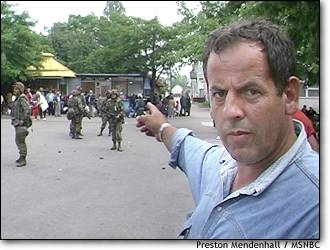
UROSEVAC, Yugoslavia, June 18 — Fare Mustafa could hardly believe his eyes. Fifty yards away sat the man he holds responsible for the machine gun murders of eight of his cousins in the village of Racak last January. Mustafa wanted revenge. Before long, a large angry crowd of ethnic Albanians had surrounded a group of Serbs, with nothing between them and a lynching but a platoon of the U.S. Army’s 82nd Airborne.
FOR THESE U.S. troops and for other NATO peacekeepers around Kosovo,
the central paradox of their mission has been exposed quickly. Here, allegedly,
was Cedomir “Cedo” Aksic, a man villagers claim was behind the notorious
massacre at Racak, where 45 civilians died. And yet, as American troops
had to point out Friday, NATO is not authorized to make arrests based on
such charges. In effect, the U.S. troops had to abet Aksic’s flight to
safety in neighboring Serbia.
Urosevac, about 30 miles south
of Pristina, very nearly spun out of control anyway. Hundreds of Serb civilians
fearing retribution at the hands of returning ethnic Albanian refugees
were desperate to leave but had missed the last train from Kosovo to Serbia.
Word of the Serb’s plight spread among Urosevac’s Albanian population.
It also reached the U.S. Army, which quickly moved a platoon into the area
to prevent a flare-up at the downtown train station.
‘I KNEW HIM WELL'
Mustafa said he was on his way
back to his home village of Racak after living as a refugee in Macedonia
for the last three months. “And there he was,” Mustafa said pointing to
a man he identified as Aksic, the director of the Urosevac branch of Serb
Forrest, a national logging company.
Mustafa claims Aksic participated in the “Racak massacre,” a now-famous
bloodbath widely acknowledged as the incident that hardened NATO alliance
resolve to take military action against Yugoslav President Slobodan Milosevic.
Ethnic Albanians frequently say
that some of the greatest atrocities committed in Kosovo were perpetrated
by familiar individuals — a local police chief, a neighbor, or, in Aksic’s
case, a well-known factory director. “I knew him well,” Mustafa said, betraying
no emotion as he pointed to Aksic. “I would see him in Stimlje (a town
five miles from Racak) to check on the logging operations. He used to chide
me. He’d ask, ‘Where is the KLA?’ or ‘Go back to your backwards village
life,’ ” said Mustafa, an electrician.
On Jan. 15, the day of the Racak
massacre, Mustafa said he saw Aksic come down the road leading to the village.
He was wearing a uniform with the insignia of special Serb anti-terrorist
units. Aksic spoke Albanian fluently, Mustafa said, and he called out the
names of Albanian men in Racak. “The ones that went out without looking
first were killed. I saw him, so I ran out the back and fled.”
Mustafa said he did not see the
actual killings, but several days later villagers led international monitors
to at least 45 bodies, including that of a 12-year-old, strewn in a gully
above Racak.
CROWD GETS UGLY
On Wednesday, the 82nd Airborne took over the town and its municipal
buildings. On Friday, the troops’ carefully planned peacekeeping operations
in Urosevac were on the edge of chaos.
Fadil Elezi, an ethnic Albanian
resident who worked as an English translator for the Organization for Security
and Cooperation in Europe until the NATO bombing began, pleaded with the
American soldiers to arrest Aksic and another man in the crowd of Serbs.
“There are men there who did a
lot of very bad crimes,” Elezi said. “You are protecting them, and if you
let them go the [International War Crimes] Tribunal won’t catch them.”
‘The United States is late again. You were in bombing Milosevic. You
were late because none of these atrocities would have happened if you had
acted sooner. And now the war crimes investigators are late.’ said Fadil
Elezi.
Soldiers from the 82nd Airborne,
who arrived in Kosovo last Saturday, told Elezi and Mustafa that they were
peacekeepers, not lawyers, and that only tribunal investigators could detain
Aksic. War crimes investigators are present in Kosovo, but their staff
is already taxed by the discovery of nearly 100 mass graves since Sunday.
Elezi boldly pressed on. “The
United States is late again. You were in bombing Milosevic. You were late
because none of these atrocities would have happened if you had acted sooner.
And now the war crimes investigators are late. You have eyewitnesses to
war crimes standing in front of you, but you do nothing.”
The growing crowd of Albanians
around Elezi frightened the Serb civilians, who moved to the far side of
the town’s train station. The man identified as Aksic, followed by other
Serbs, approached a U.S. soldier at the adjacent town hall. “You see,”
Elezi said, “now he’s afraid.” The Serb crowd prevented MSNBC from approaching
Aksic to confirm Mustafa and Elezi’s allegations.
Sgt. Kevin Neil, an Army Special
Forces civil affairs officer, was called in to mediate. “I agree with you,”
Neil told Elezi and the crowd. “But our orders do not include arresting
people.”
“I may sound like an idiot. I
know your concern is if he leaves you’ll never get him, but we can’t do
anything,” Neil said.
ANOTHER FACE IN THE CROWD
Meanwhile, two other ethnic Albanian
men claimed they had identified a second war crimes suspect in the crowd.
Arben Deliu pointed to a Serb man and said, “He burned people.”
Deliu said that Obrad Popovic,
a resident of the nearby village of Slivove, had worked with his sons Zoran
and Dragan, who were Serb paramilitaries. “They provided lists of all the
Albanians in the villages around them to the paramilitaries. And then Popovic
helped get rid of the bodies,” Deliu said. He said he was not a witness
to burnings of any bodies.
A U.S. Army civil affairs officer
at the scene who spoke on condition of anonymity told MSNBC that Popovic
had initially been found on Thursday night when the 82nd Airborne was on
patrol in Urosevac. The soldiers had to force fighters from the Kosovo
Liberation Army to give up a former Yugoslav army barracks they had made
into a local headquarters. Once the KLA left the facility, the American
soldiers searched the building and found Popovic locked in a closet. His
hands and feet were bound together with wire and he had suffered several
broken ribs.
“The KLA had worked this guy over,”
the officer said. “They knew he had done something and had started their
retribution.”
A KLA “photographer” was in town Friday, under instructions
by “KLA intelligence officers” to take pictures. He took photos of both
Aksic and Popovic. He said the
KLA’s evidence would be turned over to international war crimes investigators.
Mustafa, who lost eight cousins
with the same last name in the Racak massacre, watched from a distance
as the American troops broke up the gathering of ethnic Albanians. The
train to take the Serbs away had again failed to materialize, and Aksic
would have to spend another night under NATO guard.
“I don’t know what to do,” Mustafa
said, looking at Aksic, who would not meet Mustafa’s gaze. “I guess I want
to kill him.”
MSNBC’s Preston Mendenhall is
on assignment in Yugoslavia.