A Refugee’s Costly Homecoming
June 17, 1999
Kosovars pay price of rushing home as U.S. doctors
rush to tend wounded
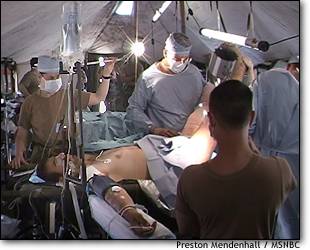 CAMP BONDSTEEL,
Kosovo, June 17 — U.S. Army doctors barely had time to unpack after
their arrival Thursday before they were rushed into a warzone emergency.
Shahin Darllish, an ethnic Albanian from Kacanik in the U.S. sector, ignored
the pleas of international relief agencies and NATO and rushed back from
Macedonia to see what was left of his home. What he found would cost him
dearly.
CAMP BONDSTEEL,
Kosovo, June 17 — U.S. Army doctors barely had time to unpack after
their arrival Thursday before they were rushed into a warzone emergency.
Shahin Darllish, an ethnic Albanian from Kacanik in the U.S. sector, ignored
the pleas of international relief agencies and NATO and rushed back from
Macedonia to see what was left of his home. What he found would cost him
dearly.
DARLLISH HAD been severely injured three days prior when he returned
home and opened the front door to his remarkably in tact home. The door
promptly exploded, badly mangling his foot.
STILL UNPACKING SUPPLIES
News of Darllish’s misfortune reached
the Army’s Forward Surgical Team (FST) as they were still unpacking supplies
in the early hours of Thursday morning. The local Kosovo Liberation Army
command said that the 38-year-old refugee had shown up in their headquarters
and was in desperate need of medical attention.Maj. Eric Mansfield, a doctor
with the 82nd Airborne division left with a team of medics for the KLA
headquarters near Kacanik. Darllish’s left foot dangled from his leg and
shrapnel wounds covered his calves and thighs. Still, he had dragged himself
a mile from the accident over the last three days and now help had arrived.
“His foot was dripping with maggots,”
Mansfield told MSNBC. Darllish was treated briefly on the scene, then rushed
to better facilities at the U.S. military headquarters, known now as Camp
Bondsteel, about 10 miles away. Army doctor Maj. John Sayles operated on
Darllish Thursday morning, amputating his left foot and cutting away infected
tissue around other wounds.
“He would have died had
he not received emergency treatment,” Sayles said while Darllish recovered
in an Army green tent from the two-hour operation.
MORE THAN PATROLS
This was just one example of the
kind of non-traditional work the U.S. military was being called on to do
just five days into the KFOR deployment. Sayles credited his team’s experience
in Kenya during the aftermath of the U.S. Embassy bombings last August
for their cool response to the situation. He said the FST had no illusions
about the difficulty of the much larger Kosovo mission.
“I don’t think a single one of us was really surprised
by what we did today,” Sayles said.
Nothing in Kosovo is easy these
days. Plans to transfer Darllish to a civilian medical facility in Kosovo
had to be put on hold. Decades-long discrimination in Kosovo meant that
Albanians lacked adequate hospitals. Serb doctors would refuse to treat
Darllish in what facilities were still functioning after the war, if those
doctors hadn’t already fled north.
MORE ON THE WAY
The U.N. believes some 250,000
ethnic Albanian refugees of the 850,000 driven out of the country were
already making their way home on Thursday, a situation relief agencies
regard as a potential disaster. An additional 600,000 refugees are still
outside Kosovo, where the United Nations was urging them to stay put.
As Darllish’s injuries demonstrated,
Kosovo was still a dangerous place despite the continuing withdrawal of
Yugoslav troops from the region.
The International Committee for
the Red Cross said Thursday that 20 refugees had been injured in mine-related
incidents. Yet as refugees continue to make their way to rural areas, humanitarian
organizations expect the number of casualties to rise quickly. Judith Kumin,
spokeswoman for the U.N. High Commissioner for Refugees, said in Geneva
on Thursday that the agency would not help the refugees to get home until
safety improves in Kosovo.
“If we offer organized returns,
it sends a signal that there is a degree of safety which simply at the
moment is not there,” she said. “It’s of course a very difficult situation
for us because people are voting with their feet.”
MAPPING THE DANGERS
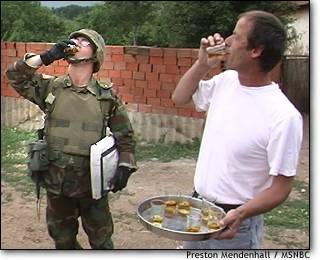
U.S. Army Capt. Marshall Miles drinks whiskey with
an ethnic Albanian villager, relenting in the face of Balkan hospitality
Thursday.
The U.S. peacekeeping contingent,
which will ultimately number 7,000, is actively involved in locating and
marking mines left behind by retreating Yugoslav forces. A U.S. Infantry
reconnaissance mission made up of M1A1 tanks and Bradley armored fighting
vehicles rumbled through the Kosovo countryside Thursday gathering intelligence
— and a huge Kosovar Albanian fan club
In the village of Softaj 10 miles north of Camp Bondsteel, the U.S.
peacekeepers’ base, hundreds of residents swarmed the soldiers, cheering,
throwing flowers and offering water and whiskey.
“We’re not only here to do route
reconnaissance,” Capt. Marshall Miles told MSNBC. “We’re also here to win
the hearts and minds of the people.” Miles held meetings with several town
elders, who had made detailed notes of local mine fields when they watched
Serb forces lay the devices last month.
“Thank you so much for coming
here and for kicking out the Serb military,” 63-year-old Nazmi Mahmuti
told Miles. “We will build a statue of you and your men in our village.”
MSNBC’s Preston Mendenhall is
on assignment in Yugoslavia.