July 29, 1999
Albanians Greet Albright in Kosovo
By TOM RAUM Associated Press Writer
PRISTINA, Yugoslavia (AP) - Secretary of State Madeleine Albright, greeted
by ethnic Albanians
as a liberator, pledged today that ``as long as you choose, Kosovo
will remain your home.''
``You have been through a terrible ordeal this past year. ... Much
has been lost and cannot be
regained,'' Albright, the highest-ranking U.S. official to visit the
Serbian province since the 78-day
NATO air war, told a cheering crowd.
``I hope that today we may pledge that here in Kosovo never again will
people with guns come in
the night, never again will houses and villages be burned, and never
again will there be massacres
and mass graves.''
About 2,000 Albanians, many chanting ``U.S.A.,'' turned out to greet
Albright, whom they
affectionately call ``Nona,'' or Mother. American, Albanian and British
flags waved in the crowd.
The secretary of state came to Pristina for a firsthand look at postwar
reconstruction. The crowd
responded enthusiastically when she declared that Yugoslav President
Slobodan Milosevic ``should
answer for his crimes.''
``She is the best woman in the world,'' said Lirie Hana, 54, ``She is
the one who made it possible
to breathe free.''
Added Ibrahim Hallaci, 44: ``I'm here to await and thank her for everything
she did for us. As a
simple citizen, I am very, very happy that I could come and chant her
name in freedom for which
she worked so hard.''
In contrast, Albright got a hostile reception when she visited a Serbian
Orthodox monastery in
Gracanica, just south of Pristina. About 150 people, mostly Serb men,
chanted ``Serbia, Serbia''
and ``Slobo, Slobo,'' referring to Milosevic. Some shouted obscenities.
When Albright's spokesman, James Rubin, alighted from his car he was
greeted with a
thumbs-down gesture and several shouted an obscenity.
Albright went first to the headquarters of the NATO peacekeeping force,
known as KFOR, where
she met with the NATO commander, British Lt. Gen. Mike Jackson, and
the chief U.N.
administrator in the province, Bernard Kouchner of France.
``Obviously there's a lot of work to be done, but there's also a tremendous
amount of enthusiasm
and willingness to work,'' Albright said after the briefings. ``I am
very encouraged by the
cooperation between KFOR and UNMIK,'' the U.N. Mission in Kosovo. ``They
are working well
together.''
When asked about the Serbs and what she would say to local Serb leaders
in a meeting later, she
said: ``I will tell them that the system is here to protect them. KFOR
and UNMIK will cooperate
for everybody's future. But don't forget that some disgusting things
happened here. But we want
them to stay if we want to build a multiethnic Kosovo.''
There was a tense moment earlier when a gunshot rang out as Hashim Thaci,
head of the Kosovo
Liberation Army and de facto leader of Kosovo's ethnic Albanians, pulled
up to the U.N.
headquarters for a meeting with Albright. U.N. security agents rushed
out of the building and
Thaci's guards surrounded his car. Many bystanders dropped to the ground.
British soldiers guarding the area said there was no indication where
the shot came from or where it
might have been aimed. Albright was inside the building.
An American official who later briefed reporters on the condition of
anonymity said consideration
was given to postponing her outdoor speech because of the gunshot,
and because others in the
vicinity were known to be armed.
But she wanted to go ahead with it, the official said. However, as a
concession, she was driven the
block and a half to the speech in a bulletproof vehicle instead of
walking. And, once the speech
was over, she was whisked quickly away.
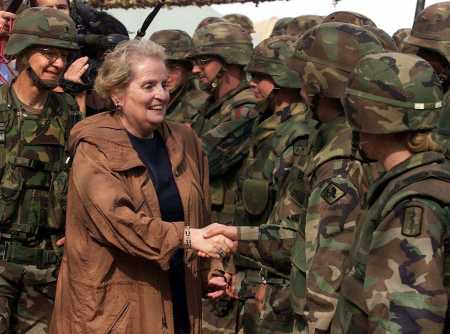
At her last stop in Kosovo, Albright took a helicopter to Camp
Bondsteel, in the middle of the
American-controlled sector, and told U.S. troops: ``You have a difficult
and dangerous job at a
very uncertain time.''
Before leaving Rome for Pristina on Wednesday, Albright, referring to
the pace of reconstruction,
told reporters: ``Clearly one would wish that this were moving faster.''
But she decline to criticize
the U.N. operation attempting to resettle hundreds of thousands who
were displaced from Kosovo
during the past year.
As for destruction from Serb assaults on Kosovo Albanians and from NATO
bombing, she said
that, based on preliminary estimates, there ``has been less damage
than initially feared.''
She said $500 million the United States has pledged to help feed and
house refugees returning to
Kosovo was ``a good start,'' although she emphasized that Western allies
will have to pick up the
brunt of reconstruction costs.
Altogether, more than 60 nations and dozens of international aid agencies
have pledged $2 billion.
``The process of building up is proceeding more slowly than we had anticipated,''
Italian Foreign
Minister Lamberto Dini said at a news conference with Albright on Wednesday
after the two had a
working lunch.
Albright was to meet with U.S. peacekeepers in Kosovo, plus officials
of the Kosovo Liberation
Army and political influence groups. She also was expected to fly over
some areas where there is
evidence of atrocities from the Serb offensive against the province,
aides said.
Following the Kosovo visit, Albright will join President Clinton on
Friday for a conference in
Sarajevo with other world leaders on Balkans reconstruction. Milosevic
will not be there.

