U.S. soldiers killed when their armored personnel carrier
overturned during a peacekeeping patrol in Kosovo. The
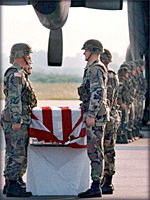
bodies were being flown home from the airport in
Skopje, Macedonia
An honor guard flanks the flag-draped coffin of one
of two
U.S. soldiers killed when their armored personnel
carrier
overturned during a peacekeeping patrol in Kosovo.
The
bodies were being flown home from the airport in
Skopje, Macedonia
By Colleen Barry
The Associated Press
P R I S T I N A, Yugoslavia, July 20 — Hatred and violence are claiming
new victims in Kosovo, even as old ones are just being documented by international
investigators documenting war crimes.
Four ethnic Albanians killed over the weekend
near Klina, in western Kosovo, provide stark evidence that the ethnic hatreds
that led to the brutal Serb-Albanian conflict are continuing despite attempts
by NATO-led peace forces to cap tensions.
Evidence of earlier brutality was unearthed
Monday in the northern town of Podujevo, where local authorities exhumed
the bodies of 19 victims of a Serb massacre — including 80-year-old Fariz
Fazliu, who went missing on March 28, the Muslim holy day Bajram.
The old man’s embroidered black and white
belt, part of a traditional costume from the region, was still cinched
around the body.
“Even the grave is full of blood,” said Nimon
Fazliu, the man’s nephew, believing he saw dark stains on the dank walls
of the grave.
U.S. Peacekeepers Identified
Elsewhere in the province, American peacekeeping forces in Kosovo suffered
their first deaths when an armored personnel carrier overturned, killing
two soldiers and injuring three others, a spokesman said Monday.
The deaths of the peacekeepers — Spec. Sherwood
B. Brim, 30, of Dallas, and Sgt. William W. Wright, 27, of Clearlake, Calif.
— occurred near Dmorovce, 10 miles northeast of Gnjilane, where U.S. forces
are based.
The accident came five weeks after U.S. forces,
now totaling about 5,000, entered the province along with other NATO troops
under a peace accord.
NATO has struggled to prevent ethnic attacks,
both by returning ethnic Albanian refugees seeking revenge against Kosovo’s
Serbian minority and others by Serbs targeting Albanians.
As hatred and violence persist in Kosovo,
political fallout from the war is mounting in Serbia.
For nearly three weeks, protests against President
Slobodan Milosevic and his government have spread over much of Serbia as
the opposition tries to capitalize on public anger over the defeat by NATO
and de facto loss of Kosovo. But the opposition remains fractured.
In an interview with the Montenegrin Vijesti
daily published Monday, opposition leader Zoran Djindjic rejected cooperation
with rival Vuk Draskovic, who has said that Milosevic’s ouster should not
be the main opposition goal.