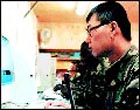
Md., hunching over a computer screen in the MWR (morale, welfare, and recreation) tent. He's
tapping out holiday greetings to his sister Yueng Key Poon in New Jersey. Pausing, he adds, "This is important, helping people out here."
Richard Mertens
Special to The Christian Science Monitor
CAMP BONDSTEEL, YUGOSLAVIA
At the sprawling American Army base in Kosovo, Christmas trees glitter
in the mess tents. Packages
flood the mailroom. At the PX, Christmas decorations are being marked
down 50 percent - a sure
sign the celebration of the birth of Jesus is near.
But there isn't much evidence of holiday cheer on the freckled face
of Spc. Keith Tuck of Fresno,
Calif.
With an M-16 slung over his shoulder, he stands at the Camp Bondsteel
entrance inspecting an
unending line of trucks and cars outside the double gate and the concrete
barriers.
The stocky young man says his first child was born just 11 months ago.
"It
would have been my family's first Christmas together," laments Specialist
Tuck.
For the 7,000 American soldiers charged with keeping peace on earth
- at
least this corner of it - Christmas promises to be just another day
of work.
Peacekeeping, they say, can take no holidays.
"We've known for four months we were coming here," says Lt. Col. David
Abramowitz, of Leavenworth, Kan., a helicopter commander. "We had our
Christmases before we came. Having said that, it's always tough to
have
soldiers away from home for Christmas."
Some soldiers try to put the situation in perspective. Yes, Christmas
is a family
holiday. But their work is certainly in keeping with the spirit of
the day.
"It's kind of hard being away from home for Christmas," says Specialist
Chun Poon, of Waldorf,
Md., hunching over a computer screen in the MWR (morale, welfare, and
recreation) tent. He's
tapping out holiday greetings to his sister Yueng Key Poon in New Jersey.
Pausing, he adds, "This is important, helping people out here."
Others cope by trying to ignore the holiday.
In Camp Bondsteel's weight room, Pvt. Shaun Johnson, of Las Vegas, Nev.,
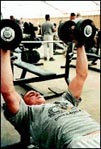 lies
on his back and pumps iron. Private Johnson says he expects to spend
lies
on his back and pumps iron. Private Johnson says he expects to spend
Christmas Day on patrol in the town of Vitina, a mixed and sometimes
turbulent community of Serbs and ethnic Albanians.
"I try not to think about it," he says, pausing to catch his breath. "I
try to act
like it's another day. Once I get home I'll make up for it."
The international administration in Kosovo has been trying to inject holiday
cheer into the grim Kosovo winter. Last week in Mitrovica, a city bitterly
divided between Serbs and ethnic Albanians, the United Nations put up a
"millennium tree" on the center of the bridge that connects the two halves
of
the city.
"It is not Serb, it is not Albanian," declares Steffand Mistura, the local
UN
administrator. It's a "symbol of hope."
But there is little evidence that this is a season of hope in Mitrovica.
When Mr.
Mistura tries to speak to a group of Serb men on the north end of the
bridge, they chant "Kosovo is
Serbia!" and drown out his words with firecrackers.
For most international aid workers, Christmas offers a respite, a chance
for home leave. But a few
are staying put. In the Pristina office of the Baltimore-based Catholic
Relief Services, Genevieve
Abel, hurries to finish a Christmas letter. It has a distinctly Kosovo
touch. Next to photographs of
the smiling young aid worker are pictures of a destroyed oil refinery
and a series of burned and
burning houses.
As a veteran aid worker, Ms. Abel has spent only two of the last 10
Christmases at home. "I've
made my peace with being overseas," she says. She also comes prepared.
She has a video of "It's a
Wonderful Life," Bing Crosby on CD, and packets of egg-nog mix.
Most Kosovars are ethnic Albanians, the vast majority of them are Muslim.
For observant Muslims,
this month is Ramadan, a period of daily fasting from sunrise to sunset.
But many Muslim Kosovars
celebrate Christmas, too. Young people especially see Christmas as
a European holiday, and by
embracing Christmas they embrace Europe.
"We used to have the best parties at Christmas," says Ardian Arifaj,
an editor
at the Kosovo newspaper Koha Ditore.
At St. Anthony's Catholic Church in Pristina, the Rev. Nosh Gjolaj is
looking
forward to celebrating midnight Mass tonight. St. Anthony's ministers
to a few
thousand of the 75,000 Catholic Albanians in Kosovo.
A year ago, 10,000 ethnic Albanians, mostly young people, gathered in
and
around the church for midnight mass, while the Serb police tried to
keep some
of them away.
This year, Father Gjolaj says, they would celebrate "the new peace to
come,
between people and religions."
In Pristina on Wednesday, about 300 ethnic Albanian children brought
in their
 plastic toy pistols,
rifles, and knives to swap for toys intended to promote
plastic toy pistols,
rifles, and knives to swap for toys intended to promote
more peaceful play. The Save the Children charity gave out teddy bears,
cars, sports equipment,
books, and toy musical instruments. A few children brought in real
weapons.
"Our children have to learn that the war is over," Nerimane Kamberi,
a father accompanied by his
four-year old son, told the Associated Press.
The commercial spirit is also evident in the streets of Pristina. On
the main street, a man in a red-
and-white bathrobe and purple moon boots stands next to a pretty young
woman in a blue satin
dress. They pose in front of a papier-mâché carriage,
where a photographer takes children's pictures
for $4.
"For children, Father Christmas is not enough," says the woman in the
blue dress. "Children love
Cinderella."
As dusk falls over Pristina, Jeff Adams, a UN police officer from Leavenworth,
Kan., stands on
Mother Teresa Street and directs traffic in his own festive way. He's
wearing a blue jump suit, a
lime-green reflective vest, and a red-and-white hat.
There, looking a bit like an overgrown department store elf, he accomplishes
a rare feat in Kosovo:
he imposes order. With only a whistle and hand signals, he tames the
most unruly traffic in the
Balkans. Cars stop and start, turn right and left, as neatly as if
he were back in Kansas.
Indeed, home looms large in his thoughts. His wife and two children
are in Kansas, but he will not be
joining them for Christmas.
"I'm going to miss my family a lot," he says, standing off to one side
of the traffic. "That's going to be
on my mind while I'm out here." But bringing peace, too, will be on
his mind. "We have a lot of to do
here."
P>

