 Staff photo
by Marcus castro
Staff photo
by Marcus castro
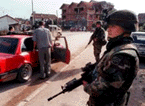
Pvt. Michael Bustamante, right, watches a row of waiting vehicles as other members of his squad search for weapons at a checkpoint in Vitina.
By Henry Cuningham
Military editor
VITINA, Kosovo -- Pvt. Michael Bustamante had not been at Fort Bragg
long enough to maneuver on the training ranges before he found himself
being shot at in Kosovo.
Staff photo
by Marcus castro
Pvt. Michael Bustamante, right, watches a row of waiting vehicles
as other members of his squad search for weapons at a checkpoint in Vitina.
The 24-year-old infantryman from Rialto, Calif., returned gunfire on his fourth night on the ground.
Bustamante said it was surprising and unexpected to be shot at and shooting back during his first week in the troubled region.
‘‘They told us this is a peacekeeping mission,’’ said Bustamante, who has been in the Army for less than a year.
Fort Bragg soldiers might find themselves going on patrol, guarding churches and houses or setting up checkpoints on the road. Some have gone into houses and apartments to search for weapons.
A soldier remarked that a peacekeeper in Kosovo has to learn to smile at the local people without ever letting his guard down.
During a patrol, Bustamante was quick to notice a certain car that had driven by about five times.
When the soldiers go on patrol, they wear helmets and flak vests, carry live ammunition and are on the lookout for anything. Albanian children chant, ‘‘NATO,’’ and give the ‘‘V’’ sign for victory as the soldiers pass. Chickens peck at the side of the road, and the air is heavy with the smell of hay, manure and trash fires as the soldiers walk down the road at safe intervals, half on one side, half on the other.
They frequently have heard gunfire and mortar fire in their two months in Kosovo.
 Staff photo
by Marcus Castro
Staff photo
by Marcus Castro
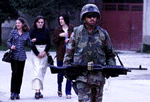
Pfc. Tony Stephens carries a 240-B machine gun on a patrol through
Katina.
Bustamante, a strapping paratrooper with a youthful face, is a member of Company A of the 505th Parachute Infantry Regiment of the 82nd Airborne Division from Fort Bragg. It’s the ‘‘Joes,’’ the U.S. soldiers, who are pounding the pavement and keeping the peace in this part of Kosovo.
The eight men in Bustamante’s squad are among about 5,800 American soldiers keeping the peace in the U.S. sector of southeastern Kosovo. The sector also has about 2,100 troops from other nations, including Greeks, Poles and Russians.
During the past decade, Serbs stripped Kosovo of its autonomy, closed Albanian schools and fired Albanians from state-owned enterprises. Since the end of the NATO air campaign, many Serbs have fled, and it’s payback time for the Albanians.
Soldiers from around the world are trying to keep the peace in Vitina, which has a relatively large Serb population.
‘‘The air campaign did a lot, but it’s the guys who are on constant patrols who are helping put this war to a close,’’ said Spc. Kerey Stickel, 20, of Vancouver, Wash. ‘‘If we were not here, this thing would still be raging on. It’s the small villages and back alleyways that’s the main problem now.’’
The soldiers have confiscated automatic guns and rocket-propelled grenades from residents.
‘‘The Air Force can’t find that stuff,’’ Stickel said. ‘‘A plane can’t spot an individual shooting up a home.’’
Young guns | Top
The men who are trying to keep the peace and re-establish order in
one of the world’s most troubled corners are young and often haven’t been
in the Army long.
Pfc. Joseph Johnson, 19, is from Retsof, N.Y., a small town between Rochester and Buffalo. The tall, thin, red-haired soldier has been in the Army for about a year.
Pvt. Jorge Cesena, 20, of San Diego, Calif., has been in the Army less than a year.
 Staff photo
by Marcus Castro
Staff photo
by Marcus Castro
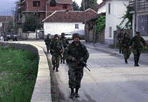
Spc. Kerey Stickel, front left, is the point man on a patrol through
the Serb section of Vitina, Kosovo.
Cesena, who has a broad chest and bulging biceps, loves to lift weights. He uses makeshift weights of cement and whatever he can get his hands on to keep in shape in Kosovo.
The squad is close. If someone gets a package from home, everyone shares. If they are on patrol, they are watching each others’ backs.
The squad leader is Staff Sgt. James Gallegos, 28, from Cuba, N.M., a small town northwest of Albuquerque. His soldiers call him ‘‘Sgt. G.’’
Gallegos says he wouldn’t go anywhere without the poster of Dale Earnhardt, the NASCAR race car driver, which hangs on the wall beside his cot in a metal factory on the outskirts of town.
He’s the kind of guy his leaders are talking about when they say that other people in the battalion have more authority but nobody has more responsibility.
Gallegos and his soldiers had just come off patrol one day when they had to go back out because someone threw a hand grenade onto a sidewalk at a crowded market, injuring 38 people. Gallegos was responsible for getting an ambulance into the area and re-establishing order in the chaotic environment.
‘‘The most important thing is the lives of the soldiers,’’ Gallegos said.
But his responsibilities include the welfare of local people, too. He quizzes them about whether they know of anyone who is sick, hungry or homeless. He gets quizzed back about the status of people involved in crimes by one ethnic group against another.
Different mission |
Top
The paratroopers say they miss being able to wear the maroon beret
of airborne soldiers, but they appreciate the protection that their helmets
provide. ‘‘We train for all-out war,’’ said Spc. Andrew Bullock of San
Diego, Calif., who wears the Ranger tab on his shoulder. ‘‘It’s a different
mission over here.’’
Bullock, who is 21, carries an M-240 machine gun, which would not be the ideal weapon in close quarters in the urban environment in which the soldiers find themselves.
 Staff photo
by Marcus Castro
Staff photo
by Marcus Castro
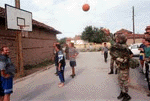
Staff Sgt. James Gallegos, right, shows a group of Serbs a 20 foot
jump shot while wearing full protective gear.
In training, the idea is that everyone who is not a U.S. soldier is an enemy. In Kosovo, things aren’t that simple. People who might be adversaries are probably not going to be wearing uniforms.
Bullock says he likes the additional $500 or $600 in extra pay and tax breaks each month while he’s on the Kosovo deployment. He figures he makes about $1,850 instead of $1,350.
In the past, there have been two or three houses burned each night in revenge against the Serbs. Farmers are shot to death while working in their fields. Soldiers have to guard houses, hospitals and churches around the clock. ‘‘It’s weird seeing how people who live in the same place two houses away will hate each other,’’ said Pfc. Tony Stephens, 20, of Cleveland, Ohio.
Stephens, who carries the 28-pound M-240 machine gun, is the son of an infantryman. Stephens said he decided to become a paratrooper because his father never had a chance to ‘‘go airborne’’ and he wants to ‘‘try to beat him.’’
Stephens was guarding a 350-year-old Serb Orthodox church one day when a car shot five or six times into a nearby Serb store and threw a grenade. ‘‘It’s just like Los Angeles,’’ said Spc. Dana Dunham, 26, of Cape Cod, Mass. ‘‘Violence is always going on.’’
Dunham said he realized how easily he could be killed after the grenade went off at the market.
‘‘It’s not me going to feel bad,’’ he said. ‘‘It’s my parents.’’

