Soldiers protect church history
August 26, 1999
By Henry Cuningham
Military editor
Inside the centuries-old Serbian Orthodox Church in Kosovo, a bearded
priest in a black robe proudly discusses the iconostasis, a screen with
religious paintings. There are no pews here. Worshippers stand during the
service.
Outside, three heavily armed U.S. soldiers from Fort Bragg stand guard
to keep the church from being burned to the ground by Albanians in revenge
for grievances against Serbs.
Kosovo is the home of some of the most significant monasteries and churches
for the Serbs, said Dr. Robert Greenberg, associate professor of Slavic
languages and literature at the University of North Carolina at Chapel
Hill.
‘‘That’s why Serbia has not wanted to give up Kosovo,’’ Greenberg said.
‘‘They consider it to be almost the cradle of Serbian civilization.’’
In the medieval Serbian kingdom from the 12th to 14th centuries, Kosovo
was the center of power, he said. The headquarters of the Serbian Orthodox
Church was the city of Pec in Kosovo, and Belgrade, the capital of 20th
century Yugoslavia, was just a border outpost.
Serbian symbols |
The Serbian Orthodox churches are the visible symbol of the ‘‘other’’
culture, Greenberg said. Despite its significance to the Serbs, the majority
of the people in Kosovo are of Albanian heritage, and most of the Albanians
are Muslim.
‘‘They (the Serbian Orthodox churches) are victimized,’’ Greenberg said.
‘‘It’s a target. These people feel such strong hatred they feel they can
obliterate the other nation by destroying the other nation and its heritage.’’
Churches are one of the distinctive features of the landscape in the
Balkans. You will find Islamic mosques in Kosovo, Bosnia, Macedonia and
Bulgaria, anywhere there are Muslim minorities.
But Fort Bragg soldiers in Kosovo are not likely to experience the same
intense adherence to Islam in the surrounding community that soldiers did
in Saudi Arabia.
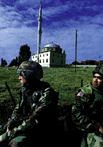
Spc. Adam Beck, left, and Pvt. Erik Longoria pass a mosque flying the
flag of the People’s Army of Albania on their way back from a village assessment
mission near Camp Monteith.
Muslims in the Balkans ‘‘have not been that observant in the past,’’
Greenberg said. ‘‘They look at themselves first as Albanian and then as
Muslims.’’
In Saudi Arabia, muezzins call the faithful to prayer at all hours of
the day and night. Women are veiled from head to foot. Alcohol is strictly
forbidden.
Not so in Kosovo.
‘‘It’s a European brand of Islam,’’ Greenberg said.
The vicious, violent conflicts in the Balkans in recent years are probably
more a clash of ethnic backgrounds rather than religion, Greenberg said.
‘‘I don’t think it’s in either religion’s philosophy to have the kind of
ethnic conflict we have seen,’’ he said.
But whatever the underlying cause, cultural monuments become targets
in ethnic strife. And soldiers with guns stand in front of houses of worship.
‘‘Given what’s going on, it’s not surprising,’’ Greenberg said. ‘‘I’m
not surprised. It’s unfortunate.’’
