Health Chief Checks State of Care in Kosovo
August 12, 1999
By Douglas J. Gillert
American Forces Press Service
CAMP BONDSTEEL, Kosovo -- One thing all the Army medics here
agree on: This is not Bosnia.
It's the children, they told Dr. Sue Bailey, assistant secretary
of defense for health affairs, as she toured the 67th Combat
Support Hospital Aug. 10.
"I have a 16-month-old daughter and it's really difficult to see
these horribly injured children," said Maj. Jimmie Keenan, chief
nurse. She said the hospital has seen so many children injured
by land mines and gunshot wounds, "it's heartbreaking."
Operating in the southwestern sector of Kosovo, the U.S. medics
have seen more civilian casualties than they ever saw in Bosnia,
said Army Dr. (Col.) Russ Taylor, commander of Task Force Med
Falcon, the 67th Combat Support Hospital from Wuerzberg,
Germany.
"We have treated 37 trauma patients in less than 30 days,
compared to the four a month we averaged in Bosnia," he said.
They've also treated more land mine victims -- 15 -- than any
other sector of Kosovo.
The primary mission of the 154 medics based here is, of course,
to provide medical care to some of the 6,100 U.S. service
members now based in Kosovo as part of Task Force Falcon. The
299th Forward Surgical Battalion at Camp Monteith and three
battalion aid stations provide additional medical support.
Some of the problems soldiers here have sought help for include
gastrointestinal disorders and stress, Keenan reported.
"Soldiers are seeing a lot of horrible things, and we've had a
lot more stress disorders in garrison," she said. Keenan said
the medics and other soldiers have learned to watch each other
for signs of stress, and commanders have removed any stigma
attached to seeking counseling, so nobody is fearful of coming
forward for help.
Although there have been no injuries as a direct result of
peacekeeping duties, the hospital treated one soldier who was
accidentally shot by his roommate as they cleaned their weapons
Aug 7. After undergoing surgery at Camp Bondsteel, the soldier
was medically evacuated to Germany's Landstuhl Medical Center
Aug. 9 for further treatment.
Medical officials are most concerned about diseases carried by
flying insects, Taylor told Bailey. He said military
veterinarians have been rounding up as many cats and dogs as
possible, giving them shots and neutering them, then letting
them go. They also have been treating military working dogs and
water supplies and controlling, as much as possible, human waste
disposal.
The hospital operates 12 ground ambulances and also coordinates
aeromedical evacuations with the aid of an Air Force liaison
team co-located with the Army medics. But the relatively good
health of U.S. soldiers and the overwhelming needs of the
civilian population have allowed the medics to focus more of
their efforts on treating civilians.
"Life, limb and eyesight" is how Army Dr. (Brig. Gen.) Michael
Kussman explained the extent of aid the Army is giving Kosovar
civilians.
"The task force commander has agreed to allow U.S. military
medics to aid refugees with the care they need immediately, as
long as it doesn't jeopardize our care of U.S. forces," said
Kussman, the senior U.S. military medical officer in Europe.
"But it's the right thing to do, and the Brits and Germans are
also treating refugee casualties."
Bailey's visit here was a follow-up to a trip to Albania in May
to check on medical force protection measures in place and to
find out what else is needed to ensure the safety of soldiers
here and in future operations. She planned to meet later in the
week with Gen. Wesley Clark, supreme allied commander, Europe,
before returning to Washington.
"What we didn't do in the Gulf some are saying we're still not
doing during this deployment" -- not screening soldiers for
environmental health problems and not conducting enough
preventive medicine, she said. Kussman assured her those issues
are being worked vigorously, and Bailey said she saw ample
evidence of that on this trip. She said the information she has
gathered is vital to her ability to articulate DoD health budget
requirements to Congress.
After visiting Camp Bondsteel, Bailey saw firsthand how the war
affected civilian health care at the Fairzjha Hospital in nearby
Urosevac. There, a Kosovar surgeon described the extreme lack of
medical equipment and supplies, revealing that he once had
nurses draw his blood while he continued an operation.
During a tour of the hospital, Bailey saw crutches whittled from
saplings and a surgical suite lit by only a desk lamp with a
single standard bulb. In a recovery ward, she greeted patients,
including a teen-aged boy whose lower right leg had been blown
away by a land mine.
To military and civilian medics alike, Bailey's parting message
was the same: "You are doing a great job under difficult
conditions, and I applaud you."
 (click
to see larger version)
(click
to see larger version)
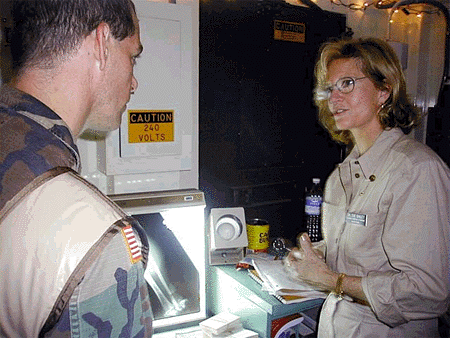
Dr. Sue Bailey, assistant secretary of defense for
health affairs, discusses an X-ray of a hand wound with Army
Maj. Terrance Gibboney at the task force manned 67th Combat
Support Hospital, Camp Bondsteel, Kosovo. Bailey toured the
hospital Aug. 10 as part of a return visit to the region, where
she has gathered information on medical needs for force
protection during current and future military deployments. A
soldier suffered the hand wound in an accidental shooting
incident.
During and following Allied Force, the air campaign to relieve
strife in the Serbian province of Kosovo, Army and Air Force
medical staffs set up and operated field medical facilities. The
Army's 212th Mobile Army Surgical Hospital and the Air Force's
86th Combat Support Hospital stood up in Albania. Medics from
the 43rd Airlift Wing, Pope Air Force Base, N.C., and the 52nd
Fighter Wing, Spangdahlem Air Base, Germany, operated mobile
aeromedical staging facilities in Tirana, Albania, and Skopje,
Macedonia.
Also in Tirana, the Air Force operated an expeditionary medical
squadron with a surgical team, critical care transport team,
flight surgeon and dentist. The composite unit's role was to
stabilize patients and evacuate them to Ramstein, but such
casualties didn't occur.
Now, the Army medics from Wuerzberg, Germany, are treating
civilian casualties of the war as well as providing troop care
in the tented 67th Combat Support Hospital at Camp Bondsteel and
299th Forward Surgical Battalion at Camp Monteith. Both camps
are located in southwestern Kosovo, where U.S. forces are
operating as part of Task Force Falcon. The 52nd Expeditionary
Aeromedical Staging Squadron from Spangdahlem supports post-
campaign operations in Kosovo from its base in Skopje, and Air
Force liaison teams assist medical units throughout the region
with aeromedical evacuations into Ramstein.
 (click to see larger version)
Army Maj. Jimmie Keenan, right, describes the
health care of U.S. soldiers and refugees at Camp Bondsteel,
Kosovo, to Dr. Sue Bailey, assistant secretary of defense for
health affairs, as other medical staff look on. Bailey toured
the hospital Aug. 10 as part of a return visit to the region,
where she has gathered information on medical needs for force
protection during current and future military deployments. Photo
by Douglas J. Gillert.


 (click
to see larger version)
(click
to see larger version)