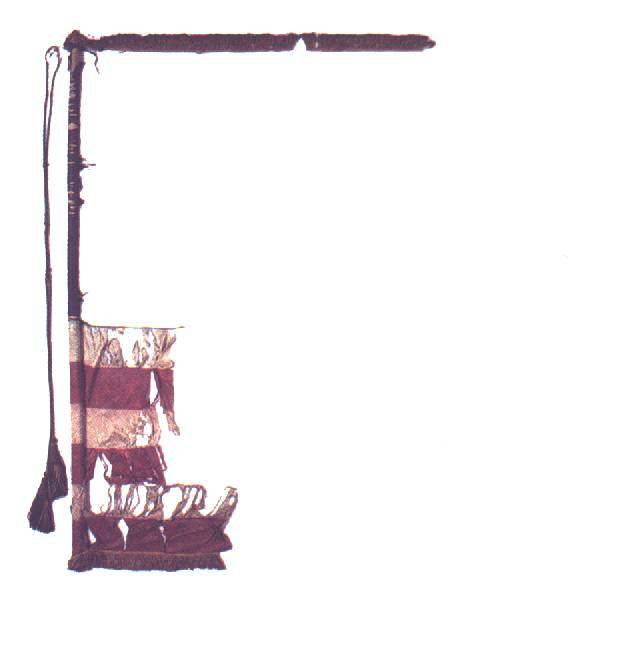
State Color
Maker: HB 1985.200
The 109th Regt. P.V.
State Color
The 109th Pennsylvania was organized near Philadelphia, in a camp at Nicetown, over the winter of 1861-62. On May 7, 1862, former Pennsylvania Governor James Pollock arrived to present a state color to the regiment. The 109th moved to Washington, then was ordered to Harper's Ferry. When the Army of Virginia was organized that summer, the 109th was assigned to the Second Corps, led by Major-General Nathaniel P. Banks. The regiment's first engagement with Confederate troops occurred at Cedar Mountain on August 9. Here, Color-Sergeant Lewis Shaw of Company C was killed. During the ensuing Second Manassas Campaign, this corps guarded the army's supply train and was not engaged. Now assigned to the Twelfth Corps, Army of the Potomac, the 109th remained on guard duty and did not fight at Antietam. During the Fredericksburg operation, the corps was part of the force guarding the army's supply line and was not engaged.
The Twelfth Corps was part of General Hooker's force that took part in the initial flanking movement of Chancellorsville in late May 1863. During the fighting on May 3, Colonel Henry J. Stainrook was killed and the regiment was thrown into confusion. The senior captain, a number of the men, and the colors "ran ignobly from the field" and did not rejoin the regiment until after the battle. The captain was shamed into resigning and the colors were given to a more worthy bearer.
The 109th arrived at Gettysburg late on July I, then took position on Gulp's Hill the next morning. The regiment was engaged that evening as Rebel troops assaulted the positions on the hill, and fought again on July 3 as the Twelfth Corps drove the enemy out of captured entrenchments. Although the 109th suffered only ten casualties, two of these were color-bearers. Sergeant John Greenwood was killed and Sergeant William McNally wounded.
Following the Gettysburg Campaign, the Twelfth Corps was part of the reinforcements sent to relieve the Union troops under siege at Chattanooga. The regiment participated in the short but severe combat
State Color
Maker: HB 1985.200
at Wauhatchie on October 28, then was held in reserve during the November fighting at Chattanooga. Most of the 109th re-enlisted and went home on furlough in late January 1864.
When the regiment returned to the Army of the Cumberland, it became a part of the Second Division, Twentieth Corps. Commanded by Brigadier-General John W. Geary, this division participated in Sherman's Atlanta Campaign (May-September 1864). during the initial phase of this campaign, the 109th fought at Re-saca (May 15), Pumpkin Vine Creek (May 25-31), and Pine Knob (June 15-22). Sergeant Fergus Eiliott of Company G carried the state color during this period. Elliott, not quite twenty-one years of age, was an Englishman who came to America in 1857. He was given the state color just after Gettysburg and was still bearer when the Atlanta Campaign began.
When the Confederate army fell back into Atlanta's defenses, Sherman's troops followed. Geary's division, together with the rest of the corps, crossed Peach Tree Creek on July 19. Geary's troops halted on a low ridge and built a defensive line with fence rails and other materials at hand. On July 20, Confederate
saw Elliott halt and rallied on the flag. At the same time, a handful of artillerists of the 13th New York Battery had turned two cannon toward the enemy and were attempting to load and fire the guns. Elliott and his comrades ran to the cannon and helped man them. Meanwhile, Captain Henry Bundy of the battery had rallied about twenty-five additional soldiers and led them forward to save his guns from capture. The pointblank canister fire from these two cannon, together with the arrival of reinforcements, helped stall and eventually repulse the Confederate attack on this part of the battlefield. Sergeant Elliott always believed he had helped turn the tide of battle that day. He applied for a Medal of Honor in the 1890s but his claim was rejected.^
Following the engagement of Peach Tree Creek, the 109th played a minor role during the rest of the Atlanta Campaign. The regiment accompanied the army on the March to the Sea. During this campaign, Sergeant Bernard J. Drury carried the colors, having been prompted to color-bearer when Elliott was promoted to First Sergeant of Company GJ The regiment then participated in the Carolinas Campaign, but saw no major fighting. On March 31, 1865, the badly-un-derstrength 109th was consolidated with the 111th Pennsylvania and served with that unit until July 19, when the 111th was mustered out of service. The 109th's state color was listed as returned by February 3, 1863, and was in the 1866 ceremony.
Presented Colors
Existing documentation indicates that the 109th received at least one additional flag during its term of service. On April 3, 1864, as the 109th was returning from furlough in Philadelphia, the regiment stopped
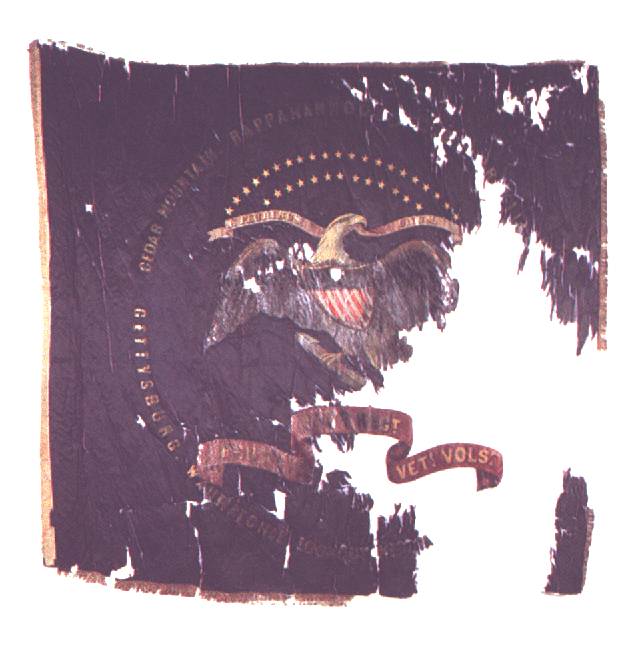
Regimental Color
briefly in Pittsburgh. On that date, in front of the Monongahela House, former Chaplain John W. McMillan presented the regiment with a "stand of colors. Corporal John M. Valleau of Company C was selected to carry this new flag, which he described as a "blue, or state color." Valleau carried it throughout the Atlanta campaign. The flag was struck repeatedly by bullets at Resaca on May 15. Another lead ball passed through Valleau 's cap and burned the hair from his scalp. The corporal later recalled that it felt like someone had laid a rod of hot iron on his head. At Pine Knob (June 15) the spearpoint was shot off; Valleau thought it a miracle that both he and Sergeant Elliott escaped, but the rest of the guard was laid hors-de-combat.9
Valleau was still carrying this color at Peach Tree Creek. When the 109th was thrown into confusion and began to drift to the rear, Valleau and his flag went along, the corporal informing Elliott that it was madness to remain under such a heavy fire. Captain Bundy, while rallying anyone he could, grabbed the
staff and demanded the flag. Valleau remonstrated with the captain and told him he would advance with the flag. The corporal and a few men accompanying him then moved forward and supported the two cannon manned by Elliott and those with him. A regimental color of the 109th is currently owned by a private collector, and may be the same flag carried by Valleau during the Atlanta Campaign.
Sergeant Elliott alluded to other flags in his personal writing of the war period. On September 8, 1863, the sergeant informed his family that he had charge of three stands of colors, but only carried one. On January 22, 1864, Elliott recorded in his diary that the "national flag" was given to Sergeant John Storey of Company F. However, the sergeant was drunk so John Valleau received the honor of carrying this flag. Elliott also briefly referred to guide flags, when he wrote that the "small ones" were put out to dry after a rain. Without further documentation, the identity of these other flags must remain a mystery.
The 111th Regt. P.V.
First State Color
Recruited in Erie, Crawford, and Warren counties, the companies of the 111th Pennsylvania assembled at a camp near Erie in September 1861. The new regiment stayed in this camp, drilling, until late February 1862, when they were summoned to Harrisburg. On March I, Governor Curtin personally gave the 111th a state color as the regiment was drawn up in line in front of the State Arsenal. Later that same day, the regiment entrained for Baltimore. It remained in this city on guard duty until late May, when it was ordered to Harper's Ferry to reinforce Major-General Nathaniel Banks's troops.
The 111th remained in the Shenandoah Valley until the Army of Virginia was organized in June. Assigned to Banks's Second Corps, the regiment took part in the engagement at Cedar Mountain (August 9), suffering ninety casualties. During the ensuing Second Manassas Campaign, Banks's corps guarded the army's trains and was not actively involved in the fighting. Banks's corps then became the Twelfth Corps, Army of the Potomac. The 111th fought at An-tietam on September 17, losing 110 soldiers, its heaviest loss of the war. The bearer of the state color was seriously wounded in this battle and the battered flag was given to Sergeant Alonzo Foust of Company 1.2 Thereafter, the corps remained near Harper's Ferry on guard duty until it rejoined the army just after the December battle at Fredericksburg.
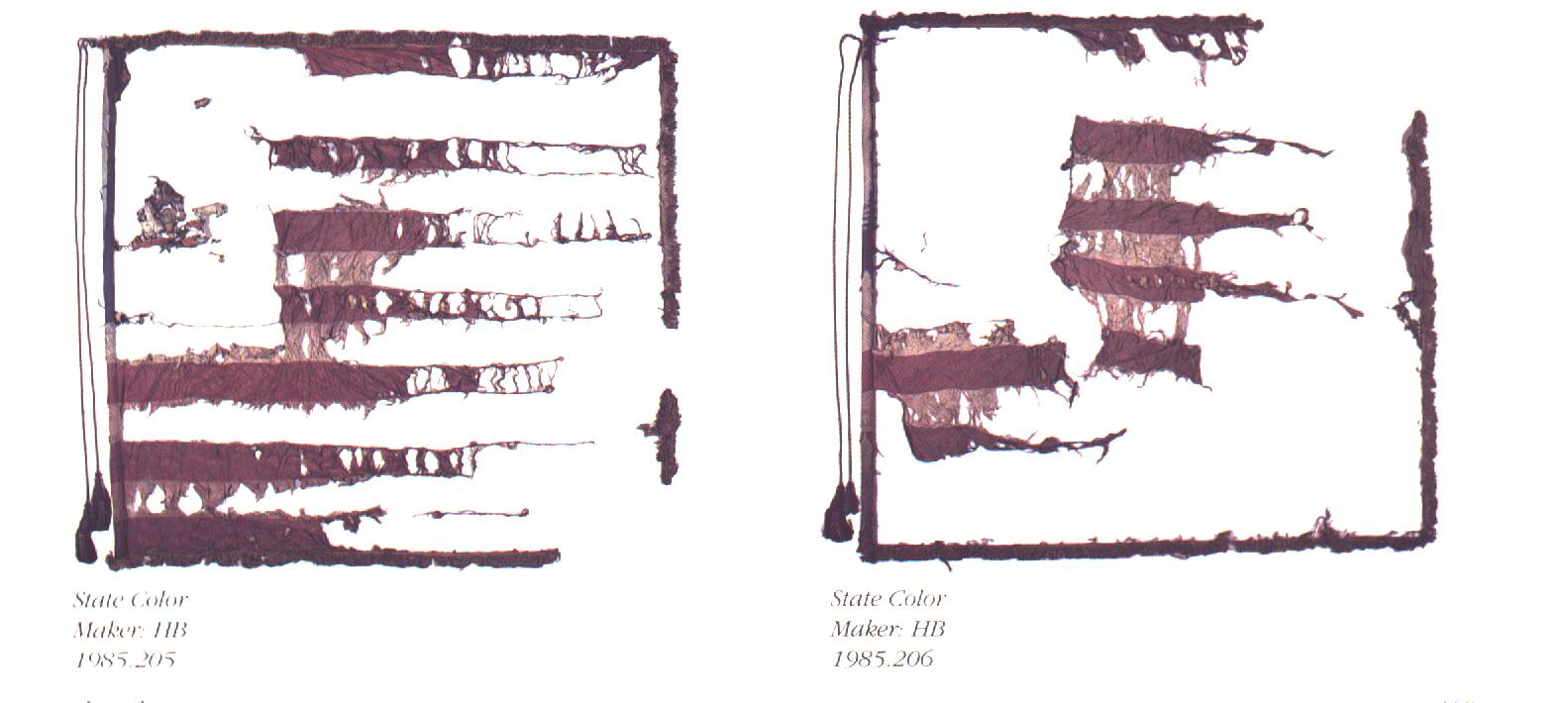
First State Color (left) Second State Color (Right)
In 1863, the 111th first engaged the enemy at Chancellorsville on May 1-3, fortunately escaping with few casualties during the fighting in the woods near the Chancellor House. At Gettysburg, the regiment fought on July 2-3 at Gulp's Hill, again escaping with a short casualty list. In September, the Twelfth Corps was sent to Chattanooga to bolster the Union defenders of that important city. Together with other Twelfth Corps regiments, the 111th heroically sustained the attack of a superior number of Confederate soldiers in the October 28-29 night action at Wauhatchie, Tennessee. During the fighting around Chattanooga, the regiment was engaged at Lockout Mountain (November 24) and at Ringgold, Georgia, three days later.
In late December, most of the survivors re-enlisted for another three-year term and the regiment recieved a
furlough. A correspondent of the Erie covered the veterans' triumphal retrun noting that the two colors borne by the regiment and almost totally destroyed. The sent to Harrisburg and officially recived.
Second State Color
A replacement state flag was authorized by the State Legislature on April II, 1863, as part of Joint Resolution #11 Sergeant Foust was given the new flag on February 26, 1864, when the regiment arrived in Pittsburgh on its way back to Chattanooga. Sergeant Foust would carry this color throughout the 1864 campaigns.
Now a part of the Twentieth Corps, the 111th took part in many of the battles and skirmishes of the Atlanta Campaign (May-September 1864). It fought at Resaca (May 14-15), where the regiment gallantly charged a battery, planted its colors at this position, then had to fall back. During the operations near Dallas (May 25-June 2), the regiment sustained more than fifty casualties. The 111th suffered more losses during the fighting at Pine Knob (June 15 and 17), then lost a few more soldiers during the pursuit of the retreating enemy. During the July 20 fighting at Peach Tree Creek, the 111th lost about eighty comrades. When General Hood's troops evacuated Atlanta, the 111th was part of the first Union column to enter the city. Together with the 60th New York, the 111th raised its flags from the city court house.
The regiment remained in the city on provost guard duty until General Sherman began his now-famous "March to the Sea." The Twentieth Corps—and the 111th—accompanied Sherman on this campaign, which culminated in the capture of Savannah on December 21. Then followed the successful Carolina Campaign, during which the 111th sustained few casualties. After marching north to Washington, the regiment took part in the Grand Review (May 24, 1865), then remained on guard duty until mustered out of service on July 19. The remnant of the second state color was returned in 1866.
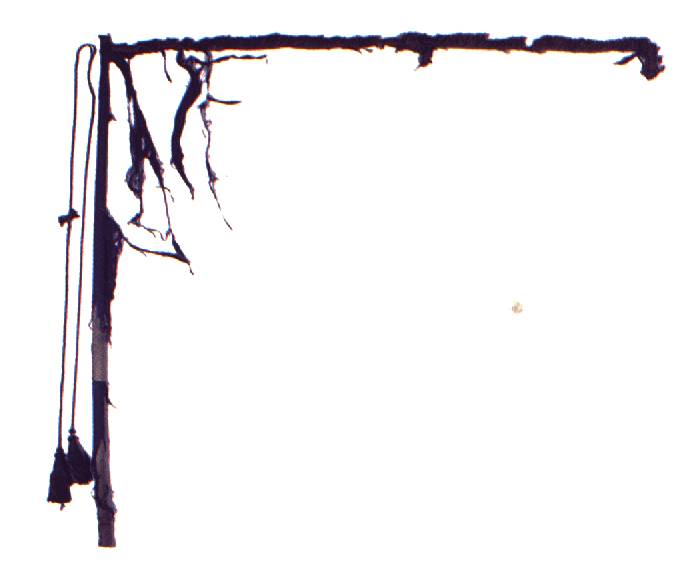
Regimental Color 111th P.V.
Presented Colors
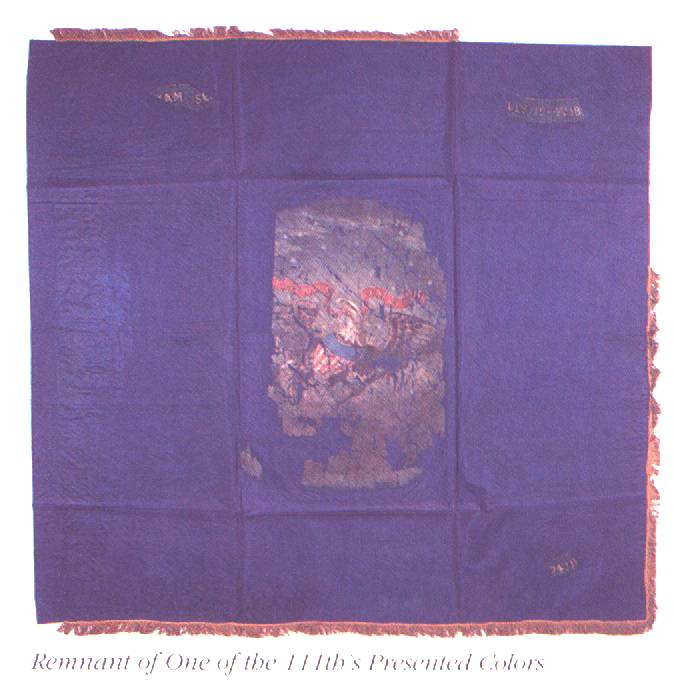
During its term of service, the 111th carried at least three flags in addition to the two state colors. In appreciation for its gallantry at Antietam, brigade commander Colonel Henry J. Stainrook of the 109th Pennsylvania presented the 111th with an "elegantly finished flag" shortly after the battler
When the regiment returned to the field in 1864, the veterans brought along a national color the 111th had carried earlier in the war. Thus, the Regimant carried three stands of colors accoding to Cpl Calvin H Blanchard of Co. D, The man chosen from the among the many volunteers desirous of carrying the tattered stars and stripes. During the Atlanta Campaighn, all three bearers went out on the skirmish line with their flags rather than remain in reserve as the customary army procedure. Blanchard had many close calls as bullets flew thick about the flag he carried. In addition to the two state colors in the collection, there is the remnant of a blue regimental color returned in 1865 when the regiment was mustered out. A collector has custody of the remnant of a blue regimental color that came from Col. George A. Cobham's family.
go back to our front page click here!!!