 AGENCIES
in Paris and Edgartown, Massachusetts Updated at 10pm, Sunday: Britain's
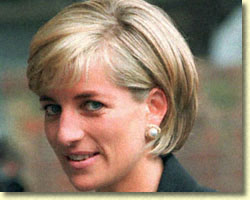
Princess Diana died on Sunday after a car crash in Paris as she was being
chased by photographers, sparking a worldwide wave of mourning for a ''people's
princess'' whose life veered from fairytale to tragedy.
AGENCIES
in Paris and Edgartown, Massachusetts Updated at 10pm, Sunday: Britain's
Princess Diana died on Sunday after a car crash in Paris as she was being
chased by photographers, sparking a worldwide wave of mourning for a ''people's
princess'' whose life veered from fairytale to tragedy.
The most photographed woman in the world and divorced wife of the heir
to the British throne, Diana died with her millionaire lover Dodi Al-Fayed
when their driver apparently lost control and hit a concrete post by the
River Seine.
Parisians laid red roses at the spot where the car crashed just after
midnight as tributes to the glamorous princess poured in from monarchs,
presidents and politicians in nations from Australia to Zimbabwe.
Prince Charles, whose 15-year marriage to Diana ended in divorce last
year, was flying to Paris to pick up the body of his former wife and fly
it back to Britain. Diana's two sisters were accompanying him.
French surgeons battled for hours to save the 36-year-old princess,
cutting open her shattered chest, sewing up a ruptured vein and massaging
the heart in a failed effort to make it pump.
Three and a half hours after the crash they conceded defeat and Diana,
campaigner against land mines, the woman who wanted to be the ''Queen of
People's Hearts'', died at 4am (10am Hong Kong time).
Queen Elizabeth and Prince Charles were said to be deeply shocked and
distressed. Charles, at Balmoral in Scotland, broke the news to their sons,
Princes William, 15, and Harry, 12.
British Prime Minister Tony Blair called her ''the people's princess''.
US President Bill Clinton, who heard the news while on holiday at Martha's
Vineyard, said he and his wife Hillary were ''profoundly saddened''.
French police placed into formal custody seven photographers who had
previously been detained, looking into whether any of them may have caused
the tragedy. A special police unit that usually handles important cases
such as terrorism investigations was put in charge of the probe.
The black Mercedes Benz in which Diana and Harrods heir Al-Fayed, 41,
were riding after dinner at the Fayed-owned Ritz Hotel smashed into a pillar
in a road tunnel under the Place de l'Alma across the River Seine from
the Eiffel Tower.
The front of the car folded like an accordion, its bumper driven back
almost to the windscreen. Al-Fayed died on the spot.
The driver of the car, a Ritz security officer, was also killed. The
fourth person in the car, one of Diana's bodyguards, was injured and freed
from the mangled wreck by rescue workers who cut the roof from stem to
stern.
Several motorcycles were seized by police and taken away from the accident
scene.
Diana died on the eve of a conference in Oslo at which about 100 countries
will try to agree on a treaty to ban anti-personnel land mines - her favourite
cause, for which she travelled to war zones in Angola and Bosnia.
The princess and Al-Fayed had been the focus of frenzied media attention
for the past month after photographs showed them embracing on a Mediterranean
holiday.
Only last week, Diana lashed out at the press in an interview published
in the French daily Le Monde.
''The press is ferocious,'' it quoted her as saying. ''It pardons nothing
... I think that in my place, any sane person would have left [Britain]
long ago. But I cannot. I have my sons.''
Prime Minister Lionel Jospin and the wife of French President Jacques
Chirac, Bernadette, visited the hospital where she was brought in the middle
of the night.
In Manila, on a tour of Southeast Asia, British Foreign Secretary Robin
Cook said: ''It will be doubly tragic if it does emerge that this accident
was in part caused by the persistent hounding of the princess and her privacy
by photographers.''
Mr Blair said he was ''utterly devastated'' by the death.
''The whole of our country, all of us, will be in a state of mourning.
Diana was a wonderful, warm and compassionate person who people, not just
in Britain but throughout the world, loved and will be mourned as a friend.''
British television and radio stations suspended normal programming and
devoted blanket coverage to the tragedy. Many sports events were cancelled
and those that went ahead did so after a minute's silence.
The BBC, whose newsreaders, reporters and interviewees all wore black,
played the national anthem hourly with pictures of the Union Jack flying
at half mast.
French television channels devoted special programmes to the princess
and the country's main Sunday newspaper published a special edition.
Diana had been due back in Britain on Sunday after her latest holiday
with Al-Fayed in the Mediterranean and had been expected to see sons William
and Harry at her London home at Kensington Palace.
After the breakdown of Diana's marriage to Prince Charles, she tried
- sometimes unsuccessfully - to keep any men friends out of the public
eye.
But she threw caution to the winds with Dodi Al-Fayed, taking her sons
on holiday on the yacht of Dodi's father Mohammed in July, then allowing
herself to be photographed in August embracing Dodi.
Meanwhile, senior French politicians said press photographers should
examine the ethics of their profession.
The speaker of the French National Assembly, former prime minister Laurent
Fabius, and Justice Minister Elisabeth Guigou hit out at the paparazzi.
Mr Fabius said: ''This proves that photographs, words and attitudes
can also, in some ways, kill.
''That bestows much responsibility on these people.''
Ms Guigou, who said the accident would undoubtedly lead to a rethink
on the intrusive methods used by paparazzi, added: ''Obviously, we are
doing all that we can to clarify the circumstances of this accident. An
inquiry is under way.''
| To our People Princess Diana, |
| Although
Diana has been claimed she had commited such damnit bad matters ... , she
is still our princess Diana !�No one can hurt her anymore . Even it
is not a true solution for this affair , it may help her to escape from
the fears and sadness . |
| From Mr X |