
The 1st Battalion 4th Marines 1/4 was activated in April 1911 and was given the task of guarding the U.S. Mexico border during the attempted revolt in Mexico led by Francisco Madero. In June 1911 the revolution ended and the Battalion was disbanded until April 1914, when turbulent political conditions in Mexico compelled President Wilson to reactivate 1/4 and station the Marines and naval vessels off the Mexican coast. The Battalion did not experiance actual combat until U.S. intervention in the Dominican Republic in 1916, where it remained for eight years helping fight against the rebels who were opposing the island goverment.
1/4 returned to the U.S. in 1924 and was given the task of protecting the U.S. Mail. Three years later the Battalion was ordered to Shanghai China to protect the lives of American citizens living in the U.S. settlement there. 1/4 remained in Chian for fourteen years, during both the Chinese civil war and the Sino-Japanese war. When diplomatic relations with Japan deteriorated in late 1941, the Battalion departed mainland China and redeployed to assist in the defense of the Republic of the Philippines. On December 8, 1941, the Japanese attacked the Philippines and the Battalion was moved with other U.S. Forces to make a stand on Corregidor Island.
On April 9, 1942 the U.S. stronghold of Bataan fell to the enemy and Japan launched a full scale assault upon the final U.S. position on Corregidor. On May 6 the American commander in the Philippines surrendered all U.S. Forces to the Japanese and 1/4 was subjected to the infamous Bataan Death March.
Two years later , 1/4 was reformed on Guadalcanal and prepared for future operations in the Western Pacific. Later, the Battalion saw action on Emirau Island, Guana, Orotz Peninsula and finally Okinawa where the Marines fought at Naha, Sugar Loaf Hill, Orohu Peninsula, and Suicide Cliff. In 1956, The Battalion was deactivated until 1962. Deployed to Vietnam in 1965, 1/4 participated in Operations Starlight, Prairie, Hastings, Deckhouse VI, and Granite. The Battalion further fought in Quang Tri City, reopened Route 547 during Operation Kentucky, set up the first link between Con Thien and Gio Linh, and as the last Battalion in northern I Corps, closed the Marine bases in Northern South Vietnam before departing country in 1969.
In May 1975 the Battalion returned to South Vietnam to assist the evacuation of U.S. citizens and Vietnamese refugees. During the same month Marines from 1/4 also boarded and recovered the Mayaguez, a U.S. merchant ship which had been illegally seized by Cambodian Communist.
During 1977 the Battalion relocated to the Marine Corps Air Ground Combat Center, Twenty Nine Palms as the first Battalion to participate in the new unit rotation program. During 1980 the Battalion was designated as one of the three Infantry Battalions assigned to the new 7th Marine Amphibious Brigade. On January 24, 1989 1st Battalion 4th Marines relocated to Marine Corps Base Camp Pendleton and was assigned to the 1st Marine Regiment.
On June 20, 1990 the 13th MEU (SOC) and BLT 1/4 deployed for routine West-Pac which became the Gulf War. In July 1990 1/4 participates in exercise Valiant Usher Republic of the Philippines. On August 22, 1990 1/4 heads for the North Arabian sea as a show of force. On September 7, 1990 1/4 is part of a contingency force for Operation Desert Sheild. October 1990 1/4 conducts night raids Exercise Knight Strike. 13 October 1/4 boards an Iraqi tanker (Al-Mu-tanabbi) that refuses to leave the area of operation. 30 October 1/4 conduct air feild seizure in Oman. The Battalion heads for home and is called back to participate in Operation Desert Storm. 1/4 participates in Desert Storm, Desert Sheild, Desert Sting, 1/4 conducts raid on Maradim Island on January 29, 1991. 1/4 also conducts raids on other islands and in Kuwait they take over 2,500 POWS and evacuate them to Saudi Arabia. The Battalion returns home after being deployed for 10 months.
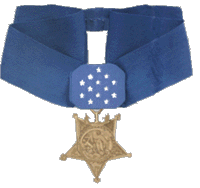
1/4 Marines That Received The CMH
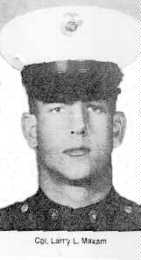
Cpl. Larry L. Maxxam
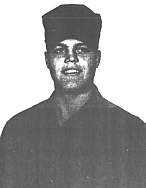
Pvt.Douglas E. Dickey